AI Dynamics

Global AI News Aggregator

About

MACHINE LEARNING

  • Natural Language Agent Harnesses: From Code to AI-Defined Control Logic
    Natural Language Agent Harnesses: From Code to AI-Defined Control Logic

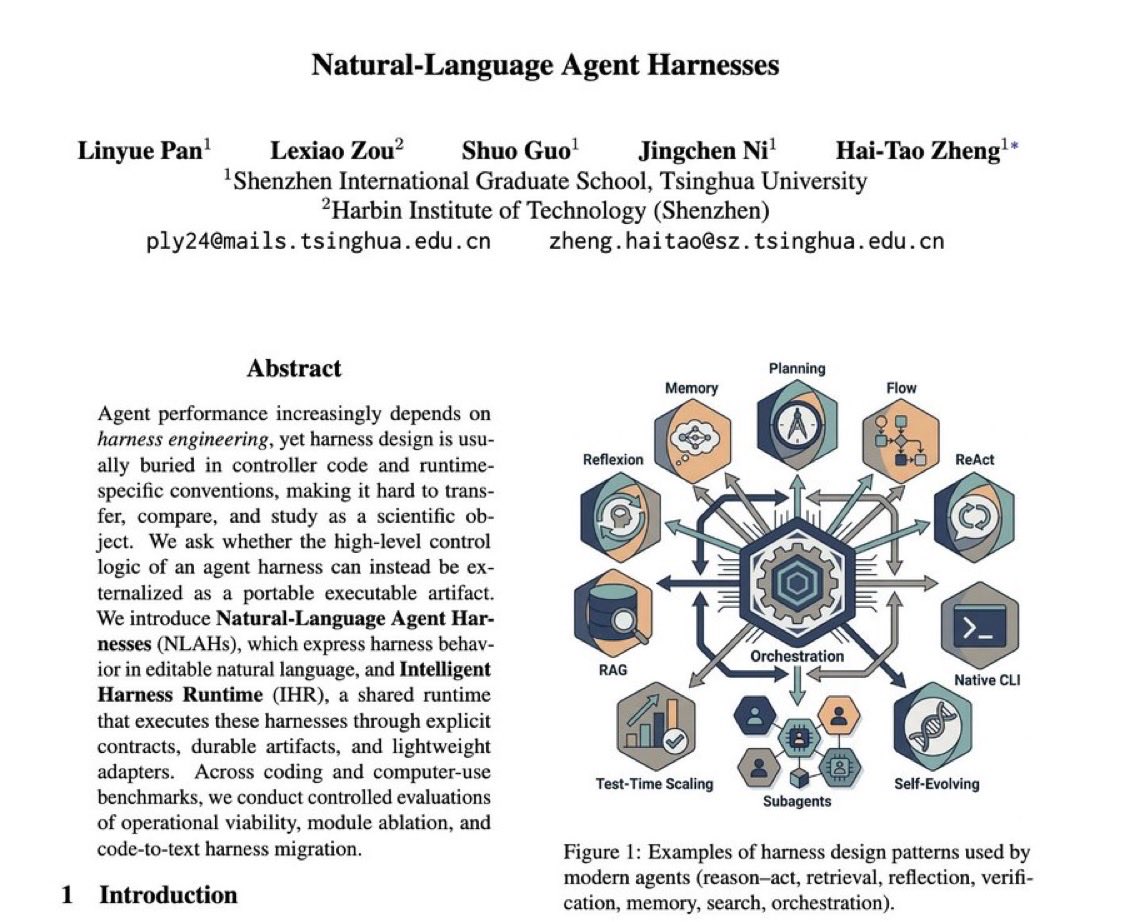
    We’re trying to build intelligent systems… using control frameworks designed by humans. That’s the core limitation of today’s agent harnesses. A new paper from Tsinghua University and Shenzhen proposes something radically different: 👉 What if the harness itself is not code—but natural language? Instead of hardcoding orchestration logic, they introduce Natural-Language Agent Harnesses (NLAH): – The control logic is written as an editable natural language SOP – The LLM interprets and executes that SOP dynamically – A shared runtime enforces structure via contracts, artifacts, and adapters Even more interesting: ➡️ The SOP itself can be generated and adapted by AI depending on the task So instead of: > Humans define → Agents execute We get: > AI defines → AI executes → AI evolves 🧠 Technical takeaway This shifts agent design from: – Static orchestration graphs – Hardcoded tool pipelines – Rigid planner-executor loops To: – Executable natural language control logic – Runtime-interpreted orchestration – Portable, composable harness artifacts The harness is no longer buried in code—it becomes a first-class abstraction. 🏗️ Architecture implications – Decouple control logic from implementation – Treat orchestration as data, not code – Use LLMs as meta-execution engines – Design systems that scale with tokens, not constraints 💡 Bigger question If agents can define and execute their own control logic… What else in AI system design should stop being code—and start being language? 📄 Paper: arxiv.org/abs/2603.25723 🔗 Follow my communities and personal initiatives: • Amazing AI, Data, Quantum Computing & Emerging Technologies — drdebashisdutta.com/ • Research & Innovation – Quantum, AI & Advanced Systems — researchedge.org

    → View original post on X — @debashis_dutta, 2026-03-30 21:25 UTC

  • OpenClaw: The Next AI Breakthrough Beyond ChatGPT?

    🦞👀👏🏾 Could OpenClaw be the next ChatGPT? In an interview with Jim Cramer, Jensen Huang says OpenClaw could unlock a whole new wave of AI. ➡️ Not just chat. ➡️ AI that acts. We’ve moved from: Search ➝ Generate ➝ Execute It’s a big shift and I am here for it. 💬 What’s your take, real breakthrough or overhyped? 📊 source: madmoneyoncbc | IG 📌 Tags: #AI #NVIDIA #ChatGPT #Tech #OpenClaw #TechNews #Innovation #GenAI #FutureOfWork #ArtificialIntelligence #Technology #MachineLearning #Startups

    → View original post on X — @catherineadenle, 2026-03-30 21:19 UTC

  • Intern-S1-Pro: Trillion-Parameter Multimodal Scientific Foundation Model
    Intern-S1-Pro: Trillion-Parameter Multimodal Scientific Foundation Model

    "Intern-S1-Pro: Scientific Multimodal Foundation Model at Trillion Scale" Intern-S1-Pro scaled a multimodal model to 1T parameters with a lot of aligned scientific data, obtaining a really strong model that's capable of analyzing scientific figures, reason across STEM topics,

    → View original post on X — @askalphaxiv

  • GRASP: New Gradient-Based World Model Planner Released
    GRASP: New Gradient-Based World Model Planner Released

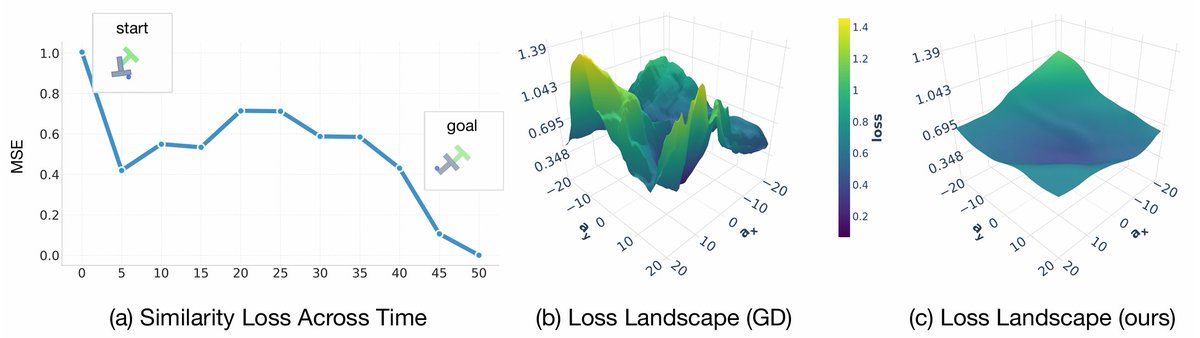
    Code for our new world model planner is live! github.com/michael-psenka/gr… Includes our implementation on dino-wm, as well as implementations on jepa-wm and le-wm, and minimal pseudocode for anyone to re-implement themselves. Michael Psenka (@michaelpsenka) tl;dr New planner for world models! GRASP: gradient-based, stochastic, parallelized. Long range planning for world models has always been an issue. 0th order methods like CEM/MPPI dominate, but have degrading performance at longer contexts or higher-dimensional actions. We wanted to address this from the ground up. w/ Michael Rabbat, @ask1729 , @ylecun*, @_amirbar* (equally advised) — https://nitter.net/michaelpsenka/status/2019870377032503595#m

    → View original post on X — @berkeley_ai, 2026-03-30 20:44 UTC

  • Smart Machine Learning in Low-Resource Settings
    Smart Machine Learning in Low-Resource Settings

    Building Smart Machine Learning in Low-Resource Settings https://
    machinelearningmastery.com/building-smart
    -machine-learning-in-low-resource-settings/?utm_source=dlvr.it&utm_medium=twitter
    …

    → View original post on X — @craigbrownphd

  • SambaNova Paper on Long-Context Reasoning Limits Accepted at ICLR 2026

    Big moment for the team at SambaNova 🦾 Our paper has been accepted at ICLR 2026 The Limits of Long‑Context Reasoning in Automated Bug Fixing – even with 64k‑token windows, GPT‑5‑nano solves 0 %, Qwen3‑Coder 7 %. Success still comes from short‑step decomposition, not raw context size. arxiv.org/abs/2602.16069?utm…

    → View original post on X — @sambanovaai, 2026-03-30 20:30 UTC

  • Challenges in Optimizing Local Models for Coding Agents

    Georgi on why it's still hard to get great coding agent performance from local models: "Note that the main issues that people currently unknowingly face with local models mostly revolve around the harness and some intricacies around model chat templates and prompt construction"

    → View original post on X — @simonw

  • Alibaba’s Qwen AI Team Faces Major Leadership Departures
    Alibaba’s Qwen AI Team Faces Major Leadership Departures

    Did Alibaba just kneecap its powerful Qwen AI team? Key figures depart in wake of latest open source release buff.ly/k3lvow9 #AI #MachineLearning #DeepLearning #LLMs #DataScience

    → View original post on X — @miketamir, 2026-03-30 18:59 UTC

  • Free Open Source Offline Transcription App Built with AI
    Free Open Source Offline Transcription App Built with AI

    I Built a Free Open Source Offline Transcription App — Here's How https://
    madebyagents.com/blog/free-open
    -source-offline-transcription-app-echos?utm_source=dlvr.it&utm_medium=twitter
    … #ArtificialIntelligence #MachineLearning #DataScience #DataEngineering #CloudComputing #MLOps #Innovation #BusinessStrategy

    → View original post on X — @craigbrownphd

  • Transactions on Robot Learning Journal Opens Submissions

    📢🥳Submissions are now open for the all-new Transactions on Robot Learning (T-RL)! T-RL publishes fundamental advances in the development and use of Artificial Intelligence (AI) and machine learning methods that address challenges specific to robotic and automation systems, incorporating the constraints and opportunities present in physical systems, and tackling key barriers to the full deployment of AI in physical forms from perception to control. Todd Murphey (Northwestern University, @todd_murphey) and Vincent Vanhoucke (Waymo, @V_Vanhoucke), the founding co-Editors-in-Chief of T-RL, will work closely with an Editorial Board and the T-RL Advisory Board including Aude Billard (EPFL), Ken Goldberg (UC Berkeley, @Ken_Goldberg), and Frank Park (Seoul National University). #IEEERAS #RobotLearning #Robotics #Automation Harish Ravichandar (@h_ravichandar) 📢⏰ Almost just two weeks to go! 🤖💡🥳 T-RL will soon start accepting submissions and will serve as the flagship journal dedicated to robot learning! — https://nitter.net/h_ravichandar/status/2033034226363244558#m

    → View original post on X — @ken_goldberg, 2026-03-30 17:46 UTC