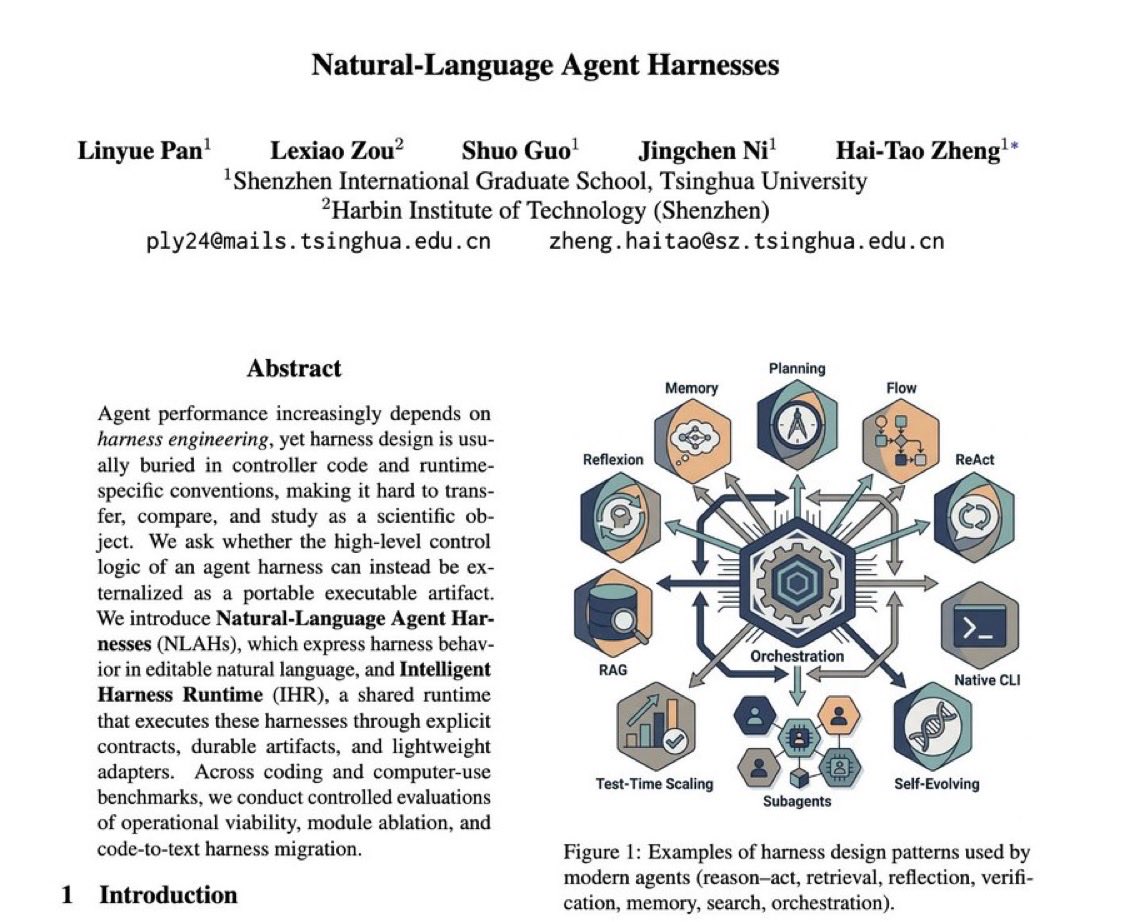
We’re trying to build intelligent systems… using control frameworks designed by humans. That’s the core limitation of today’s agent harnesses. A new paper from Tsinghua University and Shenzhen proposes something radically different: 👉 What if the harness itself is not code—but natural language? Instead of hardcoding orchestration logic, they introduce Natural-Language Agent Harnesses (NLAH): – The control logic is written as an editable natural language SOP – The LLM interprets and executes that SOP dynamically – A shared runtime enforces structure via contracts, artifacts, and adapters Even more interesting: ➡️ The SOP itself can be generated and adapted by AI depending on the task So instead of: > Humans define → Agents execute We get: > AI defines → AI executes → AI evolves 🧠 Technical takeaway This shifts agent design from: – Static orchestration graphs – Hardcoded tool pipelines – Rigid planner-executor loops To: – Executable natural language control logic – Runtime-interpreted orchestration – Portable, composable harness artifacts The harness is no longer buried in code—it becomes a first-class abstraction. 🏗️ Architecture implications – Decouple control logic from implementation – Treat orchestration as data, not code – Use LLMs as meta-execution engines – Design systems that scale with tokens, not constraints 💡 Bigger question If agents can define and execute their own control logic… What else in AI system design should stop being code—and start being language? 📄 Paper: arxiv.org/abs/2603.25723 🔗 Follow my communities and personal initiatives: • Amazing AI, Data, Quantum Computing & Emerging Technologies — drdebashisdutta.com/ • Research & Innovation – Quantum, AI & Advanced Systems — researchedge.org
→ View original post on X — @debashis_dutta, 2026-03-30 21:25 UTC