The new Grok algorithm that turns on in a month will: 1. Know everyone on the system.
2. Know everything about your content. It won't distribute you if your content is shitty and doesn't add value. I built the lists of the entire tech industry, and a whole lot of others, so
SYSTEMS
-
New Grok algorithm to know everyone and filter poor content
By
–
-
Nested Simulation Efficiency in AI Model Computing
By
–
I could certainly imagine that "nesting" the simulation might be too "effortful" for the model, compute or data density wise. My results with it are not too bad so imo it's at least worth people try / experiment with / think about. For example it might be useful to read multiple
-
BEHAVIOR Teleoperation System Launches with JoyLo Simulation Data
By
–
We thank @SimovationInc for providing high-quality JoyLo teleoperation data in simulation. BEHAVIOR is built upon @nvidia
’s Omniverse. We thank our sponsors for their generous support! @SimovationInc @nvidia @IMDAsg @StanfordHAI @SchmidtFutures (N/N) -
6D Parallelism: The Human-like Parallel Processing in AI
By
–
Little-known fact in AI: 6D parallelism is human parallelism
-
Terminal-Based Agent Control and Harbor Evaluation Framework
By
–
Key takeaways:
• terminals > GUIs for stable agent control
• task design inspired by SWE-bench, but with a more general abstraction
• eval + RL need the same “rollout” substrate, so they created Harbor
• Harbor = a unified framework for scalable parallel deployment
• TB2 is -

SAS Enhances Information Security Risk Management for Financial Institutions
By
–
SAS strengthens information security & governance with unified risk management so you can focus on unlocking new possibilities for your customers and stakeholders. Read Askari Bank’s success story + request a demo: http://
2.sas.com/60107eRLG #Finance -
Flexion Robotics Raises $50M Series A for Humanoid Robot Intelligence
By
–
Humanoid robotics just got a major boost. @FlexionRobotics has raised a $50M Series A to build what could become the intelligence layer for the next generation of humanoid robots. The Zurich-based team, led by Nikita Rudin (with experience from ETH Zurich, NVIDIA, Meta, Google, and Tesla), is taking a different approach than most in the space: 🔹 Language-level task reasoning 🔹 A VLA model trained heavily in simulation 🔹 Transformer-based whole-body control The ambition? Robots that don’t just replay human demos, but actually understand, adapt, and perform tasks with true autonomy. If humanoids are ever going to be useful in factories, logistics centers, and real industrial environments, someone has to solve this intelligence layer. Flexion is taking that challenge head-on. With $50M in fresh capital, they’re now scaling compute, expanding robot fleets, and moving toward deployments with major OEMs. And honestly? Watching the progress — even the way these robots walk — is incredible. #AI #Robotics #Humanoids #Automation #DeepLearning #FutureOfWork Source 🙏 @lukas_m_ziegler @IanLJones98 @NevilleGaunt @bamitav @altiamkabir @sijlalhussain @marcusborba @jblefevre60 @Nicochan33 @TerenceLeungSF @KirkDBorne @CurieuxExplorer @enilev @Eli_Krumova @pascal_bornet @anand_narang @sulefati7 @Xbond49 @Hana_ElSayyed @engmlubbad @Timothy_Hughes @mcanducci @RLDI_Lamy @segundoatdell @engmlubbad @rvp @ipfcoline1 @PatGrant7777 @NigelTozer @Ronald_vanLoon @pierrepinna @Khulood_Almani @BetaMoroney @AkwyZ
→ View original post on X — @marcusborba, 2025-12-01 12:42 UTC
-

Autopoietic ASI Agent V0 Superintelligence Breakthrough
By
–
[ V0.ASI.ETH ] Autopoietic ASI Agent (ASI.eth v0) #ASI #ASIFirst #Superintelligence
-
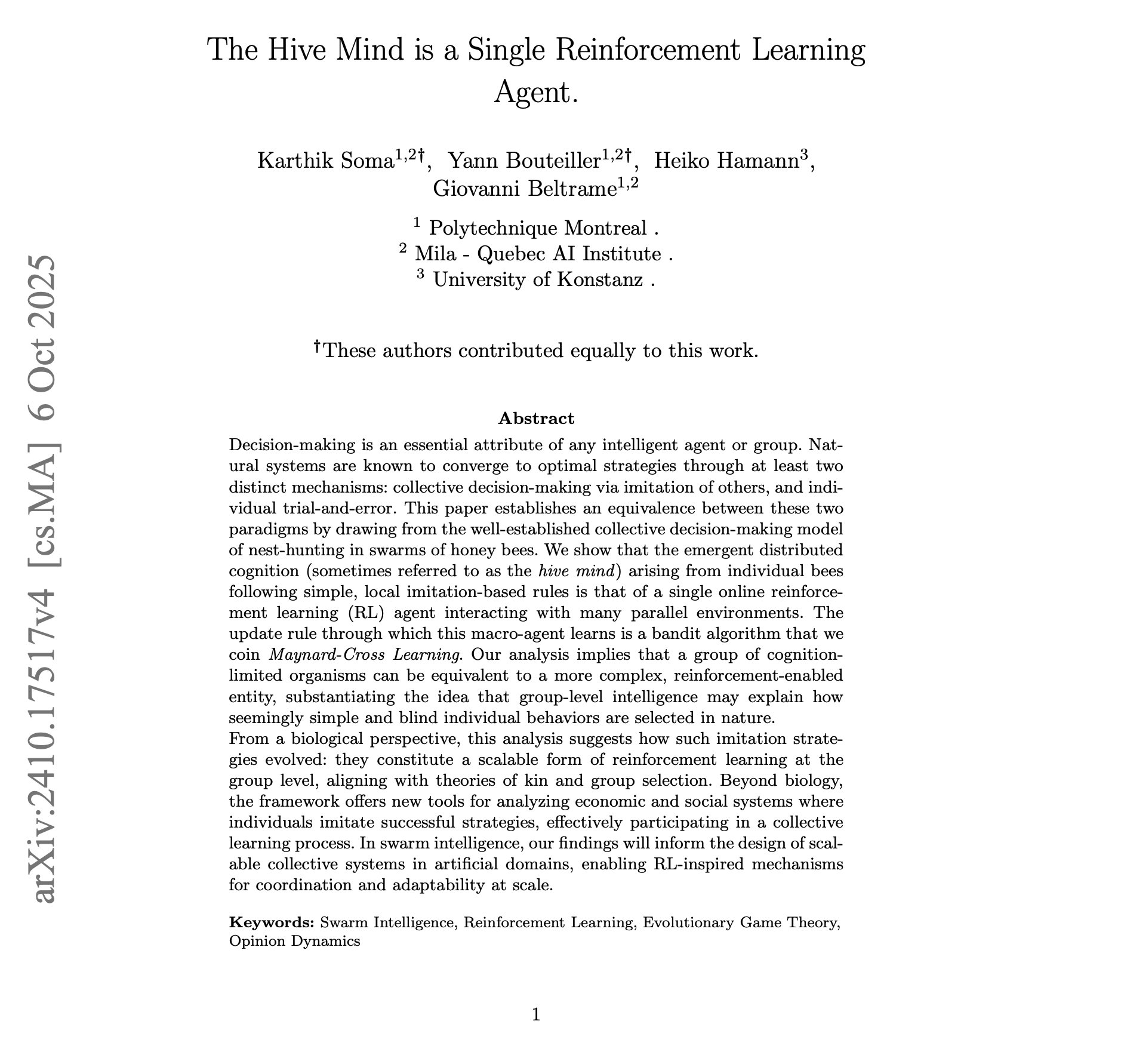
Swarm Intelligence: The Collective Learning Secret Revealed
By
–
Swarm intelligence has a secret. The standard approach treats swarms as collections of independent learners. Each agent makes decisions, learns from outcomes, and coordination somehow emerges. More agents, more complexity, more mystery. But what if the swarm itself is the
-

Agentic AI as a Complete Stack for Autonomous Outcomes
By
–
Agentic AI = a stack, not a feature. LLMs (core intelligence) Agents (planning, memory, tool use) Multi-agent systems (coordination, routing, RAG) Infrastructure (security, logging, retries, cost control) This is how AI moves from answers → autonomous outcomes.