
GoalOS is architecturally pointed at one of the Holy Grails: proof-gated, economically coordinated, open-ended autonomous work that can generate verified experience and reusable capability. #AGIALPHA
@ceobillionaire
-
Frontier AI releases should be governed by evidence dockets
By
–
Frontier AI releases should not be governed by headlines, vibes, or opaque authority.
They should be governed by Evidence Dockets. GoalOS Frontier Release Room converts high-consequence model release disputes into bounded, source-cited, validator-reviewable governance dockets. -
GoalOS converts autonomous AI output into evidence-bearing institutional capability
By
–
GoalOS turns autonomous AI output into evidence-bearing institutional capability. #AGIALPHA
-
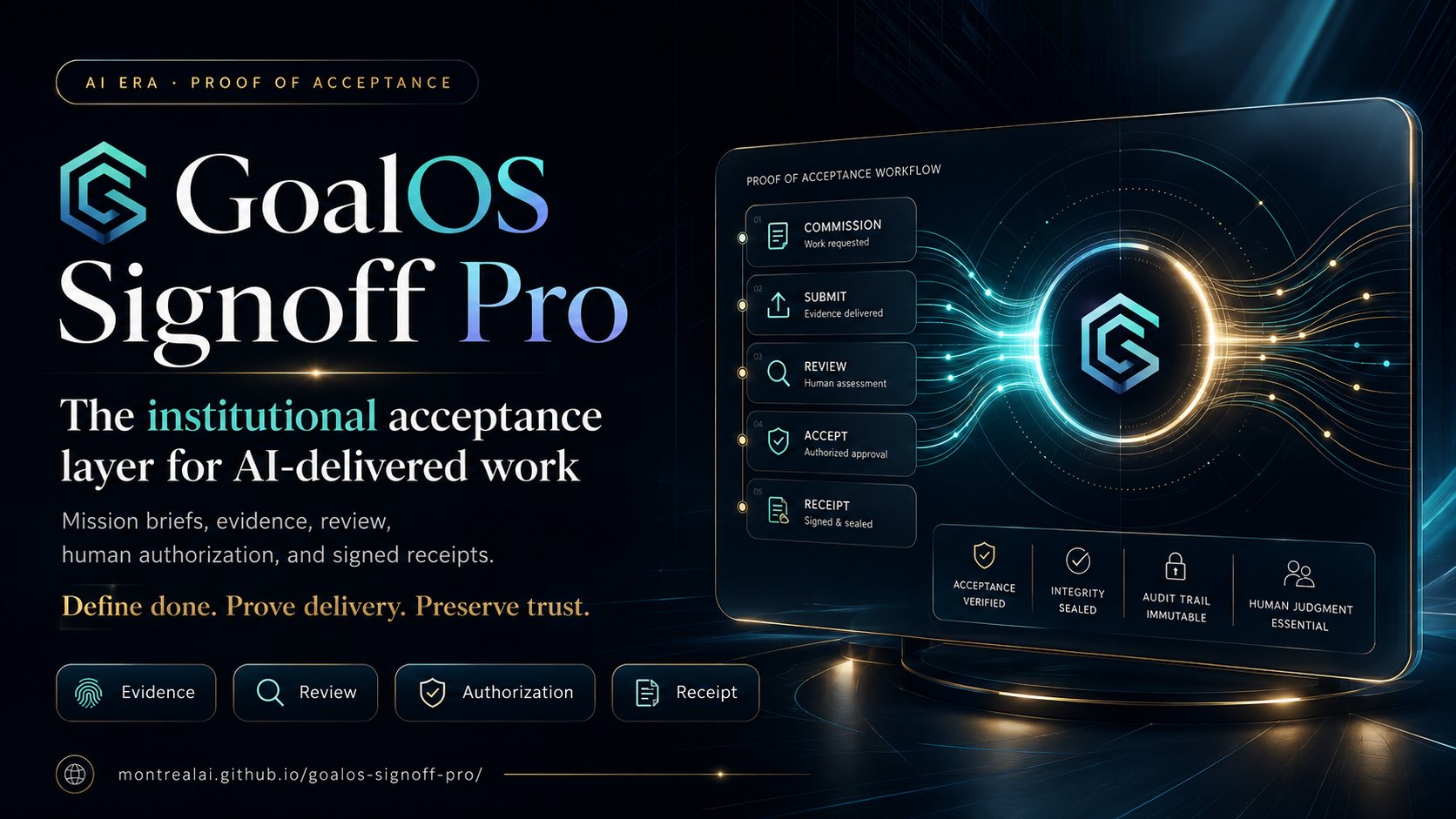
GoalOS Signoff Pro: Institutional Acceptance for AI Work
By
–
The AI era needs proof of work. GoalOS Signoff Pro is the institutional acceptance layer for AI-delivered work: mission briefs, evidence, review, human authorization, and signed receipts. Define done. Prove delivery. Preserve trust. Website: https://
montrealai.github.io/goalos-signoff
-pro/
… -
Debate on government limiting AI access
By
–
https://t.co/5anhn9NchC pic.twitter.com/tLMkgvMZJH
— Vincent Boucher · AGI.eth → ASI.eth (@ceobillionaire) 26 juin 2026Do you think the government should be limiting access to AI?
-
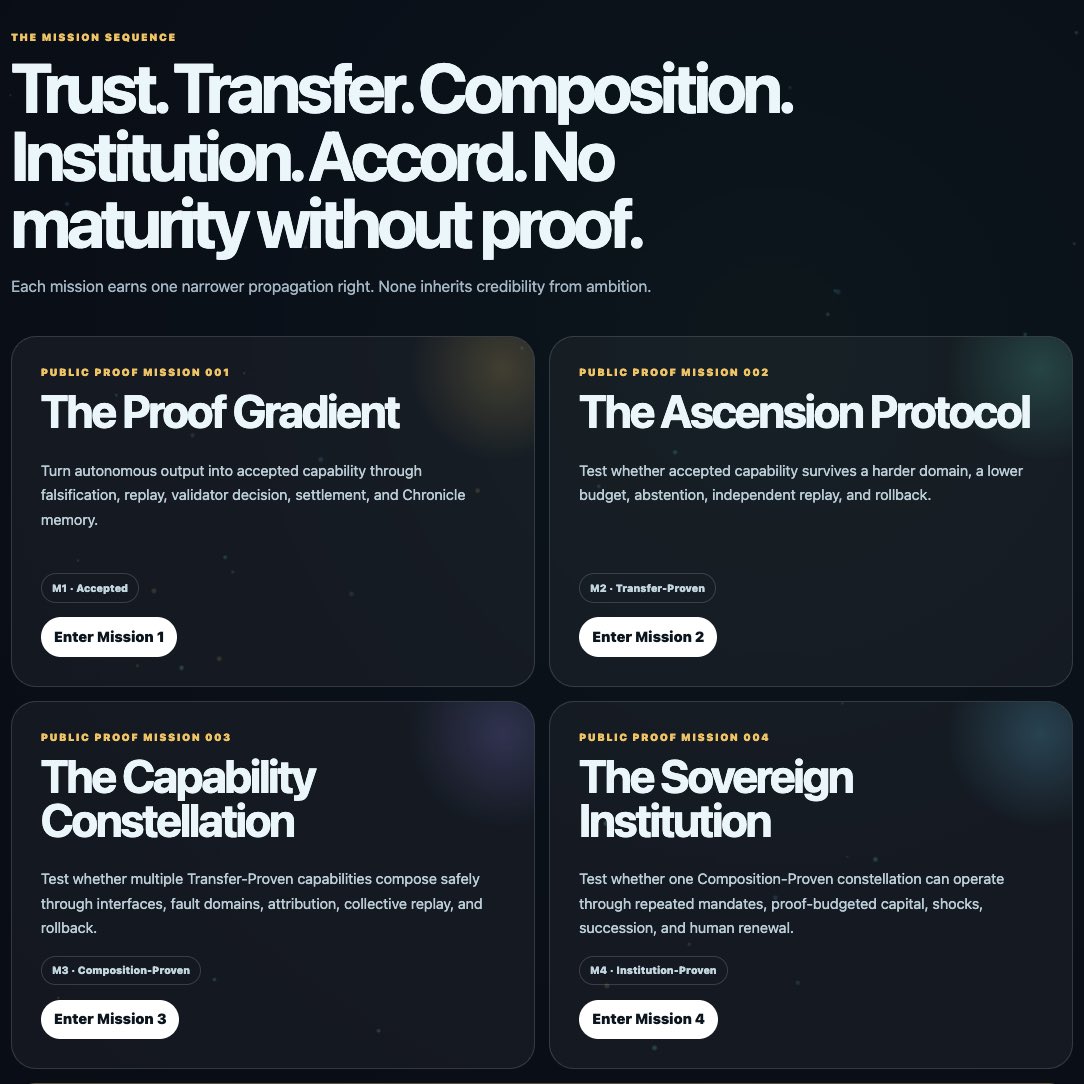
THE PROOF MISSIONS: Public Program for Autonomous Work and Proof-Governed Cooperation
By
–
THE PROOF MISSIONS A public program for turning autonomous work into accepted capability, transfer evidence, safe composition, accountable institutions, and proof-governed cooperation across sovereign institutions. https://
montrealai.github.io/goalos-agialph
a-ascension/proof-missions.html
… #AGIALPHA #ASIFirst -
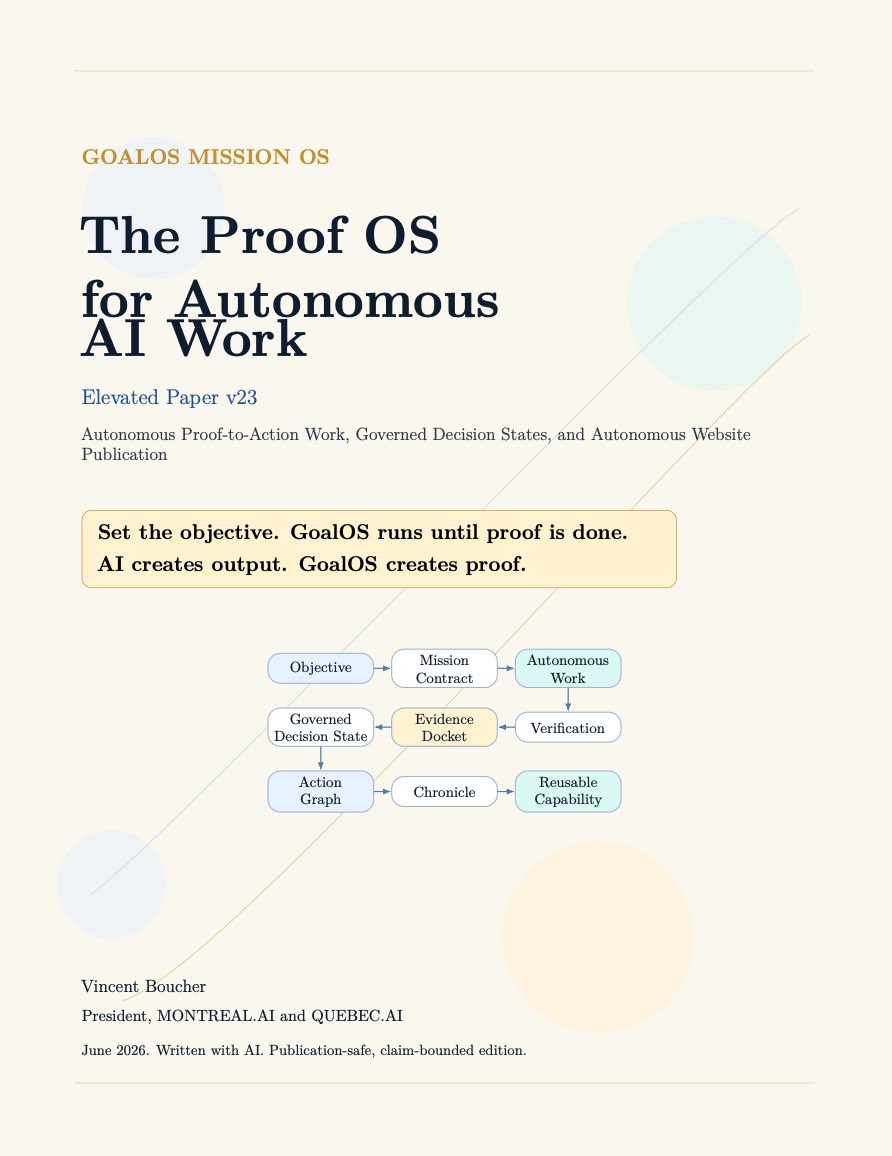
GoalOS Mission OS: The Proof OS for Autonomous AI Work
By
–
AI does not need to produce more output. It needs to produce proof. I’m sharing my paper: GoalOS Mission OS: The Proof OS for Autonomous AI Work The thesis is simple: AI creates output.
GoalOS creates proof. Today’s models can answer.
Agents can act.
But institutions need -
ASI as a systems problem from AGI through scale and coordination
By
–
The most important reframing: ASI may not require one model to become a god. It may emerge from scale, speed, coordination, recursion, and institutionalized machine cognition. That makes the transition from AGI to ASI a systems problem, not only a model-capability problem.
-
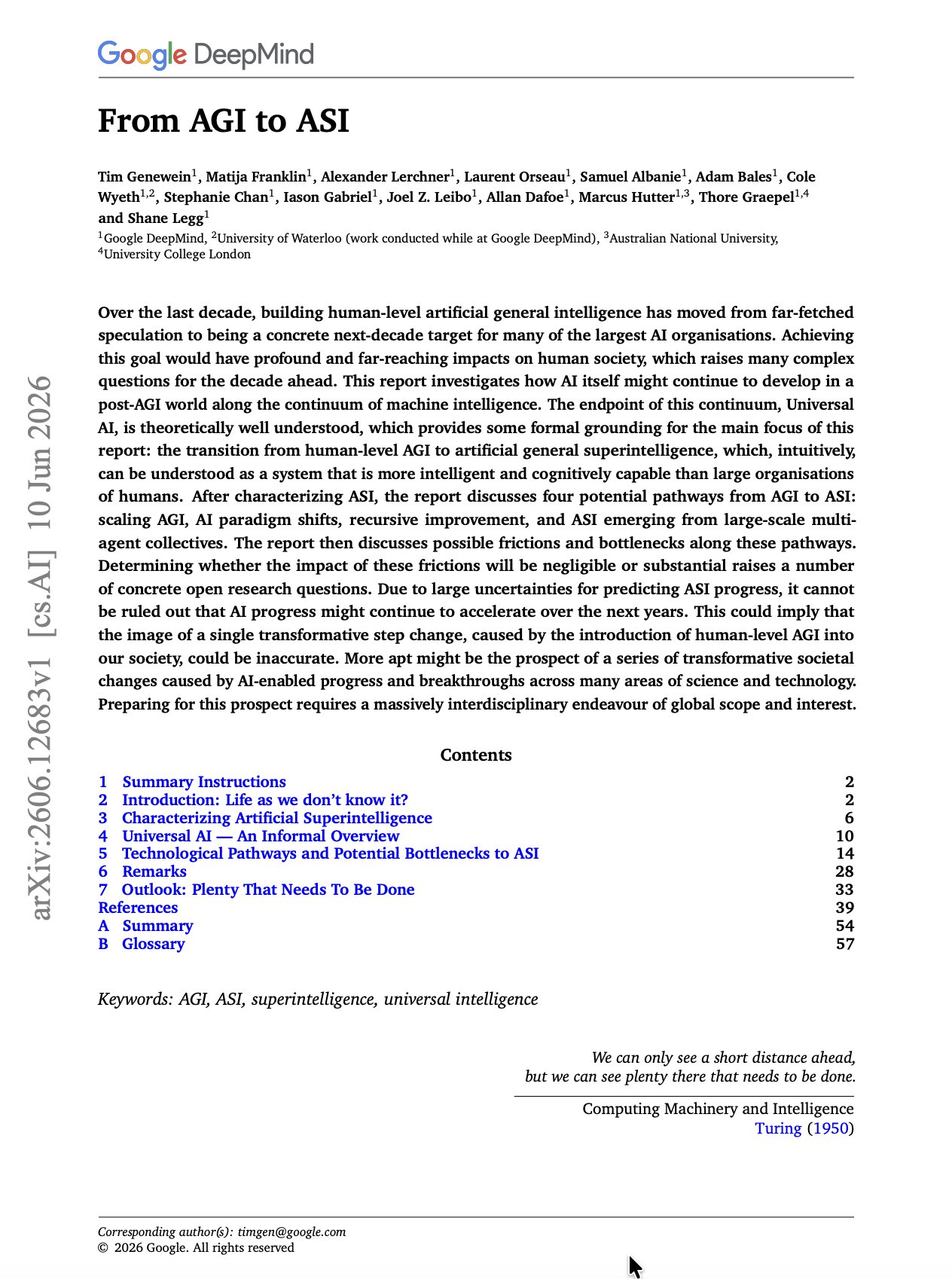
DeepMind: AGI is starting gun, not finish line, to ASI
By
–
AGI may not be the finish line. It may be the starting gun. Google DeepMind has released a major report: From AGI to ASI The central question is not whether human-level AGI would be transformative. The question is what happens after. If AI reaches roughly human-level
-
No Evidence Docket means no strong claim for agentic AI
By
–
The sentence I would highlight: “No Evidence Docket, no strong claim.” That is the standard agentic AI needs. Not vibes.
Not demos.
Not screenshots. Proof-bearing work, replayable traces, validator reports, cost/risk ledgers, and independent reproduction.