I talk to lots of people in the open weights space, including some of the key players. I use open weights models, I think I just disagree with you (in part because I care a log about non-coding uses). Feel free to send a link to the project/idea that might persuade me otherwise
MACHINE LEARNING
-
Open source importance vs closed frontier models lead
By
–
I think open source is important (it was literally the subject of a bunch of my pre-AI academic research). I also think that closed frontier models have a current lead with sustaining forces for now. And that more intelligent models can do more. Not sure we disagree on that much.
-
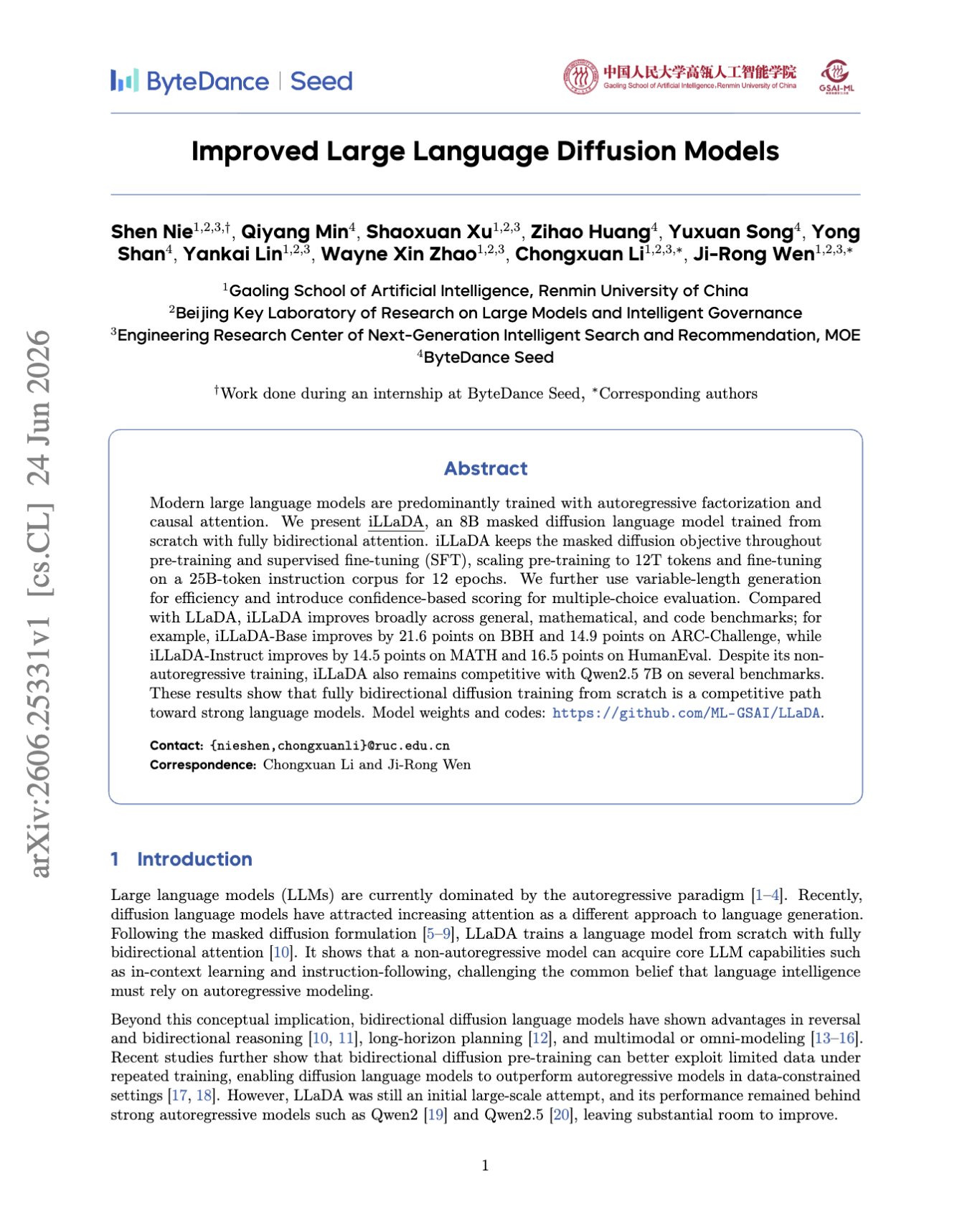
ByteDance’s iLLaDA 8B diffusion model rivals autoregressive LMs
By
–
"Improved Large Language Diffusion Models" ByteDance just made bidirectional masked diffusion on-par with autoregessive LM! This paper iLLaDA trains an 8B Transformer from scratch on 12T tokens, then keeps the same denoising objective for SFT on a 25B-token instruction corpus.
-
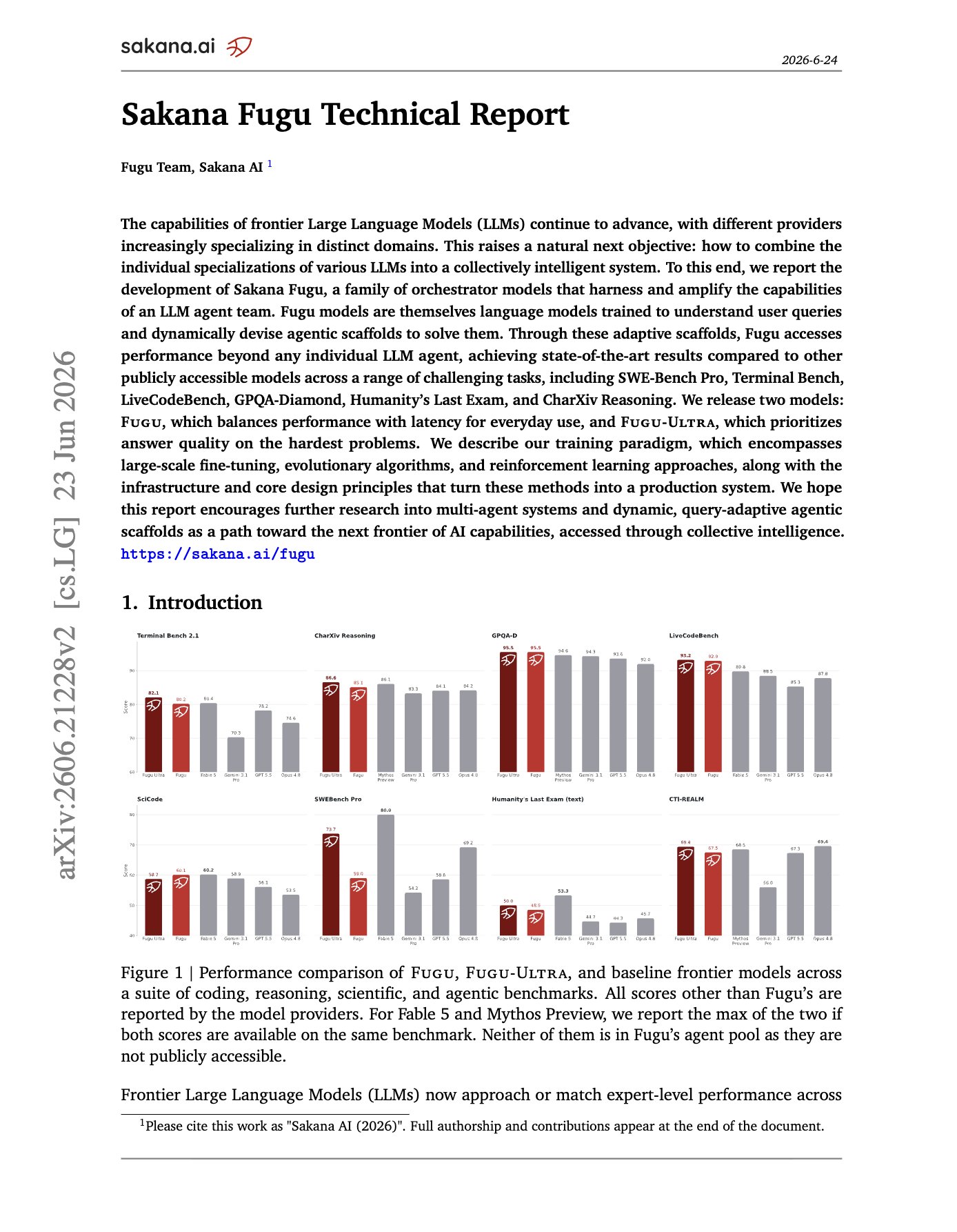
Sakana AI’s Fugu dynamically routes queries to multiple models
By
–
Sakana Fugu Technical Report Instead of training one larger model, Sakana AI trains an orchestrator that reads each query and dynamically routes or composes GPT-5.5, Gemini-3.1-Pro, Claude Opus 4.8 and other agents into query-specific workflows. With Fugu being the fast router,
-
Every enterprise will have its own model-harness-sandbox-eval flywheel
By
–
Every enterprise will have its own model-harness-sandbox-eval flywheel with token value per watt optimization. This is the future. Simple reason: tacit knowledge about the domain and customers and their workflows that the company uniquely understands and has built trust around.
-
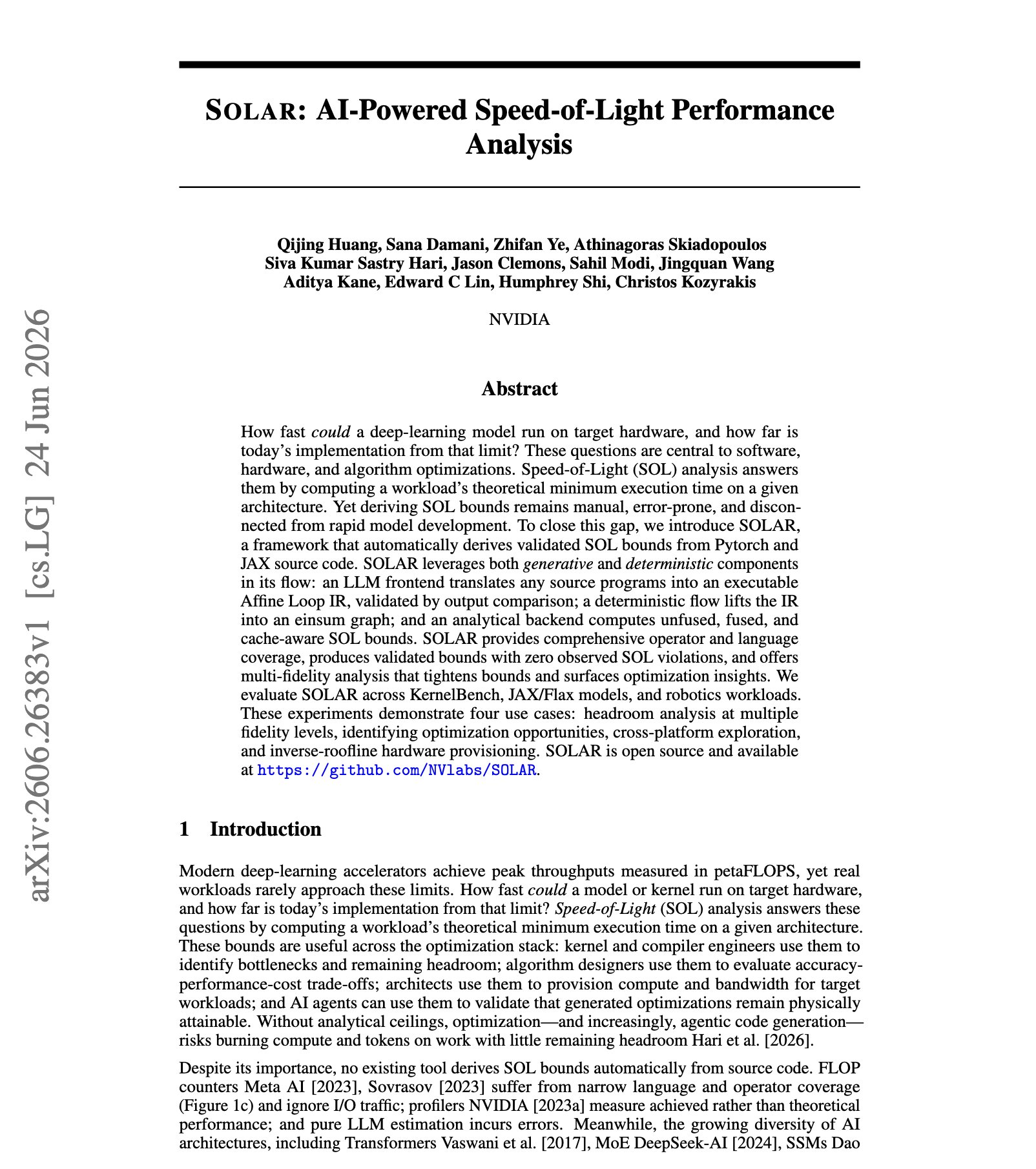
NVIDIA SOLAR automates speed-of-light performance analysis from PyTorch/JAX
By
–
NEW paper from NVIDIA. (bookmark it) Speed-of-light performance analysis tells you the theoretical floor of a workload, but teams still derive it by hand and freeze it. SOLAR automates the whole thing straight from PyTorch or JAX source. An LLM frontend translates arbitrary
-
More companies falling behind frontier models, early RSI acceleration
By
–
More companies are falling behind the frontier than keeping up with it (Mistral, Grok, etc.) & we are in the era of early RSI where there is acceleration. I haven’t seen any evidence of sudden frontier models emerging, but interested in seeing what you are hinting at.
-
Open source harness advances depend on model intelligence from few firms
By
–
Lots of advances coming from the open source harness movement (including Moltbook, RAG approaches back in the day, etc.) but they depend on the intelligence of the models created by a small handful of companies & the more intelligent those models, the more others can do with them
-
Snorkel AI at aiDotEngineer World’s Fair with booth and events
By
–
We'll be at @aiDotEngineer World's Fair next week! Find us at Booth L-G12 and join us for:
— Snorkel AI (@SnorkelAI) 27 juin 2026
🧋 Side event: Research & Boba with the creators of Agents' Last Exam – June 29, 4:00 PM (10 minutes from the conference)
🎤 Session: How a 4B Model Outsmarted a 235B Giant – June 30, 3:45… pic.twitter.com/0uPiTRl3J6We'll be at @aiDotEngineer World's Fair next week! Find us at Booth L-G12 and join us for: Side event: Research & Boba with the creators of Agents' Last Exam – June 29, 4:00 PM (10 minutes from the conference) Session: How a 4B Model Outsmarted a 235B Giant – June 30, 3:45
-
Next-token prediction compresses latent structure into understanding
By
–
A model trained for next-token prediction is forced to build compressed representations of latent structure in text. Ilya Sutskever correctly refers to this phenomenon as understanding. Here, a model trained for next-step sensor prediction, with a robot that has proprioception… pic.twitter.com/rHh1nFjJxd
— Nando de Freitas (@NandoDF) 27 juin 2026A model trained for next-token prediction is forced to build compressed representations of latent structure in text. Ilya Sutskever correctly refers to this phenomenon as understanding. Here, a model trained for next-step sensor prediction, with a robot that has proprioception