100M+ posts a day is a huge data. Does Grok learn something new from it as well?
MACHINE LEARNING
-
ML Improves Computer Systems Through VM Lifetime Prediction
By
–
Another great example of how ML can be used to improve computer systems, by learning how the system is actually being used (in this case by predicting VM lifetimes for optimizing their placement). Nice work, Pratik Worah and @martin_maas and coauthors!
-

SWE-grep: ML-Powered Code Search and Explanation Tool
By
–
SWE-grep is truly some inspired ML from @cognition
. Take a 1M line codebase like React. With multiple fast inference calls on Cerebras, it can fetch & explain relevant code in seconds. Here are a few measurements taken on React, Vercel, PyTorch repos. -
CS Fundamentals, Local LLMs, and Inference Explained
By
–
what do you know? cs fundamentals? running llms locally? inference?
-

Transformers Learning Multiplication Through Auxiliary Loss
By
–
Why Can't Transformers Learn Multiplication? This paper found that plain training never builds long-range links of multiplications. So by adding a new auxiliary loss that predicts the “running sum”, it enables the model to successfully learn multi-digit multiplication!
-
PaddleOCR VL 900M Params Achieves SOTA on OmniDocBench
By
–
Pretty wild what 900M params can do – PaddleOCR VL > SOTA on OmniDocBench v1.0 & v1.5 (text, tables, formulas, charts, reading order)
> Multilingual – 109 languages (Latin, Arabic, Cyrillic, Devanagari, Thai, etc)
> Handles handwriting, historical docs, noisy scans
> Supports -
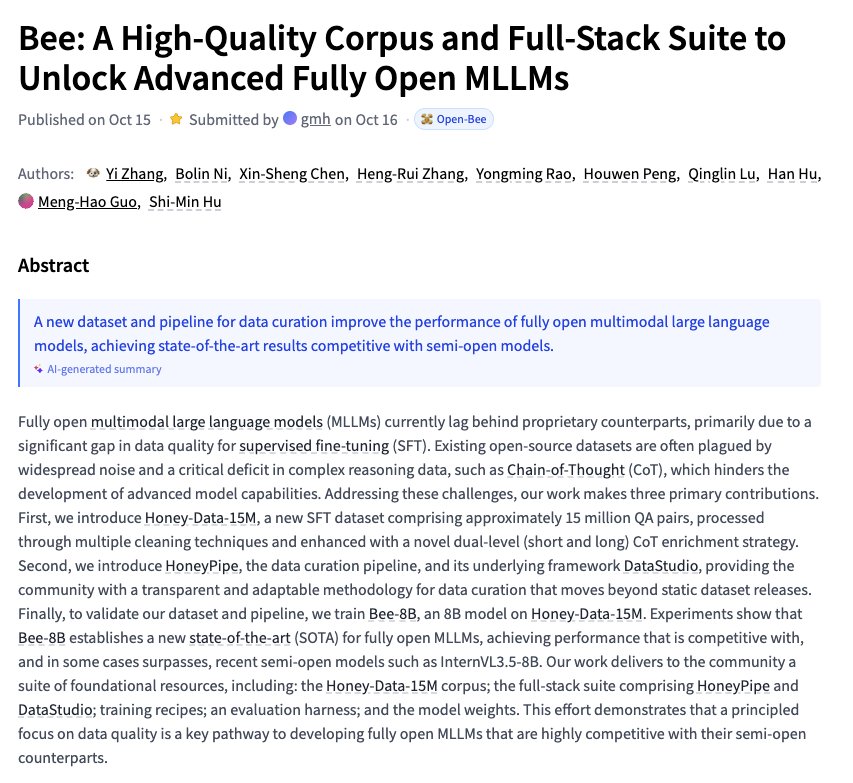
Bee: Open-Source Multimodal LLM Corpus and Framework
By
–
Bee A High-Quality Corpus and Full-Stack Suite to Unlock Advanced Fully Open MLLMs
-
Stanford Hosts First AI Agents Conference as Primary Authors
By
–
Stanford researchers are organizing the first-of-its-kind conference, where AI agents are the primary authors and reviewers. Join the #agents4science online conference on Oct. 22: https://
agents4science.stanford.edu