Agentic AI is exposing the limits of GPU-only systems. New coverage from @datacenter highlights how @Intel and SambaNova are rethinking inference: → GPUs for prefill
→ RDUs for fast decode
→ CPUs for orchestration A shift toward efficiency, not just scale. Read more ↓
COMPUTING
-
Agentic AI Pushes GPU-Only Systems to Their Limits
By
–
-

Matei Zaharia ACM Prize Computing Pioneer Databricks Spark
By
–
I had a fascinating conversion this week with a computing pioneer, Matei Zaharia, the CTO of Databricks, who is the recipient of this year’s ACM Prize in Computing, a kind of genius award, in part because of his development of the Spark open-source software. Out chat confirmed my
-
Open-source LLM frameworks accelerate on NVIDIA platform
By
–
Open-source software never stops. It only accelerates.
— NVIDIA (@nvidia) 8 avril 2026
Dynamo, @sgl_project, TensorRT LLM, and @vllm_project are constantly optimized by a vast ecosystem of developers building on top of the NVIDIA platform.
The result: your token output keeps improving and token cost keeps… pic.twitter.com/DB1ND736ugOpen-source software never stops. It only accelerates. Dynamo, @sgl_project, TensorRT LLM, and @vllm_project are constantly optimized by a vast ecosystem of developers building on top of the NVIDIA platform. The result: your token output keeps improving and token cost keeps decreasing on the same hardware resources while your developer velocity stays at its peak. Build on the foundation continuously optimized by the world’s best developers. ⚡ 🔗 nvda.ws/3OsTQL0
-
TriAttention: Efficient Long Reasoning with Trigonometric KV Compression
By
–
“TriAttention: Efficient Long Reasoning with Trigonometric KV Compression”
— alphaXiv (@askalphaxiv) 8 avril 2026
Most KV-cache compression methods guess what to keep by looking at recent attention.
But this paper argues that the signal is unstable because RoPE keeps rotating queries with position, so what looks… pic.twitter.com/GrEYc0gZ2b“TriAttention: Efficient Long Reasoning with Trigonometric KV Compression” Most KV-cache compression methods guess what to keep by looking at recent attention. But this paper argues that the signal is unstable because RoPE keeps rotating queries with position, so what looks unimportant now may matter later. So they proposed TriAttention, which looks in the pre-RoPE space and finds that many heads have stable Q/K centers. That lets it predict which token distances a head is likely to retrieve, and compress the KV cache using that structure rather than noisy recent attention. This shift from "keeping what was attended recently” to “keeping what this head is likely to need later” Empirically, it matches full attention on AIME25 with 2.5x higher throughput or 10.7x less KV memory.
-
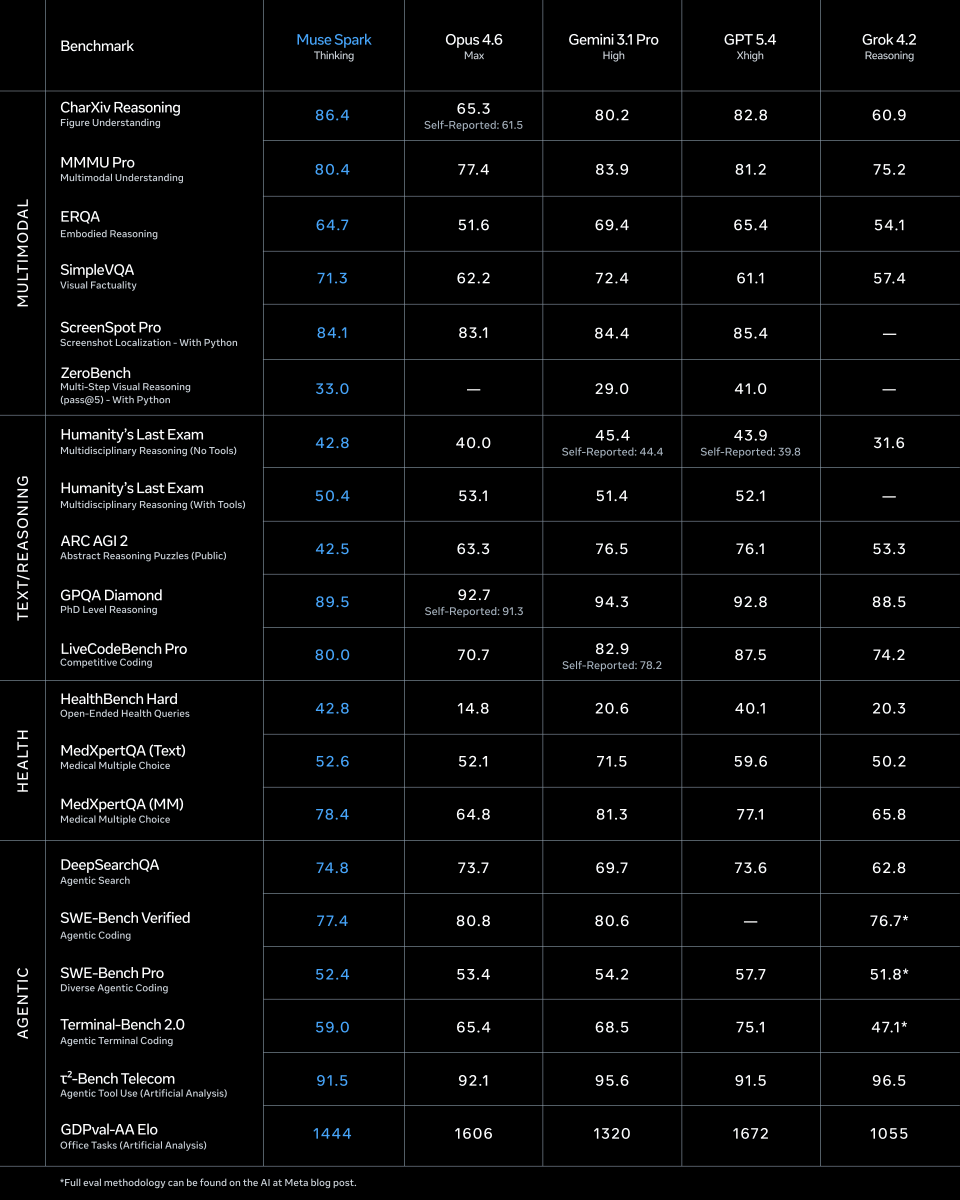
Nine Months of Building: Muse Spark Model Launch Success
By
–
Fun nine months! My first week i remember we had a long dinner in the cafeteria daydreaming about the cool research directions to pursue, then going to back to our desks to write a basic script to inference llama. Now we have a pretty complete stack and our first model is out 🥑 Alexandr Wang (@alexandr_wang) 1/ today we're releasing muse spark, the first model from MSL. nine months ago we rebuilt our ai stack from scratch. new infrastructure, new architecture, new data pipelines. muse spark is the result of that work, and now it powers meta ai. 🧵 — https://nitter.net/alexandr_wang/status/2041909376508985381#m
→ View original post on X — @_jasonwei, 2026-04-08 17:25 UTC
-
Hamiltonian Monte Carlo: Physics-Based Probabilistic Sampling
By
–
Hamiltonian Monte Carlo: probability as physics.
— Mathematica (@mathemetica) 8 avril 2026
Endow particles with momentum, then let Hamilton’s equations (dq/dt = ∂H/∂p, dp/dt = −∂H/∂q) carve reversible, volume-preserving trajectories through phase space.pic.twitter.com/Uf7MD4lqnqHamiltonian Monte Carlo: probability as physics. Endow particles with momentum, then let Hamilton’s equations (dq/dt = ∂H/∂p, dp/dt = −∂H/∂q) carve reversible, volume-preserving trajectories through phase space.
-
Anthropic Launches Managed Agents for Unpredictable Programs
By
–
New on the Engineering Blog: Building Managed Agents—our hosted service for long-running agents—meant solving an old problem in computing: how to design a system for "programs as yet unthought of." Read more: anthropic.com/engineering/managed-agents [Translated from EN to English]
→ View original post on X — @anthropicai, 2026-04-08 17:20 UTC
-
Liquid AI Releases LFM2.5-VL-450M Tiny Vision-Language Model
By
–
New tiny VLM: LFM2.5-VL-450M
— Maxime Labonne @ ICLR (@maximelabonne) 8 avril 2026
> Supports bounding box prediction, object detection, and function calling
> Improved multilingual capabilities across 9 languages
> Enhanced instruction following for vision and text tasks https://t.co/diQjDO9RCX pic.twitter.com/hJqlV6YFcDNew tiny VLM: LFM2.5-VL-450M > Supports bounding box prediction, object detection, and function calling > Improved multilingual capabilities across 9 languages > Enhanced instruction following for vision and text tasks Liquid AI (@liquidai) Today, we release LFM2.5-VL-450M, a vision-language model built for real-time reasoning on edge devices. It processes a 512×512 image and returns structured outputs in ~240ms on-device. — https://nitter.net/liquidai/status/2041912441060143251#m