I would probably start with 1. my Build A Large Language Model (From Scratch) book to understand the basic architecture and basic pipeline. Then maybe 2. Build A Reasoning Model (From Scratch) for inference scaling and reinforcement learning
3. Maybe one of the "production"
CODE
-
Learning Path: LLM Architecture, Reasoning Models, and Production Systems
By
–
-
Cosine Similarity: Elegant Geometric Approach to Document Comparison
By
–
“Cosine Similarity” is everywhere in machine learning, but it’s often treated as a black box. At its core, it’s just a normalized measure in a vector space, comparing two document representations. It doesn’t really understand meaning, it’s a purely geometric view based on the angle between vectors, yet it works surprisingly well at capturing how similar two documents are, almost as if it understood their content. Simple idea, but the intuition behind it is genuinely elegant. This is one of the most read pages on Algebrica. algebrica.org/cosine-similar…
→ View original post on X — @deeplearn007, 2026-04-05 13:22 UTC
-

BM25: The Powerful 30-Year-Old Search Algorithm Still Beating Vectors
By
–
Stop using vector search everywhere! A 30-year-old algorithm with zero training, zero embeddings, and zero fine-tuning still powers Elasticsearch, OpenSearch, and most production search systems today. It's called BM25. Let me explain what makes it so powerful: Imagine you're searching for "transformer attention mechanism" in a library of ML papers. BM25 asks three simple questions: "How rare is this word?" Every paper contains "the" and "is", which makes it useless. But "transformer" is specific and informative. BM25 boosts rare words and ignores the noise. → This is IDF(qᵢ) in the formula "How many times does it appear?" If "attention" appears 10 times in a paper, that's a good sign. But 10 vs 100 occurrences won't make much difference. BM25 applies diminishing returns. → This is f(qᵢ, D) combined with k₁ that controls saturation "Is this document unusually long?" A 50-page paper will naturally contain more keywords than a 5-page paper. BM25 levels the playing field so longer documents don't cheat their way to the top. → This is |D|/avgdl controlled by parameter b Three questions. No neural networks. No training data. Just elegant math (refer to the image below) The best part: BM25 excels at exact keyword matching – something embeddings often struggle with. If your user searches for "error code 5012," embeddings might return semantically similar results. BM25 will find the exact match. This is why hybrid search exists. Top RAG systems today combine BM25 with vector search. You get the best of both worlds: semantic understanding AND precise keyword matching. So before you throw GPUs at every search problem, consider BM25. It might already solve your problem, or make your semantic search even better when combined.
→ View original post on X — @akshay_pachaar, 2026-04-05 13:02 UTC
-
Python Rewrite and Architecture Leak Analysis Revealed
By
–
The Python rewrite angle is clever haha. Honestly the leak was more interesting for what it revealed about the architecture than anything else. Skills, hooks, the whole execution model… not that surprising if you use it daily but nice to see confirmed.
-
Intermediate Reasoning Steps in AI Models and Error Tolerance
By
–
This is a good reframe. The intermediate reasoning steps being "wrong" doesn't matter if the final output is correct. It's similar to how humans think through problems, lots of wrong turns before the right answer. The error compounding argument assumes each token is a final
-
File-Based Data Management for Long-Term Memory Systems
By
–
Everything managed in files is the way to go, just hard to manage long-standing memory still. Even with such a wikipedia version, but at least better to have more and well organized data vs. none!
-

Human Approval Portal for Autonomous Agents
By
–
Building a 'Human-in-the-Loop' Approval Gate for Autonomous Agents machinelearningmastery.com/b… [Translated from EN to English]
→ View original post on X — @craigbrownphd, 2026-04-05 12:44 UTC
-
AI Code Quality Beyond Tests: Complexity Metrics Matter
By
–
Tests passing while complexity explodes from 29 to 285 is the perfect illustration of why benchmarks are misleading right now. The field keeps measuring "can AI write code" when the real question is "can it maintain software." Very different things.
-
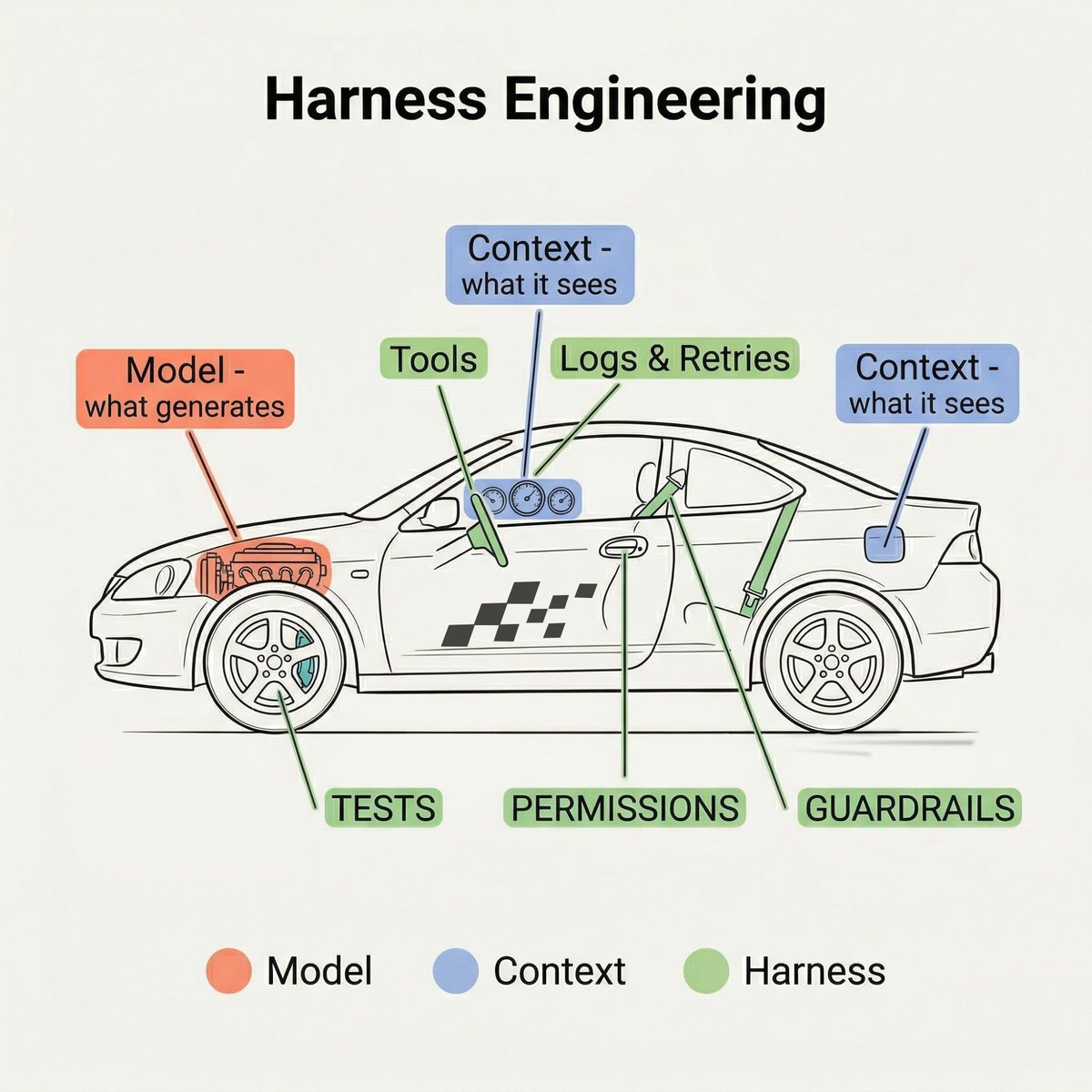
Harness Engineering: Building Better AI Agent Systems
By
–
I let Claude Code loop for 45 minutes while I was at the gym. Came back. It told me the feature was done. It wasn't. It hadn't even run the tests. Not because the model is dumb. Because I wrapped it in nothing but a loop and a dream. That's harness engineering in one sentence. And no, it's not prompt engineering with a fancier name. The model is the engine. Context is the fuel. The harness is the rest of the car. Steering. Brakes. Lane boundaries. Warning lights. Tools, permissions, tests, retries, guardrails. Engine + fuel but not strong parts in it = dangerous car. So I stopped tuning the engine and started building the car around it. In every skill file (Claude Code, Claude Co-work), I added one last step. After each interaction, the agent reflects on what I liked, what I edited, what failed. Then it updates its own skill to be better next time. Token usage dropped (a lot). Output quality went up. Compounding improvement with zero extra effort from me. LangChain did something similar at a bigger scale. Changed only the harness on a coding agent. Same model. Went from outside the top 30 to top 5 on a benchmark. Same engine, completely different results, just because the car around it was better. Next time your agent breaks, don't blame the model. Fix the car. P.S. Do your agents learn from their mistakes, or do they keep making the same ones?
-
MacBook Air M5 Sufficient for Coding Agents Work
By
–
I spent 3 hours this morning working with coding agents on MacBook 16" M5 Max in LOW POWER mode! 😱 I noticed 0 difference! This means a MacBook Air M5 is more than enough for this. BTW Apple Silicon is unbeatable! 🤷🏻♂️
→ View original post on X — @clementdelangue, 2026-04-05 08:53 UTC