Compression is one way to fight the KV cache wall. The other is to not throw the KV away. LMCache reuses and offloads it to CPU, disk, or S3 instead of evicting. Already plugs into vLLM, SGLang, and NVIDIA Dynamo. Worth a star if you serve LLMs.
@akshay_pachaar
-

Slime: Open source RL framework behind GLM-5.2 post-training
By
–

The RL framework behind GLM-5.2 is fully open source. The full post-training of GLM-5.2 ran on it in about two days. The same stack sits behind the entire GLM series, from 4.5 to 5.1. It is called slime, and it is built around one idea. Keep a single RL kernel, and push all the
-

Hermes Agent learns by failing and recording lessons
By
–

Hermes /learn explained. agents usually learn the hard way. they struggle through a task live, fail a few times, find the path that works, and only then write down what they figured out. the lesson costs you a painful session before it becomes reusable. Hermes Agent by Nous
-
Engineering focus shifting to exit conditions and context budget
By
–
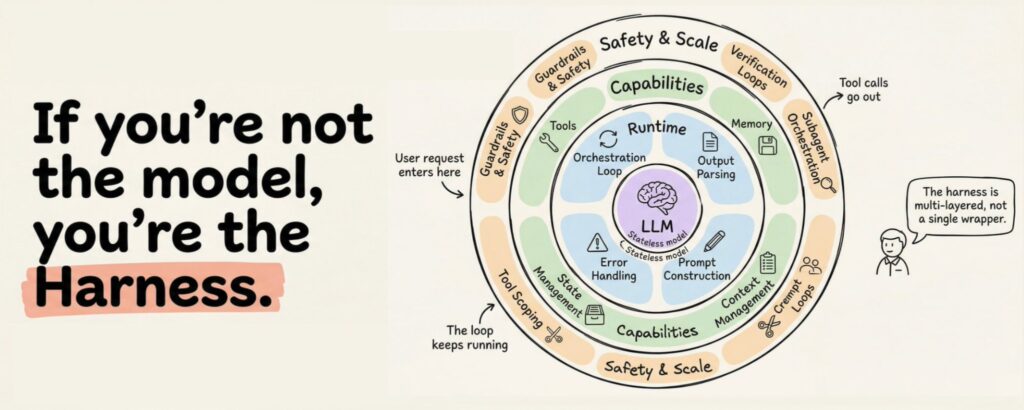
right, you can see it in where teams spend their time now. two years ago it was prompt wording. today it's the exit conditions, the context budget, and the checker that grades the work. same loop in the middle. all the engineering moved to the edges.
-
Loop raises floor, not the ceiling of model capability
By
–
agreed, the loop doesn't replace model capability. a weak model in a tight loop still hits a ceiling on hard edge cases. the claim is narrower. for a fixed model, the loop decides how much of that capability you actually get out. it raises the floor, it doesn't move the ceiling.
-
Better loop beats model swap; cost key for exit condition
By
–
fair, a stronger model raises the floor on every turn. but the post's point holds: same model, better loop, jumped from mid-benchmark into the top five. the harness moved the needle more than swapping the brain. cost is the real constraint though. that's why the exit condition
-
Karpathy: Keep AI on leash, I’m still the bottleneck
By
–
Karpathy said something you'll regret ignoring:
— Akshay 🚀 (@akshay_pachaar) 23 juin 2026
"We have to keep the AI on the leash. I'm still the bottleneck. I have to make sure this thing isn't introducing bugs and that there's no security issues."
He said it at YC talk last year, when the worry was reliability. The… https://t.co/qtbSsM5W8A pic.twitter.com/df5yjZmdO9Karpathy said something you'll regret ignoring: "We have to keep the AI on the leash. I'm still the bottleneck. I have to make sure this thing isn't introducing bugs and that there's no security issues." He said it at YC talk last year, when the worry was reliability. The
-
Turn any paper into running code with autoarxiv
By
–
Turn any paper into running code.
— Akshay 🚀 (@akshay_pachaar) 21 juin 2026
Just swap arxiv → autoarxiv in the paper url.
That hands the paper to an AI agent from alphaXiv. It reads the abstract, the claims, and the linked GitHub repo, then clones the codebase and works through the usual setup pain like dependencies,… pic.twitter.com/UOPJnWdfLJTurn any paper into running code. Just swap arxiv → autoarxiv in the paper url. That hands the paper to an AI agent from alphaXiv. It reads the abstract, the claims, and the linked GitHub repo, then clones the codebase and works through the usual setup pain like dependencies,
-
PixelRAG skips OCR by embedding screenshots directly into vectors
By
–
True if you round-trip through OCR to markdown, that's where the token cost piles up. But PixelRAG skips that. The screenshot gets embedded straight into a vector for retrieval, no image to text step in the pipeline. The VLM only reads pixels at the end, on the few tiles it
-
RAG stacks still convert pages to text, but vision models are catching up
By
–
Same, you'd think it was the default by now. But most RAG stacks still parse pages to text first, mostly because vision models were too slow and pricey to run at scale until pretty recently. That window is closing fast now.