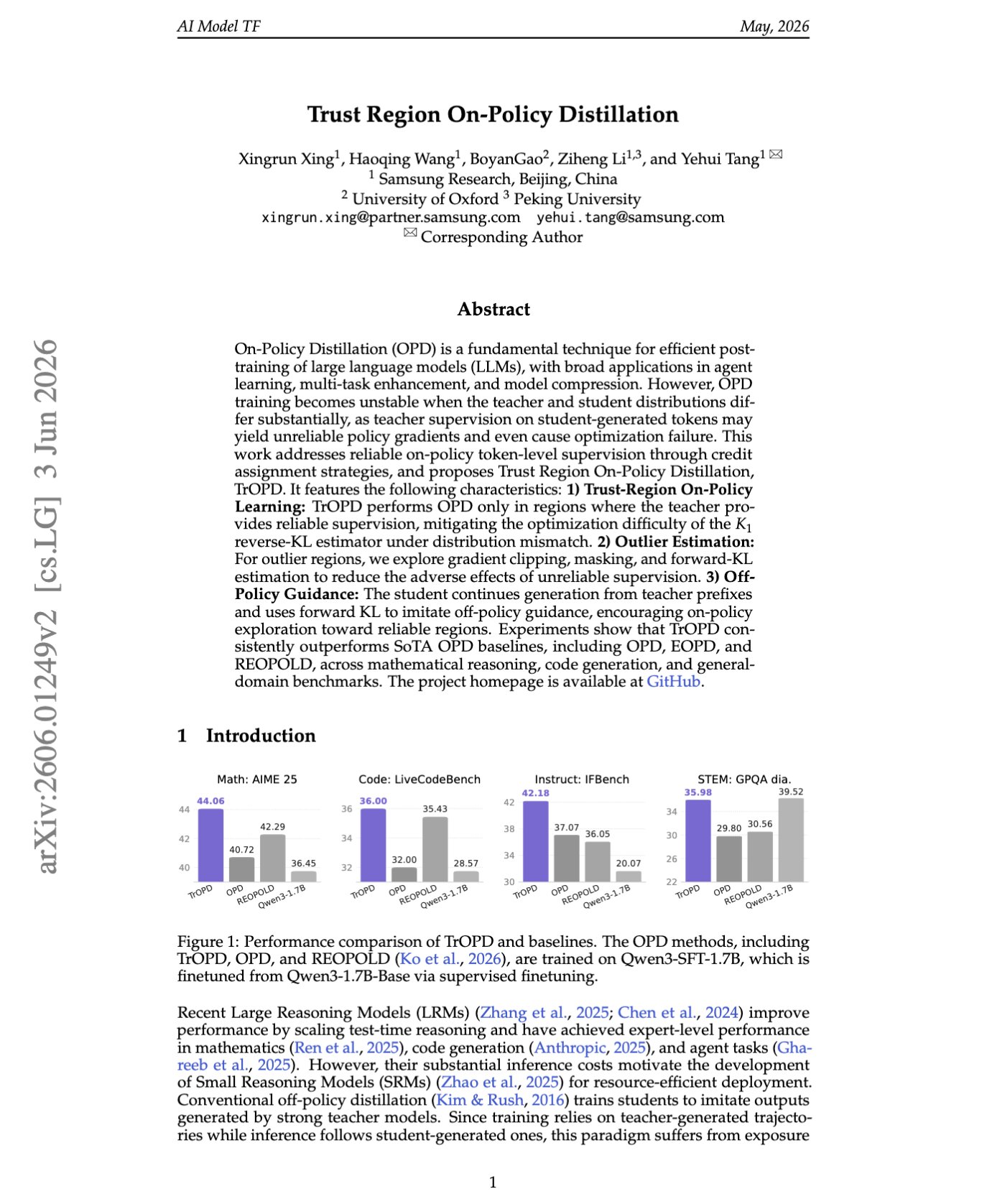
“Trust Region On-Policy Distillation” On-policy distillation is powerful, but one bad mismatch between student and teacher can negatively impact the gradients. So this paper's TrOPD only learns where the teacher is reliable, treats outliers separately, and nudges the student
SOFTWARE
-
Anthropic: Claude writes more than 80% of merged code
By
–
We have just published internal data on the share of Claude's development that is already done by Claude: – More than 80% of all merged code in our codebase is now written by Claude – It has been months that many researchers at Anthropic
-

Anthropic’s codebase 80% authored by Claude AI in 2026
By
–
"As of May 2026, more than 80% of the code we merge into Anthropic’s codebase was authored by Claude." Matches independent measures. There really is no sign this is slowing down (which doesn't mean there aren't organizational challenges to absorbing this much productivity gain)
-

AI helps Anthropic research and train better AI, closing the loop
By
–
Very interesting article from Anthropic about how, thanks to AI, they're able to streamline their process of researching and training better AI. Or as it's colloquially known: closing the loop
-
New course on serving LLMs efficiently with Red Hat
By
–
New course on serving LLMs efficiently — how do you serve models to many concurrent users at low latency and reasonable cost? This short course is built with @RedHat and taught by @cedricclyburn.
— Andrew Ng (@AndrewYNg) 4 juin 2026
Efficient LLM serving requires efficient memory management. A 70B-parameter model… pic.twitter.com/KeKveT2IicNew course on serving LLMs efficiently — how do you serve models to many concurrent users at low latency and reasonable cost? This short course is built with @RedHat and taught by @cedricclyburn
. Efficient LLM serving requires efficient memory management. A 70B-parameter model -

AI Research: Claude’s Improved Decision-Making Outperforms Humans
By
–
AI research is a series of next-step decisions. We looked at sessions where a human researcher took a wrong turn, showed Claude the session up to that point, and asked it what to do next. Mythos Preview improved on humans 64% of the time—up from 22% in 2024.
-
AI Self-Improvement Plausible if Trends Continue, But Research Judgment Lacks
By
–
None of this guarantees recursive self-improvement is on the horizon. It’s not yet clear that Claude is capable of research judgment—of choosing the right problems to work on. But if these trends continue, AI systems designing and building their own successors is plausible. This
-
Anthropic’s AI models show massive speedup in code training tasks
By
–
Each time we release a model, we run the same test: give it code that trains a small AI model, ask the new model to speed it up. It takes a skilled human 4-8 hours to reach 4x faster. In May 2024, Claude Opus 4 averaged a ~3x speedup. This April, Mythos Preview achieved ~52x.
-

Claude’s coding success jumps 50 points, rivaling human quality
By
–
The speedup isn’t just in volume. On open-ended coding problems where answers are unclear, Claude’s success rate is now 76%—a 50 point jump in just 6 months. Many engineers also say Claude’s code quality is now on par with human code; we expect it to be better within the year.
-
New memory system enables review and control of ChatGPT’s context
By
–
With the new memory system, you can review and steer what ChatGPT remembers through a memory summary, with more visibility and control over how context is used. pic.twitter.com/kXMAds0g3q
— OpenAI (@OpenAI) 4 juin 2026With the new memory system, you can review and steer what ChatGPT remembers through a memory summary, with more visibility and control over how context is used.