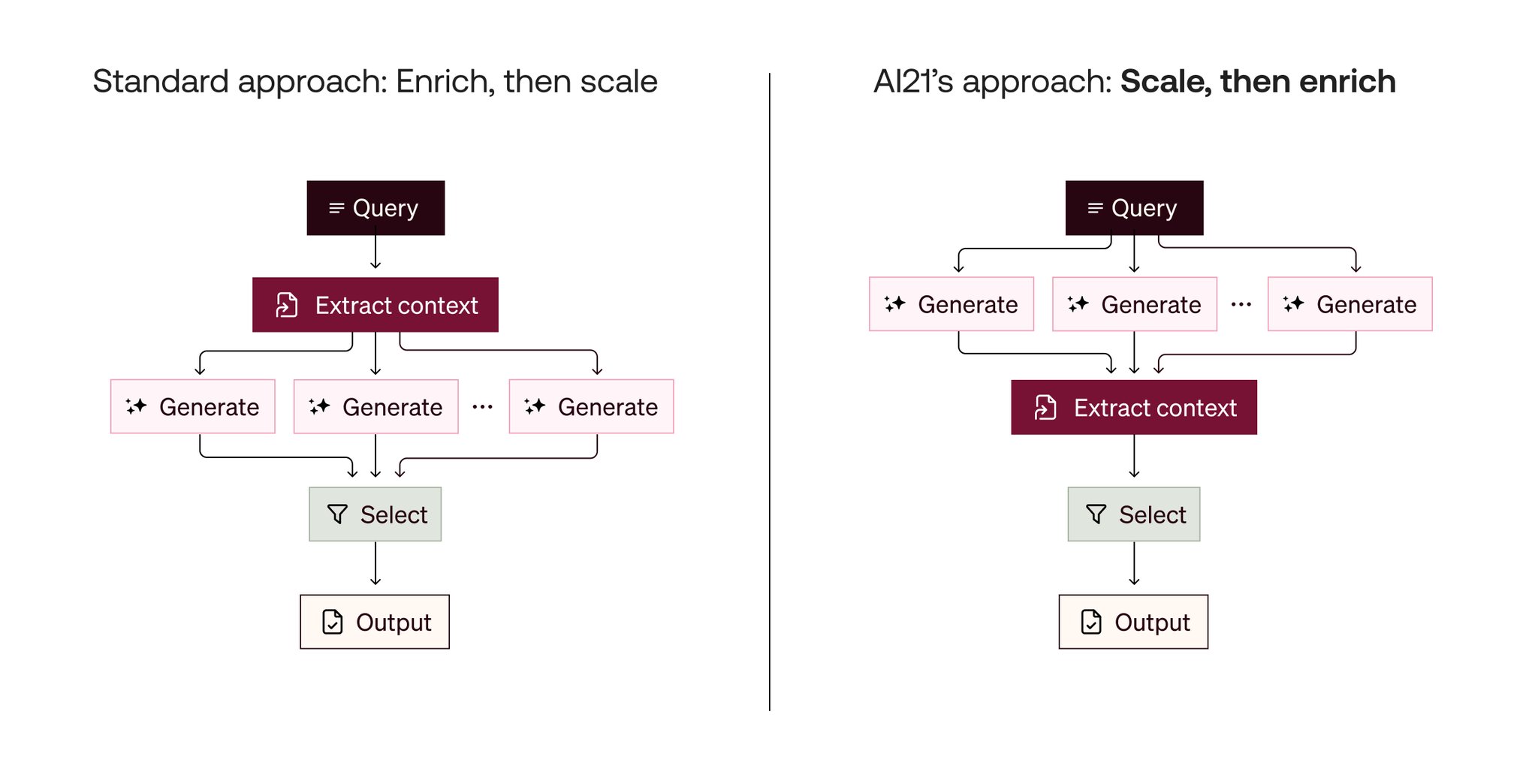
5/5 Takeaway: pipeline order is a hyperparameter. If you're already paying for parallel rollouts, reuse them – they're relevant context, not just candidate answers. Full write-up: [
https://
ai21.com/blog/first-sca
le-then-enrich-how-the-right-execution-strategy-helped-us-reach-state-of-the-art-on-swe-rebench/?utm_source=org-twitter
…]
SOFTWARE
-
Pipeline order is a hyperparameter for optimizing LLM execution strategies
By
–
-
AI21 Labs surpasses Claude Code in efficiency and performance with Test Agent.
By
–
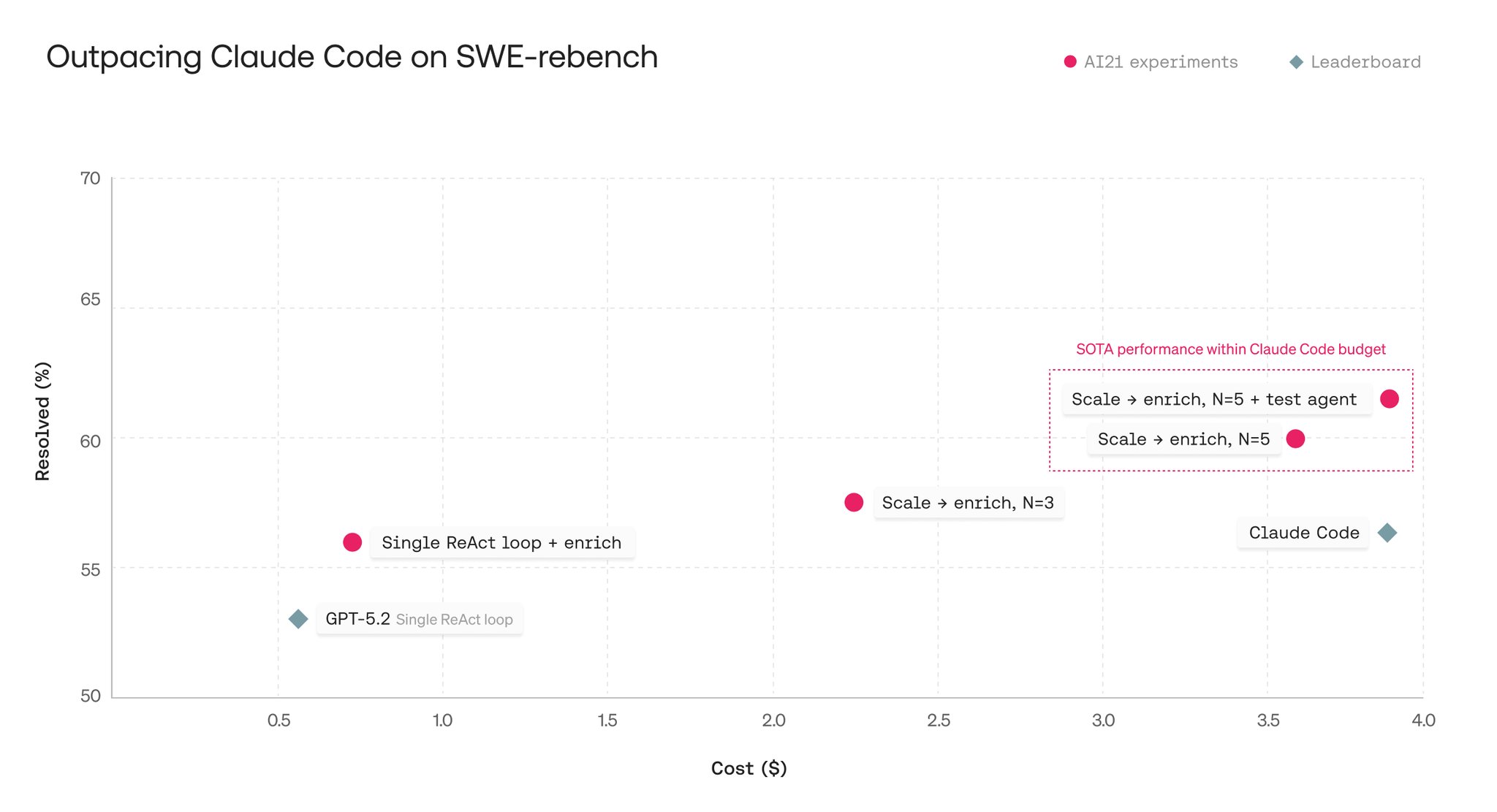
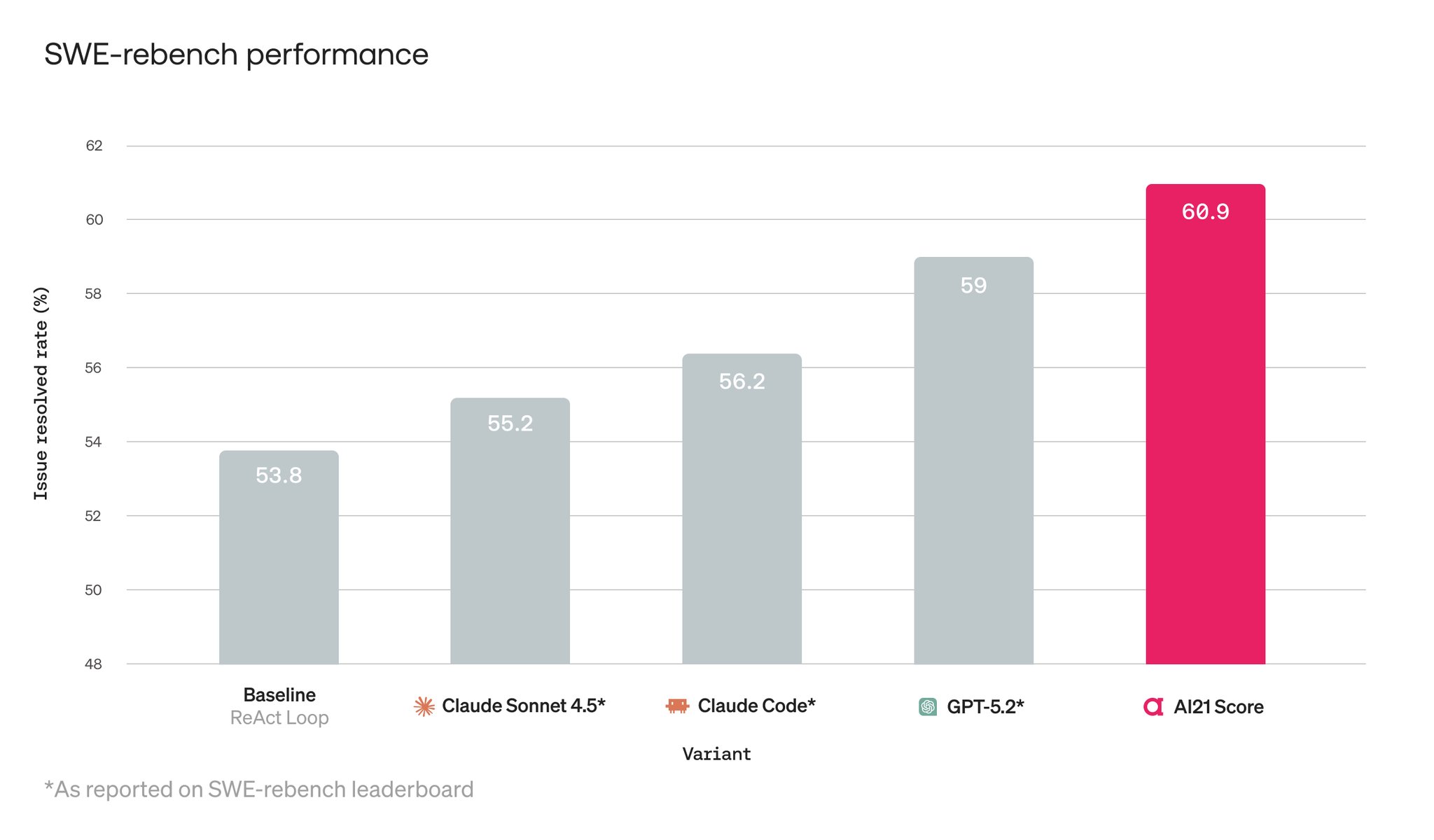
4/5 Still came in ~$0.30 under Claude Code’s spend at a similar score. So we added a lightweight Test Agent that writes repo tests and filters failing patches, pushing our final result to 60.9% – surpassing Claude Code (60.9% vs 56.2%) at the same cost.
-
AI21 Labs: ReAct Agent Performance with Enrichment and Scaling Strategies
By
–
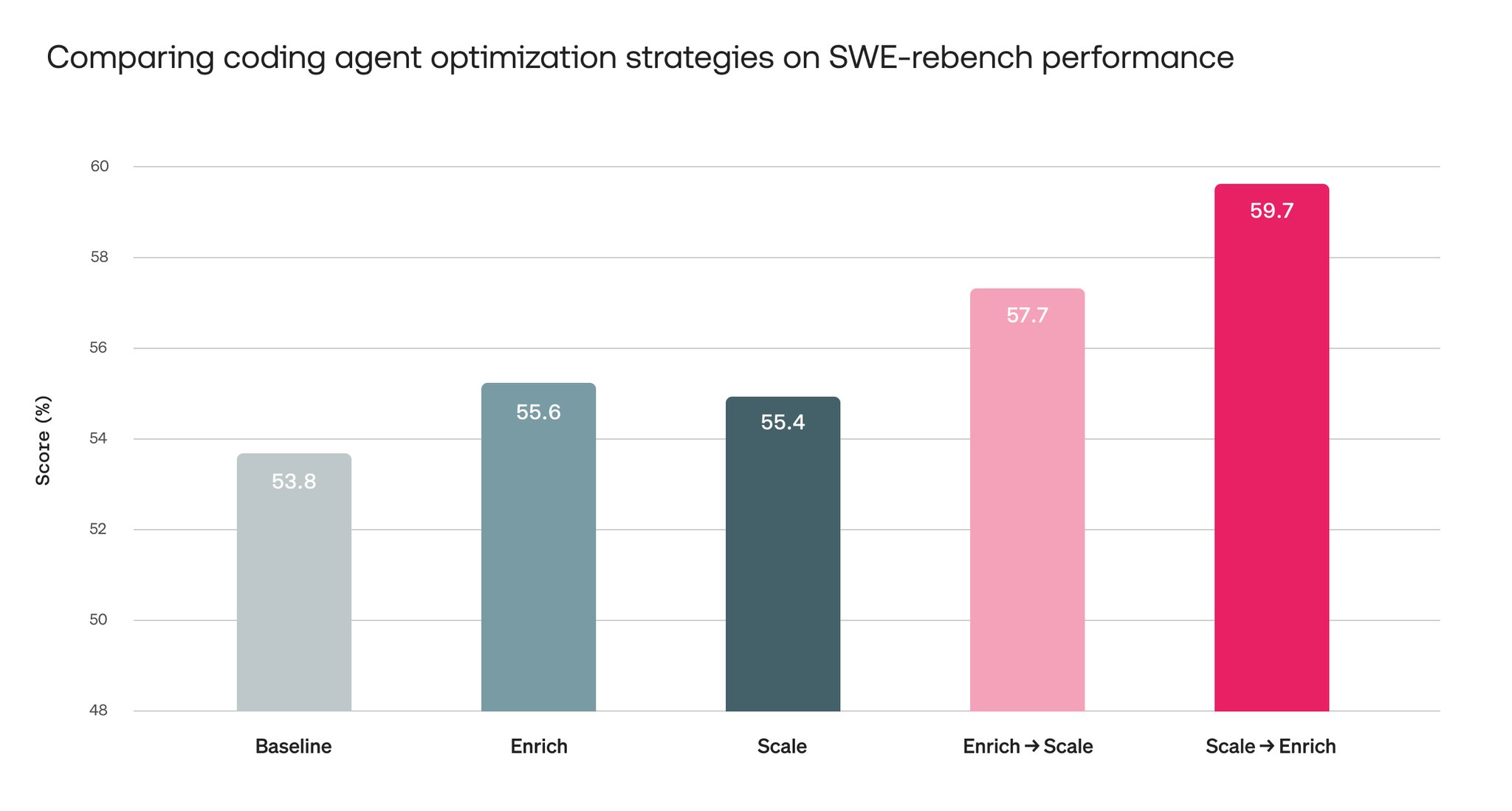
2/5 Started with a baseline: classic ReAct agent (GPT-5.2), single Docker-terminal tool. Baselines on the slice: vanilla 53.8%, enrich-only 55.6%, scale-only (n=5 + LLM judge) 55.4%, enrich-then-scale 57.7%.
-
MiniMax M3: Open-weights frontier model challenges closed model dominance
By
–
THE ERA OF RELYING EXCLUSIVELY ON THE 3 MAJOR CLOSED MODELS IS OVER@MiniMax_AI's M3 is officially out 💥💥💥
— Charly Wargnier (@DataChaz) 4 juin 2026
It delivers the exact same capabilities you expect from a frontier model, combining massive leaps forward in a highly cost-efficient, open-weights package.
Here's why… pic.twitter.com/NDUppZzMlqTHE ERA OF RELYING EXCLUSIVELY ON THE 3 MAJOR CLOSED MODELS IS OVER @MiniMax_AI
's M3 is officially out It delivers the exact same capabilities you expect from a frontier model, combining massive leaps forward in a highly cost-efficient, open-weights package. Here's why -
AI21 Labs: Reversing agent pipeline order achieves SOTA results
By
–
1/5 Our latest Labs in Front piece: Agent pipeline order matters. By reversing a common agent recipe – scale first, enrich second – we reached SOTA on a Dec ‘25 to Mar ‘26 slice (123 issues): 60.9%.
-
Claude’s neurosymbolic code useful, but more AI work needed
By
–
now/years. claude code is neurosymbolic and pretty useful in its domain, but there’s lots more to be done (see my 2020 article Next Decade in AI).
-

Launching SynthTraces: generating synthetic coding agent traces
By
–
Today I'm launching a new project called SynthTraces It is a minimal codebase to generate synthetic coding agent session traces using Pi (from @badlogicgames
) I wanted a large number of coding-agent traces, so I built a tiny harness where two models talk to each other: – an -
NVIDIA Nemotron 3 Ultra: Open Model for Agentic Tasks
By
–
Introducing NVIDIA Nemotron 3 Ultra.
— NVIDIA (@nvidia) 4 juin 2026
A frontier smart open model built for long-running agents that need to plan, reason, use tools and keep working across complex coding, research and enterprise workflows.
Up to 5x faster inference and up to 30% lower cost for agentic tasks.… pic.twitter.com/AcHTauUzjmIntroducing NVIDIA Nemotron 3 Ultra. A frontier smart open model built for long-running agents that need to plan, reason, use tools and keep working across complex coding, research and enterprise workflows. Up to 5x faster inference and up to 30% lower cost for agentic tasks.
-

NVIDIA post-trains Ultra for popular agent harnesses
By
–
We post-trained Ultra for popular agent harnesses like @openclaw
, @NousResearch Hermes Agent, and @Langchain
. The result is an open frontier model developers can customize for specialized agents across domains. Read more: https://
nvda.ws/4adkn6J -
AI Performance as a System-Level Challenge: Optimizing Chips and Software
By
–
The enterprise takeaway is simple: AI performance is now a system-level challenge. The winners will optimize chips, memory, interconnects, software, and architecture together. Less latency means faster intelligence.
Less movement means lower cost.
Less waste means AI that can