
ok this is going to be game changer for me the "AI Scientist"
RESEARCH
-
Model Reliability Over Raw Capability in AI Selection
By
–
The big reason why people choose better models isn’t so much IQ points, but reliability. This is why smaller models often suck – it isn’t that they literally can’t do the task, but that they don’t do it anywhere near reliably enough. If you used Sonnet 3.5 back in the day, and
-
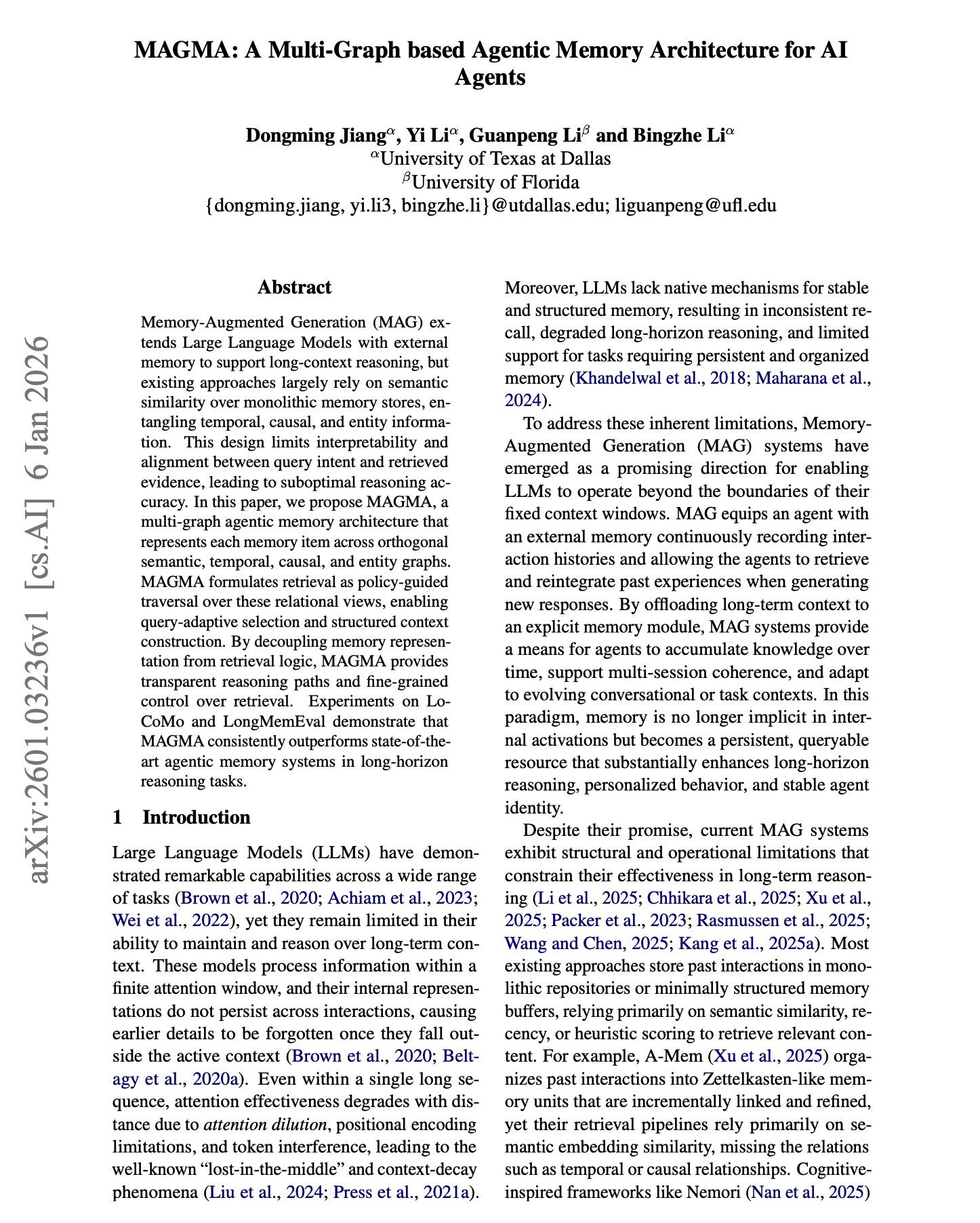
Memory Systems for Long-Horizon Coding Agent Reasoning
By
–
On building memory systems for long-horizon reasoning tasks. This is a really important topic, especially for improving coding agents like Claude Code. Current Memory-Augmented Generation approaches rely on semantic similarity over monolithic memory stores. Everything gets
-
AI Industry Leadership and Partnerships Define 2025
By
–
2025 was an important year when different industries with different missions all focused on one thing: AI that actually works. Our biggest moments were about deep partnerships that translated to industry leadership, bold conversations and best practices. Here's to 2026! pic.twitter.com/9FpcOR2PAu
— Domino Data Lab (@DominoDataLab) 8 janvier 20262025 was an important year when different industries with different missions all focused on one thing: AI that actually works. Our biggest moments were about deep partnerships that translated to industry leadership, bold conversations and best practices. Here's to 2026!
-
Jamba2 Outperforms Competing Models in Enterprise Reliability
By
–
2/4 Grounding + instruction following
Jamba2 outperforms peer models from @MistralAI and @alibaba_cloud on IFBench, IFEval, and FACTS, core indicators of enterprise reliability. -

AI and Energy Constraints: Efficient Inference at CES 2026
By
–
One thing that stayed with me from #CES2026 is how closely AI and energy are now linked. Many of the discussions focus on constraints and how to overcome them: efficient inference hardware, more processing done locally instead of in the cloud, and a more realistic view of what
-

SIGGRAPH Asia 2025 Best Paper: Advanced DLP 3D Printing Slicing
By
–
SIGGRAPH Asia 2025 Best Paper! They present a new slicing method for high-resolution DLP printing. Instead of stacking flat horizontal slices, it uses optimized curves to create slanted, varying layers. This tackles overhangs & "staircase" defects without sacrificing print
-

End-to-End Test-Time Training Eliminates KV Cache Limitations
By
–
Farewell to the shackles of KV Cache, compressing long contexts into weights—is there hope for continuously learning large models? Researchers from Stanford, NVIDIA, UC Berkeley, and the Astera Institute present a new method called End-to-End Test-Time Training (TTT-E2E). They
-
Appreciation for nanochat upgrade and request for scaling laws video
By
–
Thanks for this solid upgrade on nanochat, Karpathy! Hoping you release a video for the science of scaling laws 🙂
-

NVIDIA’s Alpamayo-R1: Open Weights 4D Understanding Autopilot Model
By
–
As NVIDIA pushed its first ever open weights autopilot model alpamayo-R1 A key frontier is native 4D understanding: not just “describe the video” but reason about depth + motion + 3D interactions over time, even for a specific region. This paper introduces 4D-RGPT (also from