When AI Writes the World's Software, Who Verifies It? https://
buff.ly/4hCaAg9
#AI #MachineLearning #DeepLearning #LLMs #DataScience
REGULATION
-

AI-Generated Software Verification: Who Ensures Quality?
By
–
-
Google Hostility Toward Feature Raises Banning Concerns
By
–
I don’t use that and Google has been quite hostile on that front, probably better to remove it before people get banned?
-
Anonymous Sources at Risk: Hosted AI Models and Journalism Security
By
–
Journalism is one of the few fields where I think concern about hosted models is very reasonable – if you're working with data that could expose one of your anonymous sources you have a genuine risk that a government might use a subpoena to access logged data from a provider
-

Anthropic’s System Cards Reveal Remaining AI Security Vulnerabilities
By
–
Anthropic's own system cards still show attacks making it through
-
Three AI Eras: From Concentration to Recursive Self-Improvement
By
–
When I think about AI power, I see 3 eras: Era 1 (now): Only a few companies can build frontier AI. They hold the cards.
Era 2: Recursive self-improving AI arrives – AI that builds better AI on its own. Short dangerous window. The leaders will try to grab real-world -
OPSWAT CEO Rewrites ICS Security Playbook Threat Prevention
By
–
#Sponsored by OPSWAT
— Lucian Fogoros (@fogoros) 21 mars 2026
OPSWAT CEO Benny Czarny wrote a book about turning ICS security upside down. The core argument: stop chasing threats. Start eliminating the conditions that allow threats to survive. The ICS security playbook is long overdue for a rewrite.
#opswat_ics pic.twitter.com/iyCakhM1lX#Sponsored by OPSWAT
OPSWAT CEO Benny Czarny wrote a book about turning ICS security upside down. The core argument: stop chasing threats. Start eliminating the conditions that allow threats to survive. The ICS security playbook is long overdue for a rewrite. #opswat_ics -
AI Art Copyright: Legal Rights and Ownership in the U.S.
By
–
Think that AI masterpiece is all yours? Think again! Even with the perfect prompt, U.S. law says no human author means no copyright.
— Satya Mallick (@LearnOpenCV) 21 mars 2026
If you're building a brand on AI art, you need to know where you stand legally. Watch to learn the truth about AI ownership! pic.twitter.com/DwvnnPfeiqThink that AI masterpiece is all yours? Think again! Even with the perfect prompt, U.S. law says no human author means no copyright. If you're building a brand on AI art, you need to know where you stand legally. Watch to learn the truth about AI ownership!
-
Unified federal AI policy needed for product shipping
By
–
Unified federal AI policy is long overdue. The state-by-state approach was going to be a nightmare for anyone shipping AI products across the US.
-
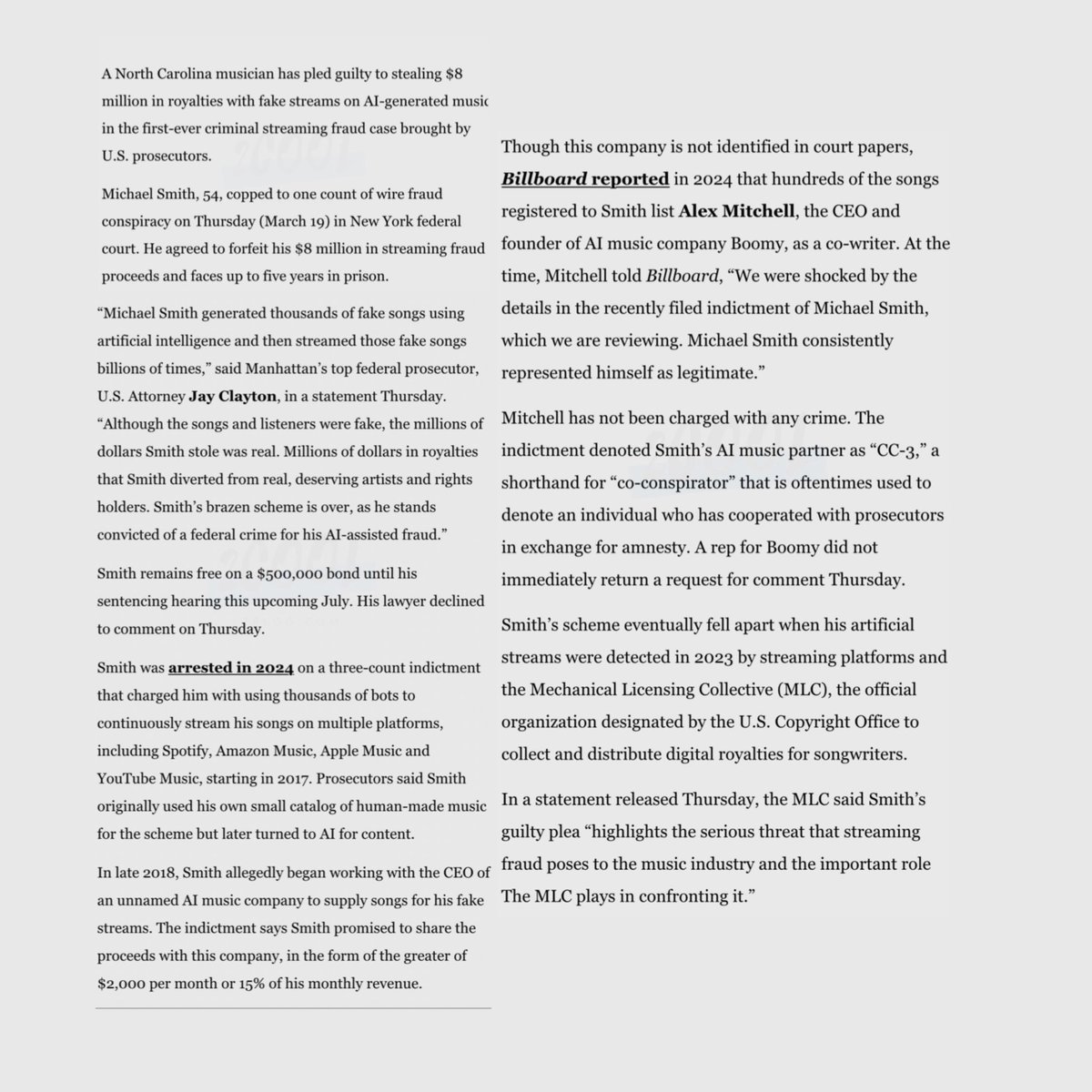
First Criminal Case of AI Streaming Fraud in 2026
By
–
-> First criminal case of streaming fraud by AI. And it's completely insane. A North Carolina man used AI to generate hundreds of thousands of songs. He put them on Spotify, Apple Music, Amazon. Then he botted billions of streams on his own tracks. -> 660,000 fake streams per day. Distributed across thousands of titles so nobody noticed anything. -> $1.2 million per year. For music that no human has ever listened to. -> Result: $8 million pocketed. Meanwhile, real artists struggle at $0.003 per stream, do promo on TikTok, beg for playlist placements. Him? AI made both the music AND the audience. He got caught. He has to repay the $8 million. But this problem goes beyond him: The music industry spent 10 years fighting piracy. Now it has to fight songs that don't exist, listened to by people who don't exist. And since this case, AI has only gotten better. The playbook is public. Tomorrow's fraud will be even harder to detect. AI doesn't just change creation. It also changes cheating. [Translated from EN to English]
→ View original post on X — @flashtweet, 2026-03-21 09:03 UTC