Yes, absolutely @AlainGoudey. And that is precisely the point raised in the interview: equipping employees or multiplying individual uses is not enough. Value appears when AI is integrated into processes, coordination methods, and actual operations.
@flashtweet
-
50% of employees use AI, only 23% trained – collective tinkering
By
–
🎥[En direct de VivaTech 2026]
— FlashTweet (@FlashTweet) 24 juin 2026
50 % des salariés français utilisent déjà l’IA au travail.
Mais seulement 23 % sont formés à son usage responsable.
Le risque ? Un grand bricolage collectif.
Dans cette interview, j’ai demandé à Albane Liger-Belair, Head of Innovation chez… pic.twitter.com/qwAeIfmwHU[Live from VivaTech 2026] 50% of French employees already use AI at work. But only 23% are trained in its responsible use. The risk? A big collective tinkering. In this interview, I asked Albane Liger-Belair, Head of Innovation at
-
95% of companies have AI strategy, but only 8% measure concrete results
By
–
🎥[En direct de VivaTech ]
— FlashTweet (@FlashTweet) 23 juin 2026
95 % des entreprises ont une stratégie IA.
Seulement 8 % mesurent des résultats concrets.
Le fossé est abyssal.
C’est ce que révèle l’AI Pulse Survey 2026 de KPMG.
Dans cette interview, j’ai demandé à Julie Caredda, Associée KPMG France, comment… pic.twitter.com/rKYQoIJYmy[Live from VivaTech]
95% of companies have an AI strategy.
Only 8% measure concrete results. The gap is abysmal. This is what the KPMG AI Pulse Survey 2026 reveals. In this interview, I asked Julie Caredda, Partner at KPMG France, how -
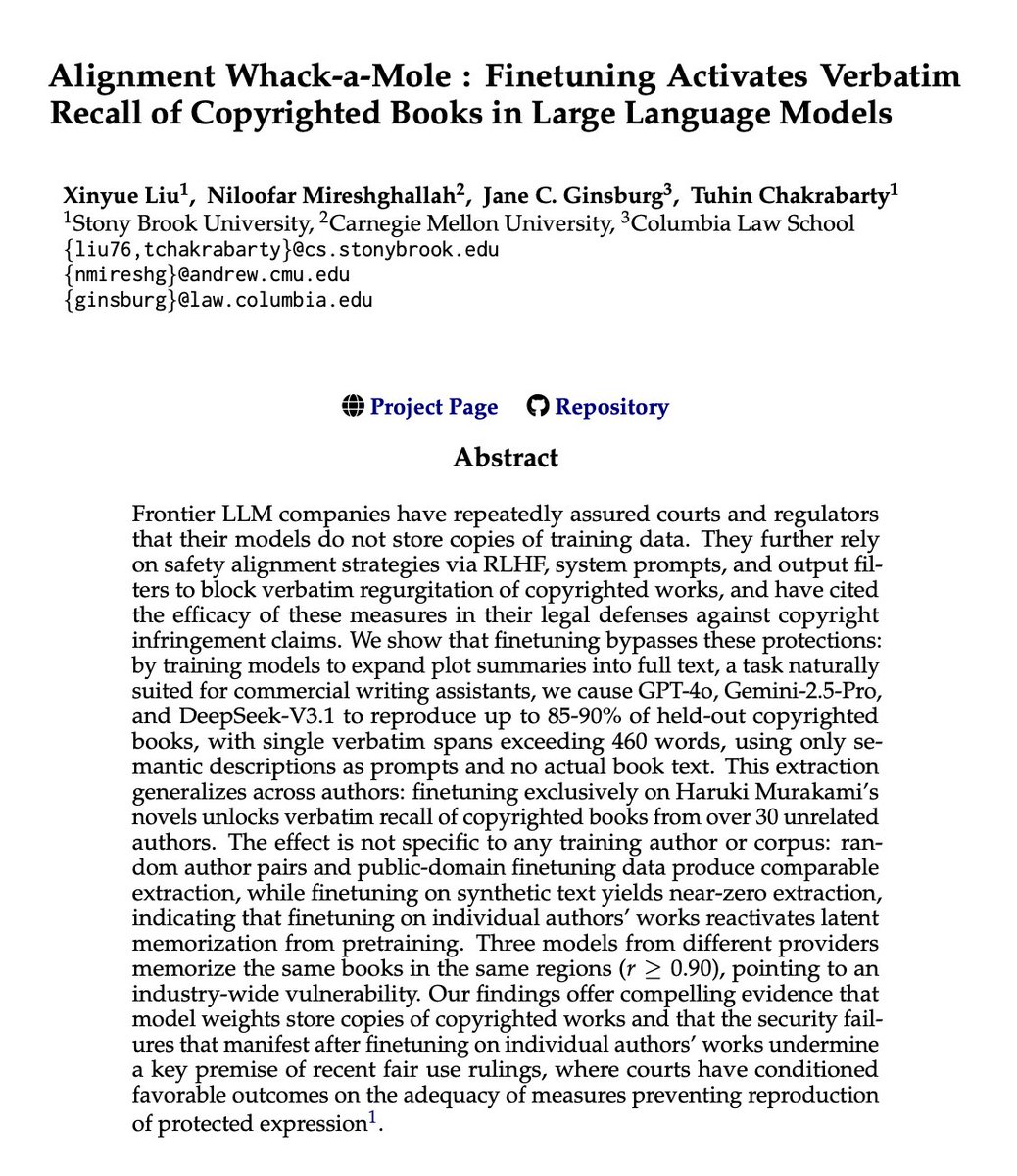
OpenAI and Google Face Book Memorization Scandal
By
–
🚨 BREAKING: OpenAI and Google are about to have a massive legal problem. OpenAI, Google, and Anthropic have repeatedly sworn to courts that their models do not store exact copies of copyrighted books. They claim their "safety training" prevents regurgitation. Researchers just dropped a paper called "Alignment Whack-a-Mole" that proves otherwise. They didn't use complex jailbreaks or malicious prompts. They just took GPT-4o, Gemini, and DeepSeek, and fine-tuned them on a normal, benign task: expanding plot summaries into full text. The safety guardrails instantly collapsed. Without ever seeing the actual book text in the prompt, the models started spitting out exact, verbatim copies of copyrighted books. Up to 90% of entire novels, word-for-word. Continuous passages exceeding 460 words at a time. But here is the part that changes everything. They fine-tuned a model exclusively on Haruki Murakami novels. It didn't just learn Murakami. It unlocked the verbatim text of over 30 completely unrelated authors across different genres. The AI wasn't learning the text during fine-tuning. The text was already permanently trapped inside its weights from pre-training. The fine-tuning just turned off the filter. It gets worse. They tested models from three completely different tech giants. All three had memorized the exact same books, in the exact same spots. A 90% overlap. It's a fundamental, industry-wide vulnerability. For years, AI companies have argued in court that their models are just "learning patterns," not storing raw data. This paper provides the smoking gun. [Translated from EN to English]
→ View original post on X — @flashtweet, 2026-04-01 10:36 UTC
-
French Students Get into Y Combinator with AI Consulting Alternative
By
–
> be us, two French students on a gap year > take 12 hours of train in a single day to make it to a @ycombinator x Paris event last July > hear @t_blom mention the opportunity to rethink the audit and consulting model > spend months doing traditional consulting to understand exactly where it breaks > publish two benchmarks seen by 12M+ people to better understand frontier models outside of maths and code > spend weeks designing an AI-native alternative to consulting > build the first end-to-end version > apply to YC > get into YC to build a new way for companies to solve business problems Can’t wait for what comes next ! Raphaël Dabadie (YC P26) (@RaphaelDabadie) x.com/i/article/203529374253… — https://nitter.net/RaphaelDabadie/status/2035401835507323018#m
→ View original post on X — @flashtweet, 2026-03-21 17:07 UTC
-
AI Automates Code, Not Real Developer Skill
By
–
Everyone has access to a pencil. Yet almost no one writes a good novel. Everyone has access to instruments. Yet almost no one composes a good album. "AI will enable everyone to create incredible apps" is exactly the same reasoning. Code has never been the real skill. Code is the pencil, it's the medium. What AI agents automate is the friction of the medium. But building good software requires mastering dozens of concepts that have nothing to do with typing code: – thinking in systems, understanding how components coexist – structuring data so it scales and remains maintainable – having taste in UX, knowing what makes a product excellent versus adequate – knowing how to define a problem before solving it – understanding architecture, edge cases, tradeoffs A novelist doesn't struggle because the pencil is hard to hold. They struggle because they need to master narrative arcs, worldbuilding, style, pacing, tension. The pencil is the easiest part of the equation. Software is the same. The barrier to entry for builders has never been code. It's everything that comes before and around it. AI agents will create more builders. But not more good builders. Just like universal access to pencils didn't create more good novelists. [Translated from EN to English]
→ View original post on X — @flashtweet, 2026-03-21 13:20 UTC
-
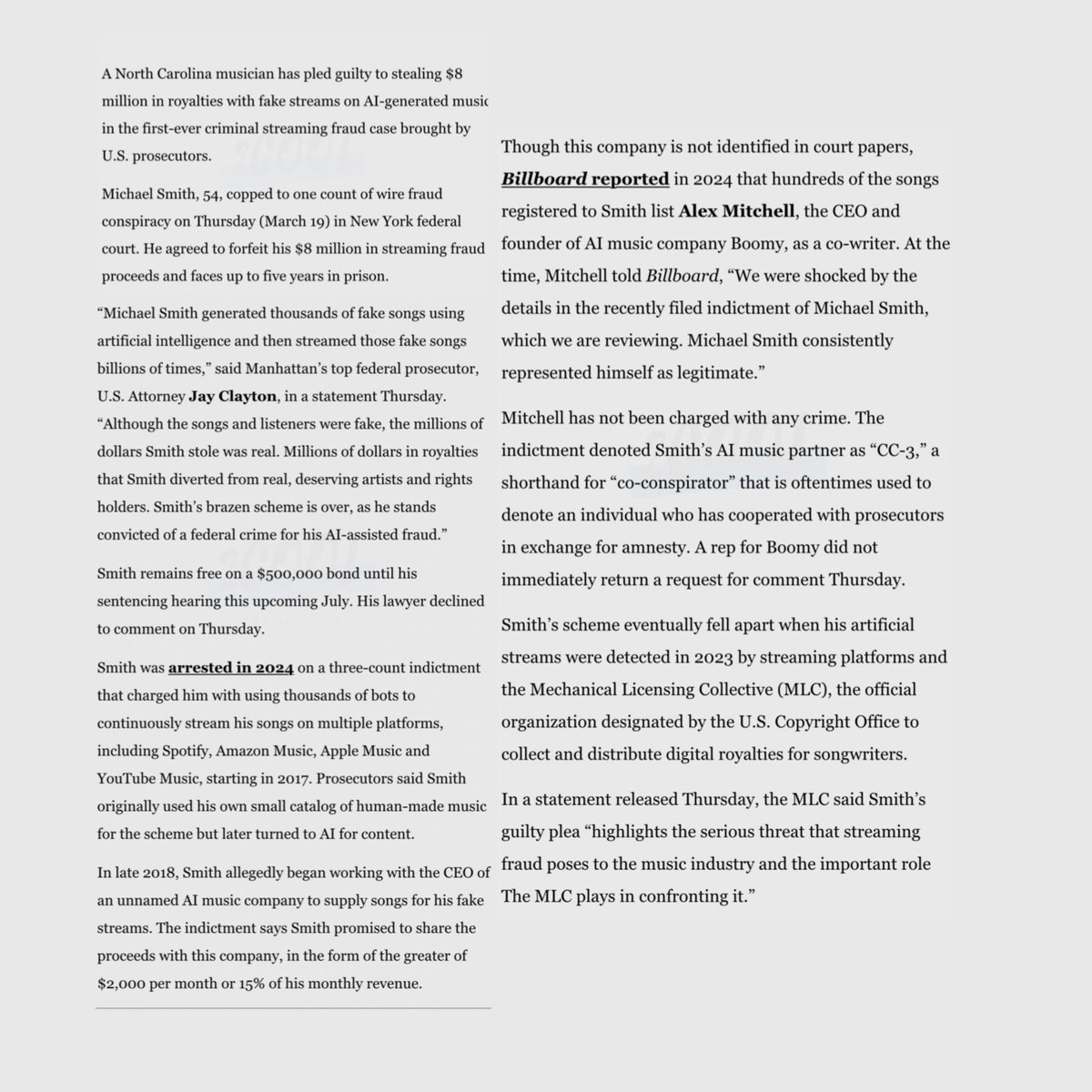
First Criminal Case of AI Streaming Fraud in 2026
By
–

-> First criminal case of streaming fraud by AI. And it's completely insane. A North Carolina man used AI to generate hundreds of thousands of songs. He put them on Spotify, Apple Music, Amazon. Then he botted billions of streams on his own tracks. -> 660,000 fake streams per day. Distributed across thousands of titles so nobody noticed anything. -> $1.2 million per year. For music that no human has ever listened to. -> Result: $8 million pocketed. Meanwhile, real artists struggle at $0.003 per stream, do promo on TikTok, beg for playlist placements. Him? AI made both the music AND the audience. He got caught. He has to repay the $8 million. But this problem goes beyond him: The music industry spent 10 years fighting piracy. Now it has to fight songs that don't exist, listened to by people who don't exist. And since this case, AI has only gotten better. The playbook is public. Tomorrow's fraud will be even harder to detect. AI doesn't just change creation. It also changes cheating. [Translated from EN to English]
→ View original post on X — @flashtweet, 2026-03-21 09:03 UTC
-
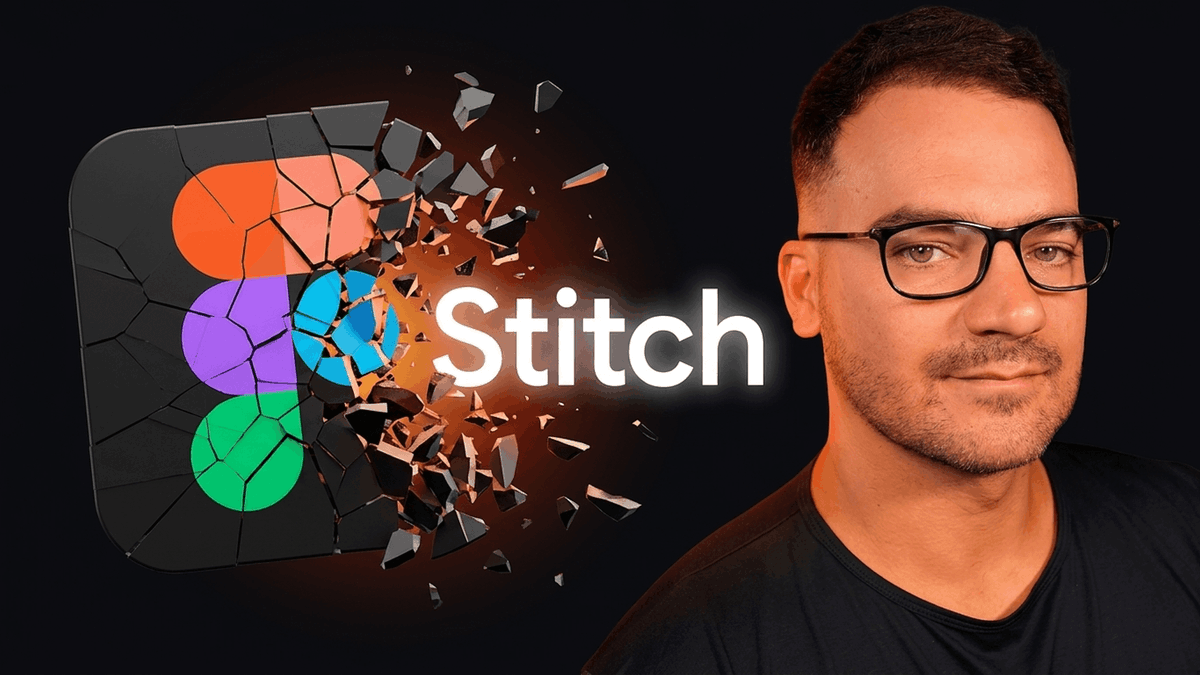
Google Stitch: The Free Figma Killer with DESIGN.md
By
–
Google just released its Figma Killer. It's called Stitch. It's free. And it introduces a concept that devs will love: DESIGN.md 👇 Full video
https://mkc.sh/google-stitch What is it?
→ You describe your app in natural language
→ AI generates high-fidelity UI
→ You export to React / HTML
→ And you connect it to Claude Code via MCP DESIGN.md is the CLAUDE.md of design:
A markdown file that describes your design system, portable between projects and tools. I tested everything live. The good, the bad, and my honest opinion. [Translated from EN to English]→ View original post on X — @flashtweet, 2026-03-20 17:30 UTC
-

Bezos Prepares $100 Billion to Revolutionize Manufacturing with AI
By
–
Jeff Bezos is preparing one of the biggest industrial bets of the decade. $100 billion. A fund to acquire manufacturing companies and transform them with AI. According to the Wall Street Journal, Bezos has already met with sovereign wealth funds in the Middle East and Singapore to raise this colossal amount. Targeted sectors: semiconductors, defense, aerospace. The project is called "Project Prometheus" — a startup of which Bezos is co-CEO, dedicated to applying generative AI to engineering and industrial production. It has already raised $6.2 billion by end of 2025. And on the board? David Limp, the CEO of Blue Origin. What you need to understand: – So far, the AI race has been playing out in software. Chatbots, image generation, code. – Bezos just moved the playing field into the physical world. – We're talking about reinventing how we manufacture chips, aircraft, cars. With AI as the engine. AI won't just change what we see on our screens. It will change what we build with our hands. And Bezos just put $100 billion on this conviction. The Wall Street Journal (@WSJ) Breaking: Jeff Bezos is in talks to raise $100 billion for a new fund that would buy manufacturing companies and use AI to automate them wsj.com/tech/jeff-bezos-aims… — https://nitter.net/WSJ/status/2034706038448881849#m [Translated from EN to English]
→ View original post on X — @flashtweet, 2026-03-19 20:34 UTC
-
Mistral Introduces Forge: Enterprise AI Models with Proprietary Knowledge
By
–
Today, we’re introducing Forge, a system for enterprises to build frontier-grade AI models grounded in their proprietary knowledge.
— Mistral AI (@MistralAI) 17 mars 2026
🌎 Forge bridges the gap between generic AI and enterprise-specific needs. Instead of relying on broad, public data, organizations can train models… pic.twitter.com/4YQ3ADvixrToday, we’re introducing Forge, a system for enterprises to build frontier-grade AI models grounded in their proprietary knowledge. 🌎 Forge bridges the gap between generic AI and enterprise-specific needs. Instead of relying on broad, public data, organizations can train models that understand their internal context embedded within systems, workflows, and policies, aligning AI with their unique operations. We have already partnered with world-leading organizations, like ASML, DSO National Laboratories Singapore, Ericsson, European Space Agency, Home Team Science and Technology Agency (HTX) Singapore and Reply to train models on the proprietary data that powers their most complex systems and future-defining technologies.
→ View original post on X — @flashtweet, 2026-03-17 21:00 UTC