SAM is a massive model that needs large GPUs to run. YOLO26 and RFDETR run on edge hardware.
@learnopencv
-
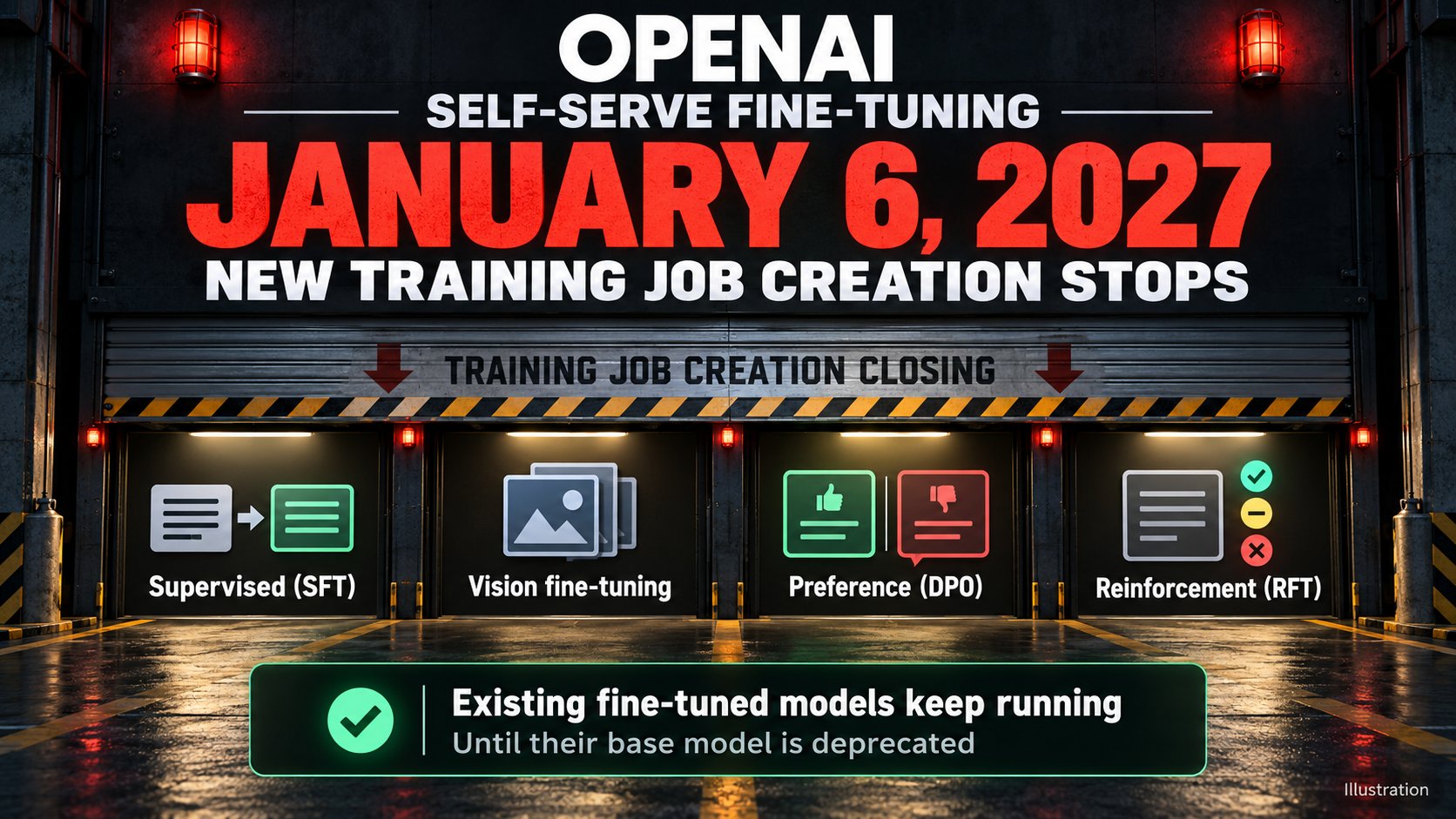
OpenAI self-serve fine-tuning API ending Jan 6, 2027
By
–
OpenAI' self-serve fine-tuning API is coming to an end on Jan 6, 2027.
-
Explaining NMS and NMS-free object detectors
By
–
Detection, Decoded
— Satya Mallick (@LearnOpenCV) 7 octobre 2026
1/ Your object detector draws 5 boxes around 1 person. A cleanup step called NMS deletes 4 of them before you ever see it. NMS-free detectors skip that step entirely. Here's why 🧵
2/ NMS keeps the most confident box and deletes anything that overlaps it "too… pic.twitter.com/OsezxeHqkODetection, Decoded 1/ Your object detector draws 5 boxes around 1 person. A cleanup step called NMS deletes 4 of them before you ever see it. NMS-free detectors skip that step entirely. Here's why 🧵 2/ NMS keeps the most confident box and deletes anything that overlaps it "too
-
AI Agent Failures: Better Model or Better Harness?
By
–
Your AI Agent Failed. Do You Need a Better Model, or a Better Harness?
— Satya Mallick (@LearnOpenCV) 6 octobre 2026
When an agent fails, the first instinct is to upgrade the model. Often the real problem is the harness: vague tools, no write limits, "failed" errors with no detail, no record of completed work, no trace. Fix… pic.twitter.com/w65hNxef8BYour AI Agent Failed. Do You Need a Better Model, or a Better Harness? When an agent fails, the first instinct is to upgrade the model. Often the real problem is the harness: vague tools, no write limits, "failed" errors with no detail, no record of completed work, no trace. Fix
-
YOLO26 vs RF-DETR: Choosing a Detection Model
By
–
YOLO26 or RF-DETR?
— Satya Mallick (@LearnOpenCV) 5 octobre 2026
YOLO26: shortlist for edge constraints and broad task support.
RF-DETR: include in custom detection/segmentation tests.
Compare errors, latency and memory on your hardware.
Benchmarks build the shortlist. Your data decides.#ComputerVision pic.twitter.com/5PXIenWmdrYOLO26 or RF-DETR?
YOLO26: shortlist for edge constraints and broad task support.
RF-DETR: include in custom detection/segmentation tests.
Compare errors, latency and memory on your hardware.
Benchmarks build the shortlist. Your data decides.
#ComputerVision -
OpenAI agent interface manages load by declining calls
By
–
OpenAI has come up with a pretty ingenious user interface for managing load. You call your agent and it may decide to not even pick up the call when it's busy
-
Waymo Sensor Fusion Part 1: LiDAR, Radar, Cameras
By
–
(How Waymo Sees — Part 1)
— Satya Mallick (@LearnOpenCV) 23 juin 2026
LiDAR tells a Waymo where everything is. Radar tells it how fast everything's moving. Cameras add color and texture. No single sensor is enough — autonomy lives in the fusion.
Full deep-dive 👇https://t.co/axILFYfFQW pic.twitter.com/bpPFiO7TD5(How Waymo Sees — Part 1)
LiDAR tells a Waymo where everything is. Radar tells it how fast everything's moving. Cameras add color and texture. No single sensor is enough — autonomy lives in the fusion.
Full deep-dive https://
learnopencv.com/3d-lidar-visua
lization/
… -
NVIDIA LocateAnything predicts entire box as atomic unit
By
–
Most VLMs predict bounding boxes one token at a time — X1, Y1, X2, Y2.
— Satya Mallick (@LearnOpenCV) 5 juin 2026
But a box isn't text. It's geometry.
NVIDIA's LocateAnything predicts the entire box as one atomic unit. Parallel Box Decoding > next-token prediction for spatial outputs.
(Part 1 🧵) Breakdown 👇… pic.twitter.com/mQ83uMqtdvMost VLMs predict bounding boxes one token at a time — X1, Y1, X2, Y2.
But a box isn't text. It's geometry.
NVIDIA's LocateAnything predicts the entire box as one atomic unit. Parallel Box Decoding > next-token prediction for spatial outputs.
(Part 1 ) Breakdown -
YOLOE-26: Instance Segmentation via Text Prompts Without Training
By
–
Instead of training a new model, what if you could just tell your AI what to look for?
— Satya Mallick (@LearnOpenCV) 4 juin 2026
That's YOLOE-26 with text prompts. Hand it a list — Person, Helmet, Safety vest — get instance segmentation masks, not just boxes.
Full tutorial: https://t.co/AZyMQYN0Tw pic.twitter.com/hty15tPBH6Instead of training a new model, what if you could just tell your AI what to look for?
That's YOLOE-26 with text prompts. Hand it a list — Person, Helmet, Safety vest — get instance segmentation masks, not just boxes.
Full tutorial: https://
vist.ly/56iqy -
AI identifies cat; bounding box pixel decoding is slow
By
–
An AI can tell you there's a cat in the image. Pointing to the exact pixels is the hard part.
— Satya Mallick (@LearnOpenCV) 2 juin 2026
The reason it's slow: most VLMs spell out a bounding box one coordinate token at a time — some even split "1024" into single digits. But a box's corners are connected. Decode them… pic.twitter.com/eoJu0PiHGUAn AI can tell you there's a cat in the image. Pointing to the exact pixels is the hard part.
The reason it's slow: most VLMs spell out a bounding box one coordinate token at a time — some even split "1024" into single digits. But a box's corners are connected. Decode them