AI Dynamics

Global AI News Aggregator

About

MACHINE LEARNING

  • MAGNet: Diffusion Forcing for Multi-Agent Social Motion Prediction

    Diffusion forcing is great for sequence modeling! We've been working on social behavior prediction but nothing's worked this well. Representation matters: We encode motion with discrete latents & model relative relationships in a neat way. It handles multiple tasks & people! Vongani Maluleke (@vonekels) When people share a space, their movements become intertwined. Embodied agents need to understand these social dynamics to interact effectively. Introducing MAGNet 🧲, a unified autoregressive diffusion forcing model for multi-agent motion generation that captures these interactions. MAGNet is flexible: predict the future, fill in missing motion, or have people react to each other, all while naturally scaling to N>2 people and generating ultra-long motion sequences. — https://nitter.net/vonekels/status/2037350776776061160#m

    → View original post on X — @berkeley_ai, 2026-03-31 15:00 UTC
  • Heaviside Foundation Model for Electromagnetism Announced

    Today, we're announcing Heaviside, our foundation model for electromagnetism. Trained on tens of millions of designs and over 20 years of proprietary simulation data, Heaviside predicts electromagnetic behavior from geometry in 13ms, which is 800,000x faster than a commercial solver. Heaviside is not a language model, and it’s not a surrogate model. Heaviside marks a new class of foundation model for physics which understands the fundamental relationships between materials, the geometries and the electromagnetic fields they generate. We’re releasing a research preview of Heaviside in Atlas RF Studio, an interactive agentic sandbox where you describe the EM behavior you want and the model generates the physical structure that produces it. @arenaphysica , we believe the implications of this class of model extend well beyond RF, as the frontier of exquisite hardware is electromagnetically-governed: wireless communication, radar, power delivery, high-speed computing, and the interconnects inside every chip on earth. In the months ahead, we’re excited to scale up Heaviside to broader frequency ranges, design spaces, and to support silicon-level designs, and deploy it with our closest partners and collaborators in service of their biggest design challenges. If you’ve read our thesis, this is just Step 2 in our pursuit of electromagnetic superintelligence. Read the full announcement and try Atlas RF Studio…tell us what you think: arenaphysica.com/publication…

    → View original post on X — @whiteafrican, 2026-03-31 14:53 UTC

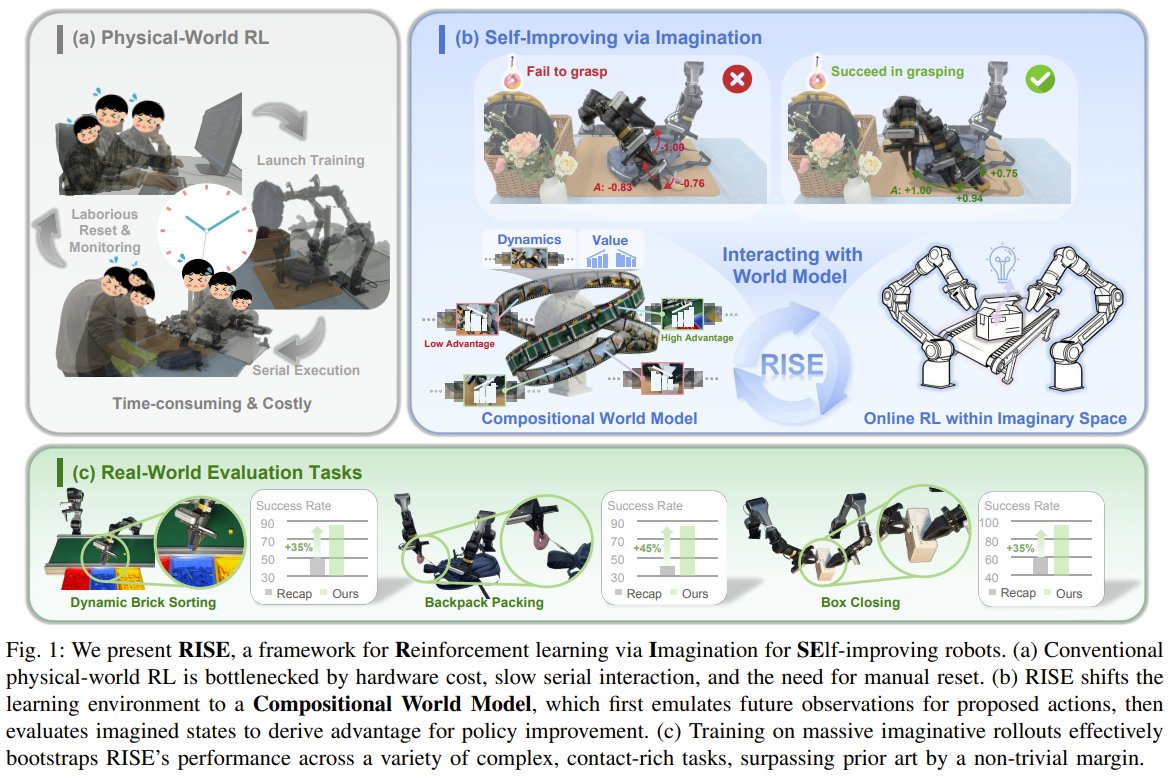
  • RISE Framework Enables Robots Self-Improvement Through Imagination
    RISE Framework Enables Robots Self-Improvement Through Imagination

    What if robots could learn complex, real-world tasks significantly faster and safer, all by just imagining? Jiazhi Yang and a team from The Chinese University of Hong Kong, Kinetix AI, and Tsinghua University just unveiled RISE. This framework lets robots self-improve by

    → View original post on X — @jiqizhixin

  • Ultralytics YOLO Models Export Integration for Metis AIPUs
    Ultralytics YOLO Models Export Integration for Metis AIPUs

    From trained model to edge deployment in days, not months. Ultralytics has introduced an updated export integration for Metis AIPUs. Export your YOLO models, compile for Metis hardware, and run inference without PyTorch at the edge. >> Join us on April 8 for an Ultralytics Live session where we'll walk through the integration in action. Stay tuned for details! >> Check out the blog here: eu1.hubs.ly/H0t6rj40 #AxeleraAI #Ultralytics #YOLO #EdgeAI #ComputerVision

    → View original post on X — @axeleraai, 2026-03-31 14:44 UTC

  • MultiGen: Neural Network-Generated Real-Time Multiplayer Game Live

    We built a real-time multiplayer game generated entirely by a neural network—and now you can actually play it. In collaboration with @modal, we just launched the live demo for MultiGen, our diffusion-based multiplayer game engine. Grab some friends and try it here 👇

    → View original post on X — @sallyeaves, 2026-03-31 14:29 UTC

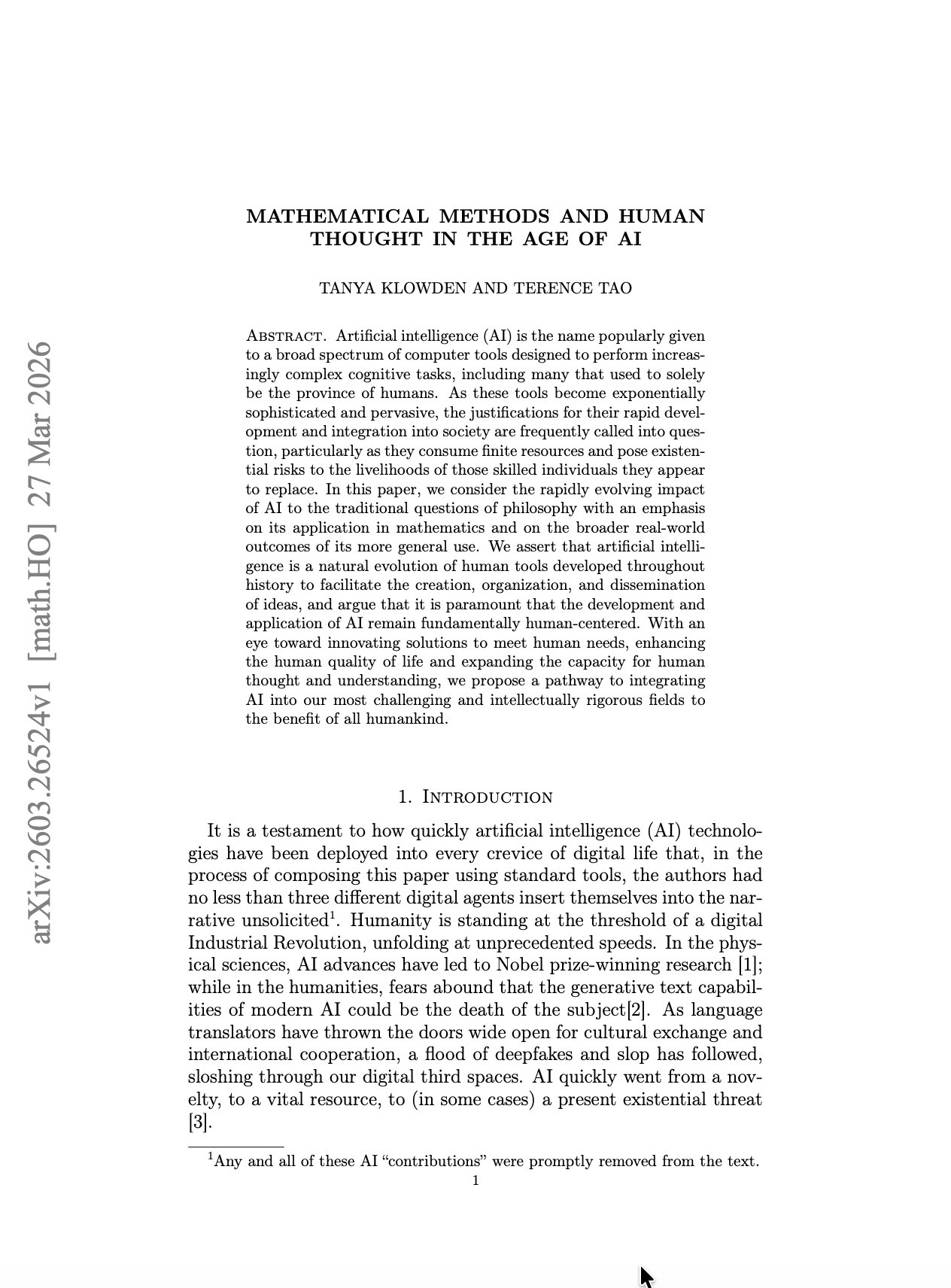
  • Mathematical Methods and Human Thought in Age of AI
    Mathematical Methods and Human Thought in Age of AI

    Mathematical methods and human thought in the age of AI Tanya Klowden, Terence Tao: https://
    arxiv.org/abs/2603.26524 #ArtificialIntelligence

    → View original post on X — @montreal_ai

  • Mathematical Methods and Human Thought in AI Age
    Mathematical Methods and Human Thought in AI Age

    Mathematical methods and human thought in the age of AI Tanya Klowden, Terence Tao: https://
    arxiv.org/abs/2603.26524 #ArtificialIntelligence

    → View original post on X — @ceobillionaire

  • Modern Time Series Analysis with R for Practical Forecasting
    Modern Time Series Analysis with R for Practical Forecasting

    Modern Time Series Analysis with R: Practical Forecasting and Impact Estimation with Tidy, Reproducible Workflows! #BigData #Analytics #DataScience #AI #MachineLearning #IoT #IIoT #PyTorch #Python #RStats #TensorFlow #Java #JavaScript #ReactJS #GoLang #CloudComputing #Serverless

    → View original post on X — @gp_pulipaka

  • Convergence Toward Continual Learning and Self-Evolving Systems

    things are converging towards continual learning and self-evolving systems.

    → View original post on X — @akshay_pachaar

  • Molmo Point: AI Visual Grounding with Precise Spatial Pointing

    Molmo Point: Teaching AI to Ground Language in Precise Visual Locations In this episode of Artificial Intelligence: Papers and Concepts, we explore Molmo Point, an extension of multimodal AI that focuses on precise visual grounding enabling models to not just describe images, but accurately point to specific regions within them. Instead of treating images as whole scenes, Molmo Point trains models to connect language with exact spatial locations, bringing AI closer to how humans reference and interpret visual information. We break down why visual grounding has been a persistent challenge in vision–language models, how pointing mechanisms improve interaction and understanding, and what this means for applications like robotics, UI automation, and real-world task execution. If you’re interested in multimodal AI, spatial reasoning, or the future of AI systems that can both see and act, this episode explains why Molmo Point represents an important step toward more precise and actionable visual intelligence. Resources: Paper Link: allenai.org/papers/molmopoin… Interested in Computer Vision and AI consulting and product development services? Email us at contact@bigvision.ai or visit us at bigvision.ai

    → View original post on X — @learnopencv, 2026-03-31 13:30 UTC