The team's approach: Introducing Self-Distilled Sparse Drafters (SD²), a novel methodology that leverages self-data distillation and fine-grained weight sparsity to produce highly efficient and well-aligned draft models.
MACHINE LEARNING
-
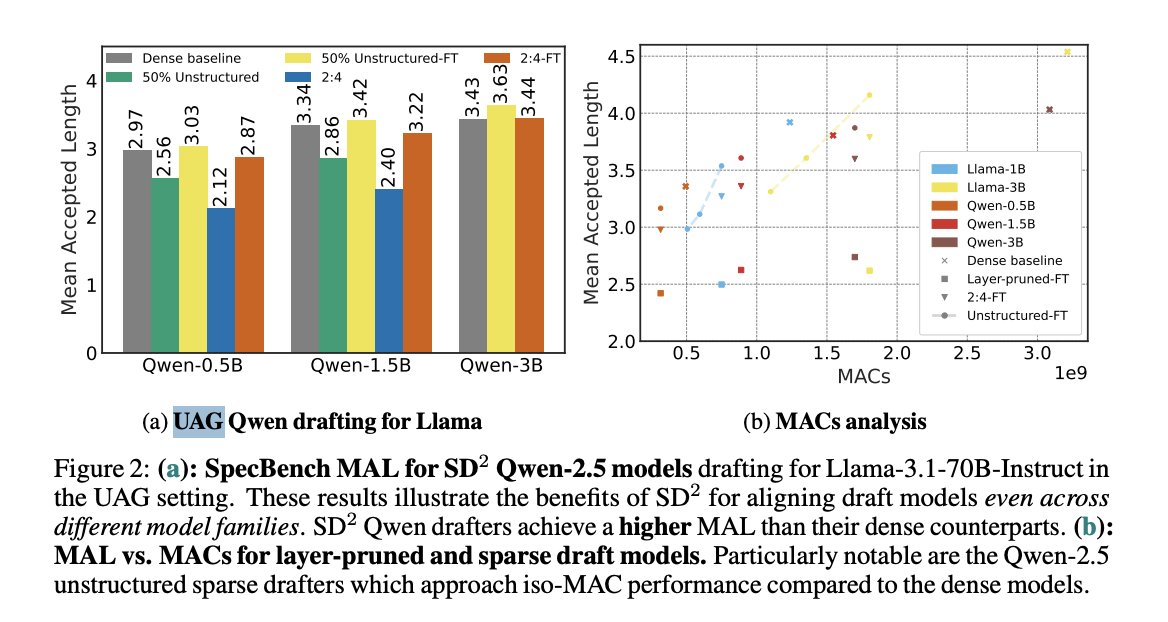
SD² Enhances Draft Token Acceptance Reducing MACs
By
–
SD² systematically enhances draft token acceptance rates while significantly reducing Multiply-Accumulate operations (MACs), even in the Universal Assisted Generation (UAG) setting, where draft and target models originate from different model families.
-
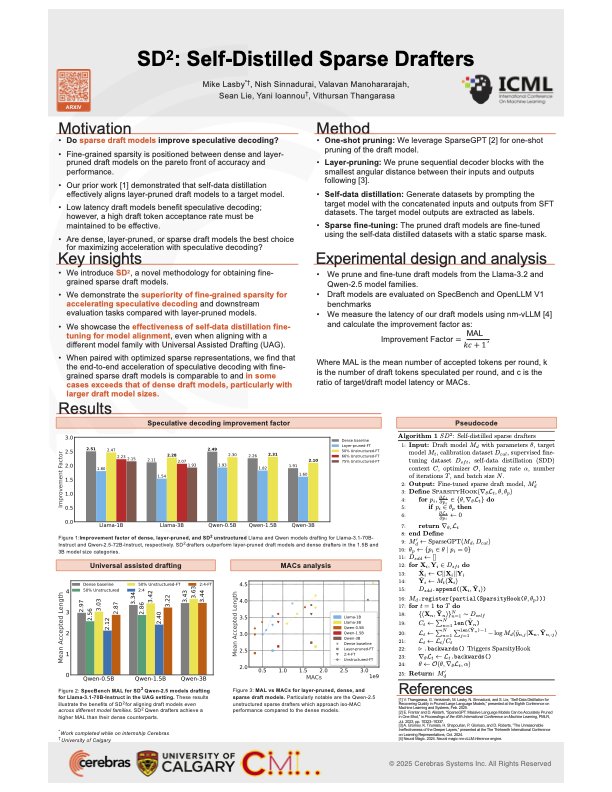
SD² Self-Distilled Sparse Drafters Speeds Up LLM Inference
By
–
Featured Paper at @icmlconf – The Internationall Conference on Machine Learning: SD² – Self-Distilled Sparse Drafters Speculative decoding is a powerful technique for reducing the latency of Large Language Models (LLMs), offering a fault-tolerant framework that enables the
-
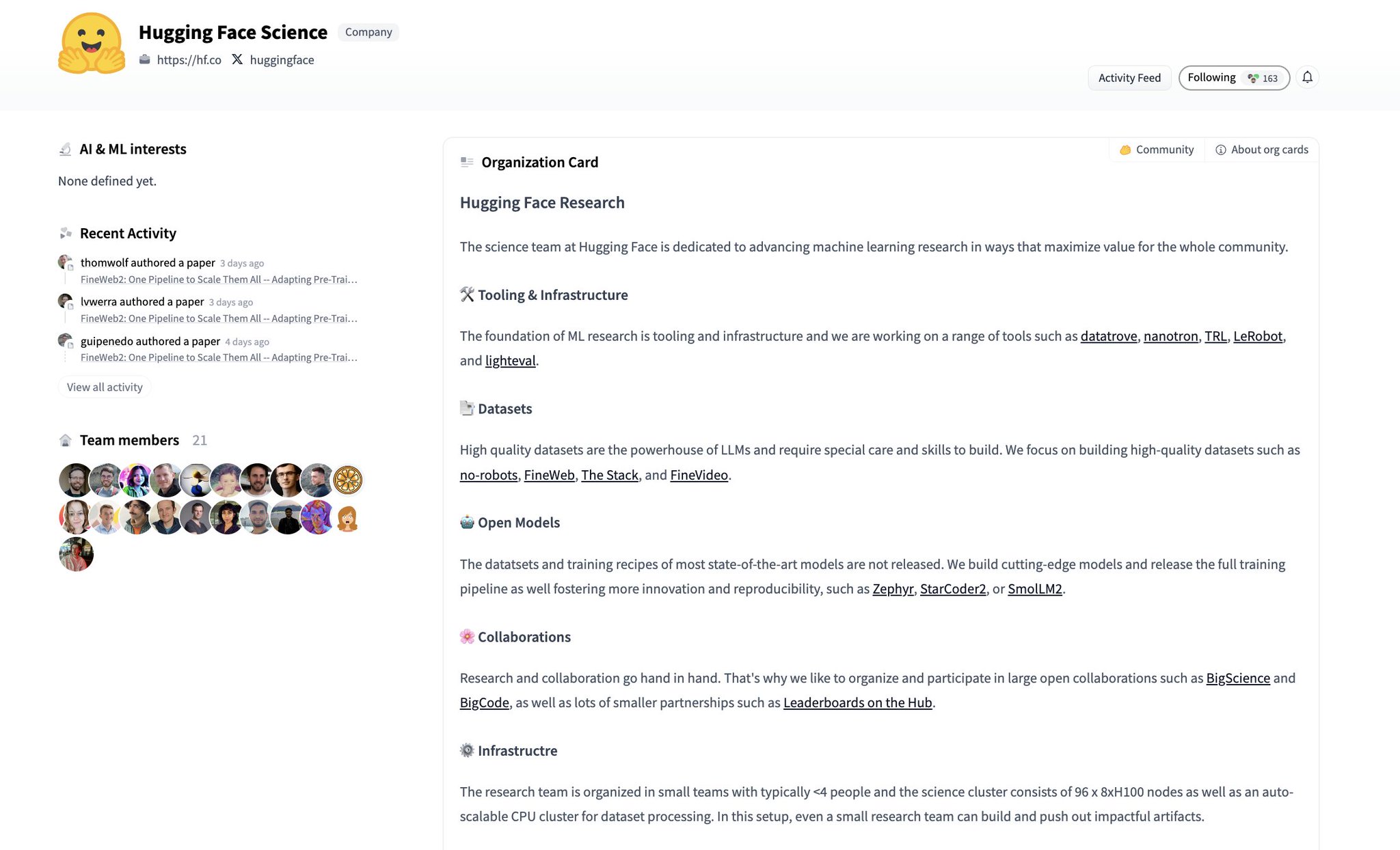
Hugging Face Science Team Showcases Year of AI Contributions
By
–
The @huggingface Science team now has an org on the hub and it's really cool to look back at all their contributions of the past 12 months! Fineweb, LeRobot, TheStack, StarCoder2, SmolLM2, Big Science, LLMleaderboard, TRL, Nanotron, or some of the courses that have been followed
-
AI Predictions for 2025 Industry Experts
By
–
AI Predictions for 2025
#AI #AIio #AIInnovation #ML #DataScience #Futureofwork @Scobleizer @AndrewYNg @drfeifei @KirkDBorne @fchollet @rowancheung @antgrasso -

SmolVLA: Accessible Vision-Language AI for Consumer Robot Projects
By
–
SmolVLA: Affordable & Efficient VLA Robotics on Consumer GPUs Want to build a robot that sees, understands, and acts, without needing a PhD or a fat wallet?
Meet SmolVLA: the most accessible way to bring vision-language intelligence to your robotics projects. See how it -
AI Self-Improvement Will Be Gradual, Not Exponential Takeoff
By
–
We don’t have AI self-improves yet, and when we do it will be a game-changer. With more wisdom now compared to the GPT-4 days, it's obvious that it will not be a “fast takeoff”, but rather extremely gradual across many years, probably a decade. The first thing to know is that self-improvement, i.e., models training themselves, is not binary. Consider the scenario of GPT-5 training GPT-6, which would be incredible. Would GPT-5 suddenly go from not being able to train GPT-6 at all to training it extremely proficiently? Definitely not. The first GPT-6 training runs would probably be extremely inefficient in time and compute compared to human researchers. And only after many trials, would GPT-5 actually be able to train GPT-6 better than humans. Second, even if a model could train itself, it would not suddenly get better at all domains. There is a gradient of difficulty in how hard it is to improve oneself in various domains. For example, maybe self-improvement only works at first on domains that we already know how to easily fix in post-training, like basic hallucinations or style. Next would be math and coding, which takes more work but has established methods for improving models. And then at the extreme, you can imagine that there are some tasks that are very hard for self-improvement. For example, the ability to speak Tlingit, a native american language spoken by ~500 people. It will be very hard for the model to self-improve on speaking Tlingit as we don’t have ways of solving low resource languages like this yet except collecting more data which would take time. So because of the gradient of difficulty-of-self-improvement, it will not all happen at once. Finally, maybe this is controversial but ultimately progress in science is bottlenecked by real-world experiments. Some may believe that reading all biology papers would tell us the cure for cancer, or that reading all ML papers and mastering all of math would allow you to train GPT-10 perfectly. If this were the case, then the people who read the most papers and studied the most theory would be the best AI researchers. But what really happened is that AI (and many other fields) became dominated by ruthlessly empirical researchers, which reflects how much progress is based on real-world experiments rather than raw intelligence. So my point is, although a super smart agent might design 2x or even 5x better experiments than our best human researchers, at the end of the day they still have to wait for experiments to run, which would be an acceleration but not a fast takeoff. In summary there are many bottlenecks for progress, not just raw intelligence or a self-improvement system. AI will solve many domains but each domain has its own rate of progress. And even the highest intelligence will still require experiments in the real world. So it will be an acceleration and not a fast takeoff, thank you for reading my rant
→ View original post on X — @_jasonwei, 2025-06-30 19:06 UTC
-
AI in 2025: Revolutionizing Industries and Redefining Opportunities
By
–
AI in 2025: Revolutionizing Industries & Redefining Opportunities
#AI #AIio #AIInnovation #ML #DataScience #Futureofwork @lexfridman @sama @kaifulee @ID_AA_Carmack @karpathy @2morrowknight @ylecun -

AI Committee Outperforms Doctors in Patient Diagnosis
By
–
It is remarkable that a committee of deliberating AI models can diagnose patients, propose the next tests, use the results of the tests to improve the diagnosis, order more tests, and eventually arrive at diagnoses, outperforming doctors. It is a specific setting, but nonetheless
-
Microsoft AI System Diagnoses Patients 4x Better Than Doctors
By
–
Microsoft Says Its New #AI System Diagnosed Patients 4 Times More Accurately Than Human Doctors #RiseoftheRobots