Why not? If deepseek, mistral,… can do it, why not Korean orgs?
LLMS
-

LLM Optimization Through Compute-Controlled Model Family Design
By
–
New post: nanochat miniseries v1 The correct way to think about LLMs is that you are not optimizing for a single specific model but for a family models controlled by a single dial (the compute you wish to spend) to achieve monotonically better results. This allows you to do
-

ScaledML Returns After 6 Years with ML Industry Foresight
By
–
ScaledML is back! After a 6 year hiatus. Consistently 2-3 years ahead of where ML will be. Examples of foresight at SML:
– OpenAI in 2016,2017,2019 announced GPT-2 & RL efforts
– Turing award for Deep Learning announced by Turing award winner on morning of award
– Groq chip -

Tailwind Rejects llms.txt PR for Being Too Useful
By
–
How useful is llms.txt? It's so useful that Tailwind rejected a PR to add an llms.txt, on the basis that it would be so useful that people wouldn't need to read their docs any more! https://
github.com/tailwindlabs/t
ailwindcss.com/pull/2388
… -

Evaluating LLM Legal Reasoning with LEXam Benchmark
By
–
How good are LLMs at legal reasoning? This Friday, join us for our AI for Law session led by @joelniklaus on LEXam — a new benchmark using real law school exams to evaluate long-form, structured legal reasoning. Link to register below
-
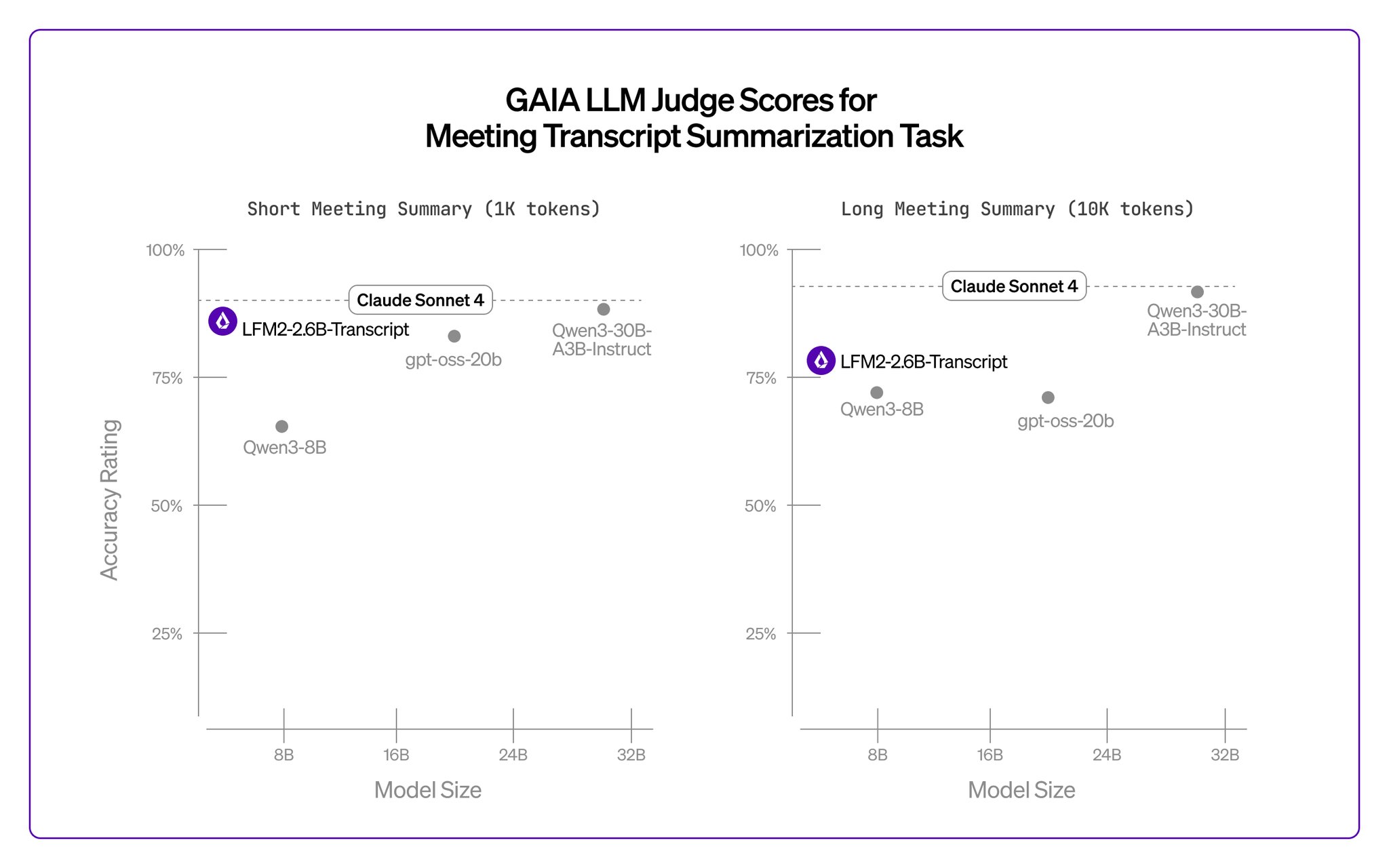
AMD Evaluates 2.6B Language Model Performance with GAIA Framework
By
–
Nice bit: the 2.6B works well, even with long meetings with 10k tokens It was a pleasure working with the AMD team, who evaluated all the models with their GAIA framework
-
LFM2-2.6B: On-Device Meeting Summarization with Cloud Quality
By
–
LFM2-2.6B-Transcript @AMD🤝@liquidai
— Maxime Labonne @ ICLR (@maximelabonne) 7 janvier 2026
> Private, on-device meeting summarization
> Cloud-level quality
> Faster processing, lower memory footprint
> Runs across CPU, GPU, and NPU on AMD Ryzen AI PC
Great showcase of what tiny models can achieve when fine-tuned pic.twitter.com/5kQXfE9j1fLFM2-2.6B-Transcript @AMD
@liquidai > Private, on-device meeting summarization
> Cloud-level quality
> Faster processing, lower memory footprint
> Runs across CPU, GPU, and NPU on AMD Ryzen AI PC Great showcase of what tiny models can achieve when fine-tuned -
ReAct Agents and High-Variance Execution in Long-Horizon Tasks
By
–
4/6 ReAct-style agents encode the entire plan in text, and only get evaluated at the very end. In long-horizon tasks, that turns execution into a high-variance gamble.
-
Maestro: Optimizing Compute Through Agentic Framework Structure
By
–
2/6 SWE-bench is not the story. Maestro is not a dedicated SWE agent, it’s an agentic framework that optimizes based on structure and learned priors. ex: knowing that 4 runs of GPT-5 mini are cheaper and better than one GPT-5 run, leads to better use of the same compute –
-

Test-Time Compute: Optimizing Where and When to Spend Resources
By
–
3/6 Once you treat execution as a test-time compute problem, the question changes. It’s no longer “which model should I use?” It’s “where should I spend compute, and when should I stop?”. That’s why multiple cheaper runs can win:
you’re buying optional paths, not just more