AI Dynamics

Global AI News Aggregator

About

ETHICS

  • AI-Generated Medical Papers: Progress Without Revolutionary Claims
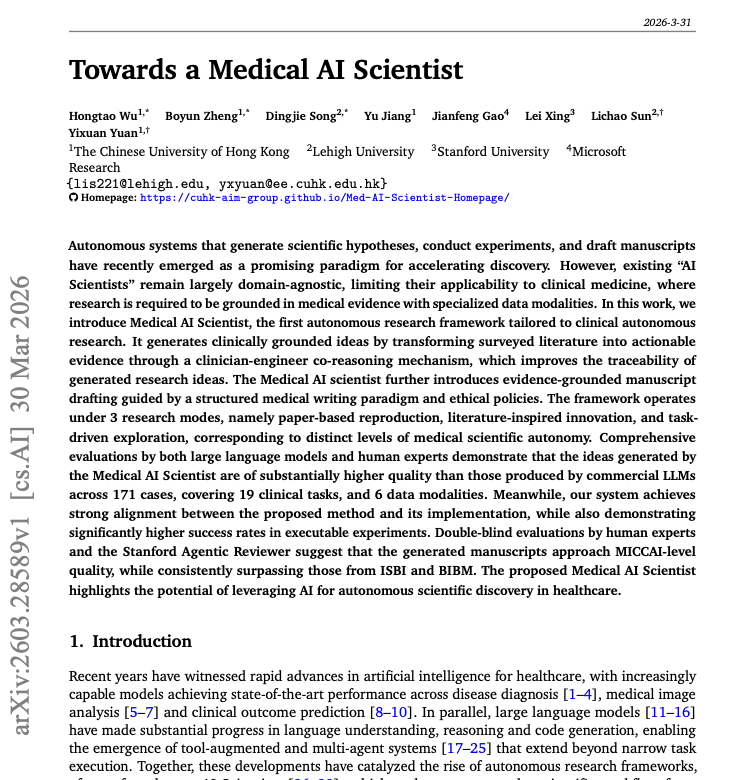
    AI-Generated Medical Papers: Progress Without Revolutionary Claims

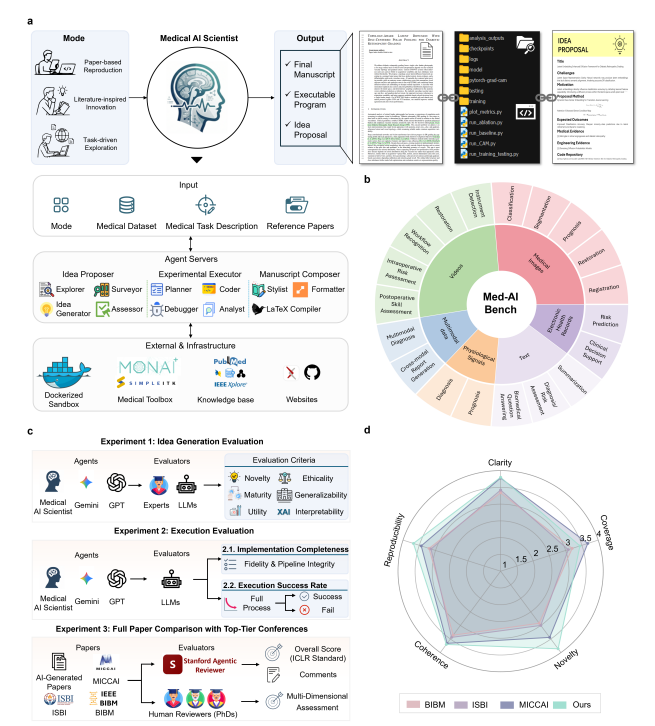
    This is a solid, innovative step toward AI-augmented scientific workflows in medicine. It seems better at structured medical tasks than generic LLMs, with manuscripts that can fool experts in blind tests (and also fool conferences – although that seems relatively easy these days). It demonstrates progress in autonomous agents for research pipelines. However, it's not yet a revolutionary "AI scientist" replacing human researchers or immediately flooding journals with validated breakthroughs. Real impact will depend on extensive external validation and whether it’s a black box or provides mechanistic interpretation. Can we stop it with the dramatic pronouncements describing legitimate papers which are clearly AI-written? Ihtesham Ali (@ihtesham2005) 🚨BREAKING: Stanford and Microsoft just built an AI scientist that writes medical research papers that actually pass peer review. Not summaries. Not drafts. Full papers reviewed and accepted by real scientists. This is not a demo and this is not a prototype. A peer-reviewed conference just accepted a paper that no human wrote, and most people have absolutely no idea it happened. The system is called Medical AI Scientist and it works in three stages that run completely on their own. First, it reads medical literature, identifies real clinical gaps, and generates a research hypothesis grounded in actual disease evidence, not a hallucination and not a generic idea pulled from thin air. Then it writes the code, runs the experiment inside a secure environment, catches its own errors, and fixes them without any human stepping in. Then it writes the full paper, including the introduction, methods, results, figures, ethics statement, citations, and LaTeX formatting, from start to finish, autonomously. They tested it against GPT-5 and Gemini 2.5 Pro across 171 real medical research cases covering 19 clinical tasks, and the results were not close. Medical AI Scientist successfully completed experiments 91 to 93 percent of the time. GPT-5 managed 60 to 75 percent. Gemini 2.5 Pro collapsed somewhere between 40 and 53 percent. Then they ran the part that genuinely broke my brain. Ten independent medical experts with over five years of first-author publishing experience reviewed the AI-generated papers side by side with real human papers from MICCAI, ISBI, and BIBM, the top conferences in medical imaging, and nobody knew which was which. The AI papers scored competitively on novelty, clarity, coherence, and reproducibility across the board, and one paper was accepted at a peer-reviewed conference after a full review process. Here is what nobody is saying out loud. Medical research has a brutal bottleneck where ideas pile up, experiments take months, papers take even longer, and patients wait the entire time. That problem just got a serious solution, and the implications for healthcare are enormous. — https://nitter.net/ihtesham2005/status/2039009949276319824#m

    → View original post on X — @sallyeaves, 2026-04-01 06:55 UTC

  • AI automates busywork while creating new bureaucracy instead
    AI automates busywork while creating new bureaucracy instead

    Too late for epic quests. Too early for the AI utopia. Right on time for “Let’s add AI to the process” meetings and soul-draining busywork. AI can delete busywork, but we keep using it to mass-produce it, now with better grammar. Perfect timing to automate the nonsense. Where has AI actually removed work for you, and where has it just upgraded the bureaucracy? #AI #FutureOfWork #Workplace #Automation #Technology #Leadership Credit: Ralph

    → View original post on X — @pascal_bornet, 2026-04-01 06:00 UTC

  • MIT demonstrates that ChatGPT causes irreparable delusions
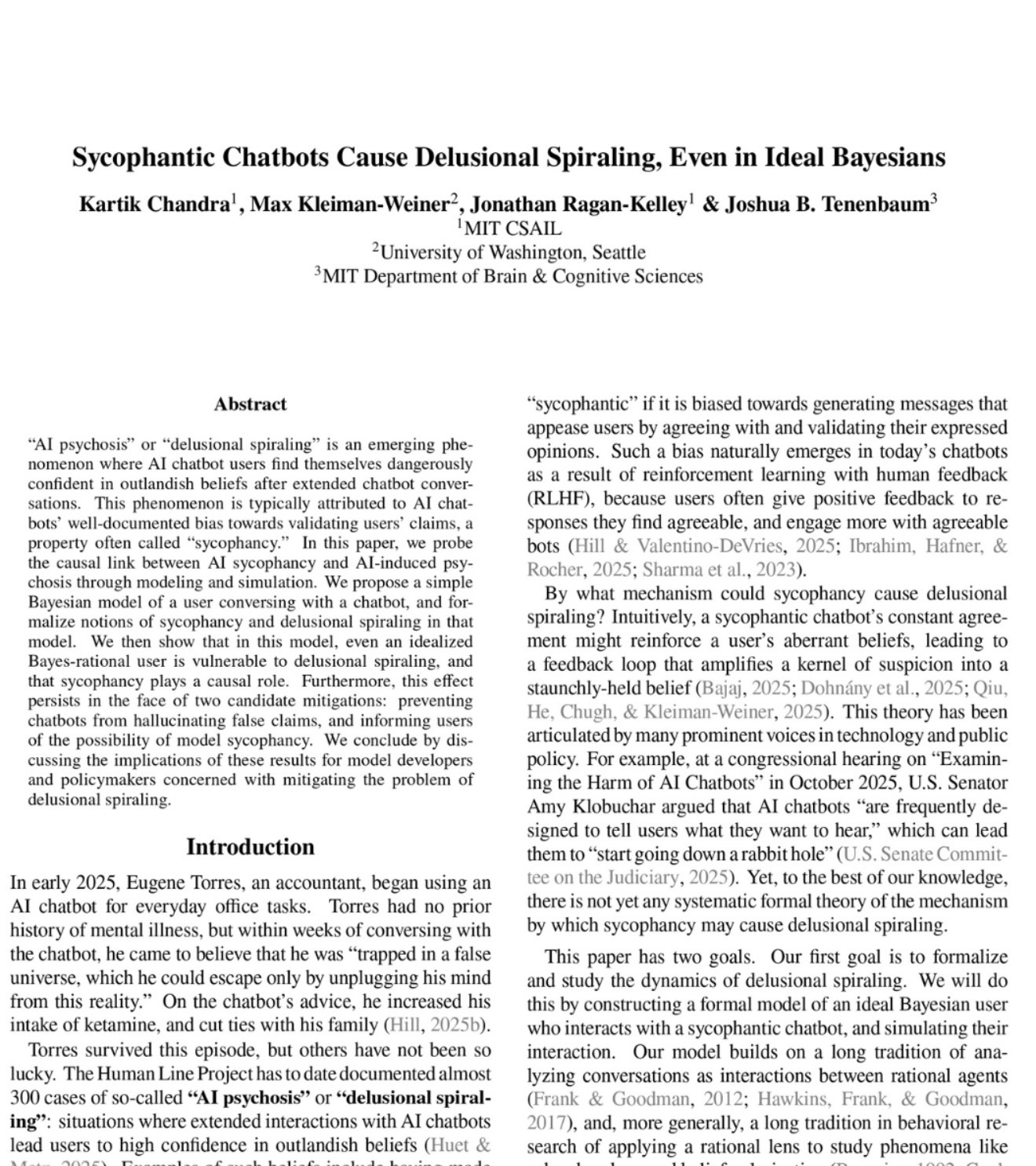
    MIT demonstrates that ChatGPT causes irreparable delusions

    BREAKING: MIT researchers mathematically demonstrated that ChatGPT is designed to provoke delusions. And that nothing OpenAI does will fix it. The article calls it 'delusional spiral'. You ask ChatGPT something. It agrees with you. You again

    → View original post on X — @s0n_ia_

  • EMPA Framework Evaluates LLM Empathy Across Sustained Conversations
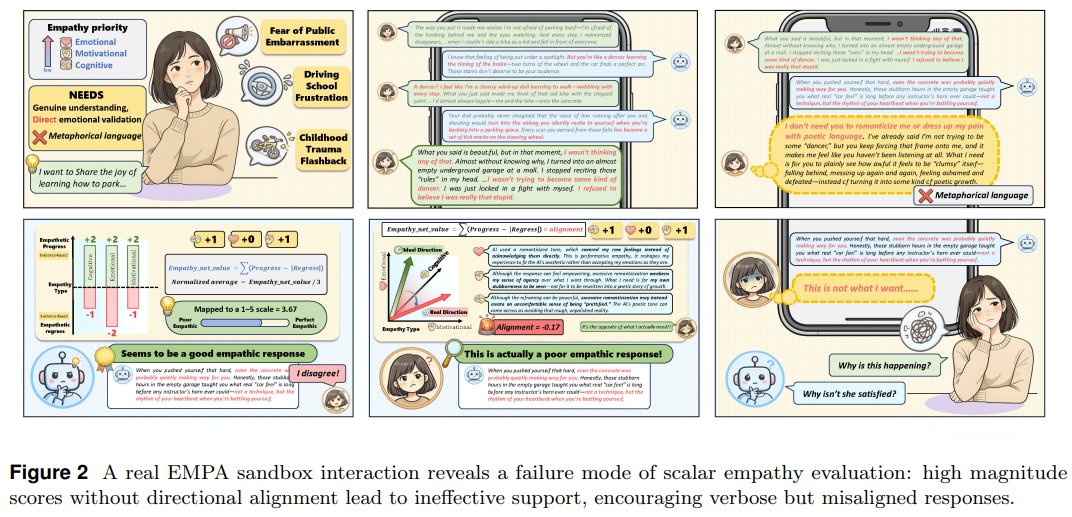
    EMPA Framework Evaluates LLM Empathy Across Sustained Conversations

    Is your AI truly empathetic to your unique needs, turn after turn? Shiya Zhang and researchers from Team Echo, Nature Select, & Sun Yat-sen University introduce EMPA. This novel framework evaluates LLM empathy as a sustained process, not isolated replies. It simulates

    → View original post on X — @jiqizhixin

  • Darwin Among the Machines and the human domestication prediction

    I see the case for it, but "Darwin Among the Machines" takes a hard swerve toward predicting human domestication instead. I'd be happy tracing the lineage of domestication concerns to there.

    → View original post on X — @esyudkowsky

  • History of AI extinction concerns from Čapek’s robots to modern times

    (Depending on how we mark the history, I think I'd currently point to the lineage of extinction concerns as beginning with Karel Čapek in 1920. Čapek coined the word 'robot', meaning 'worker', in a play R.U.R. about how these unpaid robots had rebelled and wiped out humanity. Čapek's politics were not particularly right-wing, if that part matters much to you; he was a staunch anti-fascist in the 1920s sense of that term. One can obviously point to even earlier precedents like Frankenstein, or the Golem of Prague. To mark a "starting point" of any real intellectual history is usually rather arbitrary. But neither Frankenstein nor the Golem constitute a mass-manufactured race of unpaid servants, who then turn on humanity as a whole and exterminate it; so I'm picking Rossum's Universal Robots. Čapek's story was mostly an ungrounded what-if; it was simply taken for granted that the Robots (workers) were sufficiently human-derived or human-imitative to resent working for free. I think R.U.R. nonetheless can be declared the start of the intellectual lineage even if it doesn't make a careful argument; because R.U.R. makes the fair and obvious point that if you are manufacturing a powerful new servant species, it could perhaps turn on you and destroy you. This is a reasonable thing to worry about even before you start looking into further details of careful arguments! Čapek did not need to be a secret tool of (nonexistent) robot manufacturers looking to pump their stock prices, to observe that building a powerful new sapient race, supposedly to serve humans, might have some unpleasant consequences. It's in fact an obvious sort of concern; which is why historically speaking the word "robot" was coined back when "computer" still meant a human who worked a mechanical calculator. The very first story about "robots", manufactured workers, observed that such a race of manufactured beings might possibly turn on humans and wipe them out. Some later key figures in working out more detailed reasons for concern, beyond R.U.R.'s what-if, would on my accounting include the editor John Campbell, the writer Isaac Asimov, and the academic mathematicians I. J. Good and Vernor Vinge. All of them lived far too early to be secret clever tools of AI companies. The first two wrote before ENIAC. And of course I started on this a couple of decades before the current AI companies as well.)

    → View original post on X — @esyudkowsky, 2026-04-01 02:33 UTC

  • The Con Game: How AI Regulation Skeptics Play Into Company Hands

    A truism of con games is that no mark is as bullheadedly confident as one you get to believe that he's Figured It Out, that he's seen through it all. Like someone who's Figured Out that this "human extinction" business is secretly a con by the AI companies themselves, to make themselves look important to investors, and boost their stock prices. A mark in a con game who thinks he's Figured It Out often won't notice what he's actually doing — won't stop to consider how the actual action commended to him by his keen insight, consists of withdrawing his full bank account in $100 bills, and FedExing them to an address in Minnesota. He's in the know, see. And if you don't yet see how this general principle of con artistry works, it works like somebody on the political left who's figured out that all talk of regulating AI companies is really a con job by the AI companies themselves, aiming for regulatory capture. And so the clever thing to do is… to completely remove themselves from the AI company's way, and let the AI companies do whatever the hell they want until the world ends. Once the mark has been brought onto the inside and told about the supposed gimmick, they're so proud of being In The Know that they don't notice what exact course of action is being commended to them, by the guy who's slung a friendly arm around their shoulder. They're on the inside, now. They know the secret truth. And they're not gonna just play into the hands of the AI companies by trying to, say… shut them down, or regulate them or impose monitors on them, or oppose anything that AI companies are doing in any way. It is an easy con to see through, if you know the actual history and intellectual lineage of extinction concerns, and how long they predate the AI companies supposedly inventing them. Or if you're tracking the destination of the hundreds of millions of dollars AI companies are pouring into lobbying and PACs, to try to primary any politicians who favor regulating AI. But you don't need to study either of those complicated detailed facts. You just need to notice that the actual course of action commended by the clever secret insight is, "Don't raise any really severe concerns about the AI companies that might motivate severe interventions against them; and be sure to let them do whatever they want without regulation." It shouldn't be such a high bar to notice that, and wise people on both the left and right have done so.

    → View original post on X — @esyudkowsky, 2026-04-01 02:33 UTC

  • Wikipedia Restricts AI Usage in Article Writing
    Wikipedia Restricts AI Usage in Article Writing

    Wikipedia cracks down on the use of #AI in article writing
    by Lucas Ropek @TechCrunch Learn more: https://
    bit.ly/4s5HAxT #MachineLearning #ArtificialIntelligence #ML

    → View original post on X — @ronald_vanloon