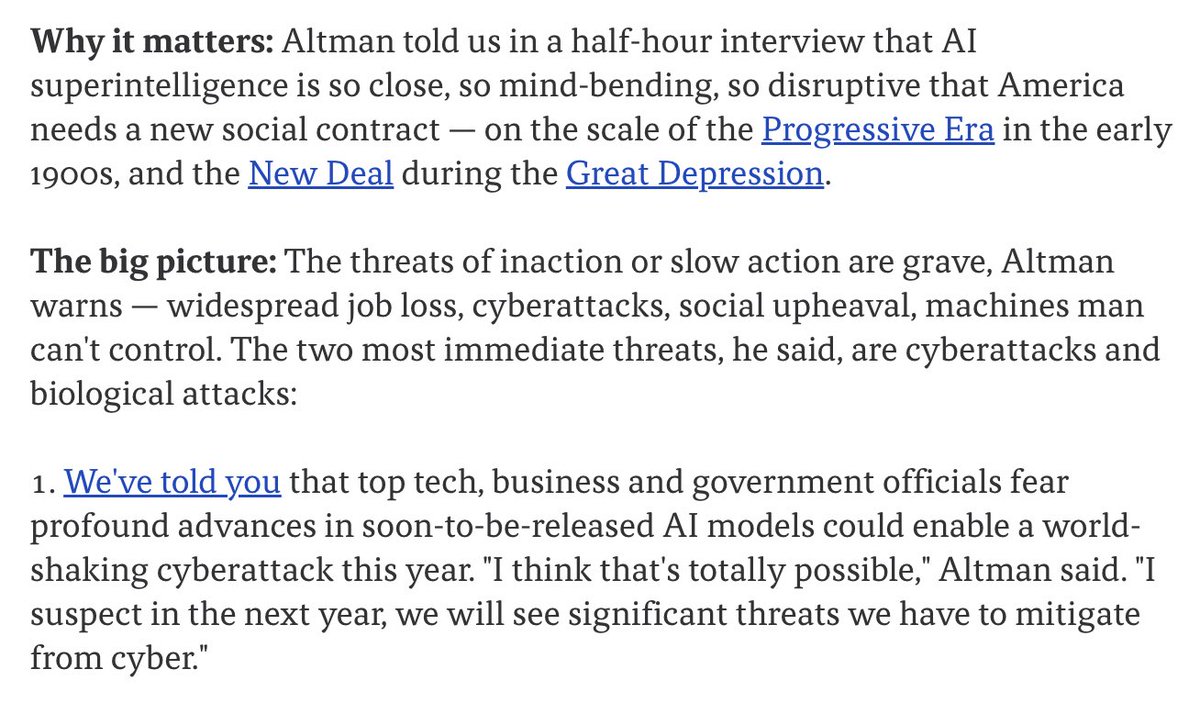
I don't know what Sam Altman saw internally at OpenAI, but it seems that, according to their definition, AGI is here, and superintelligence is incredibly close.
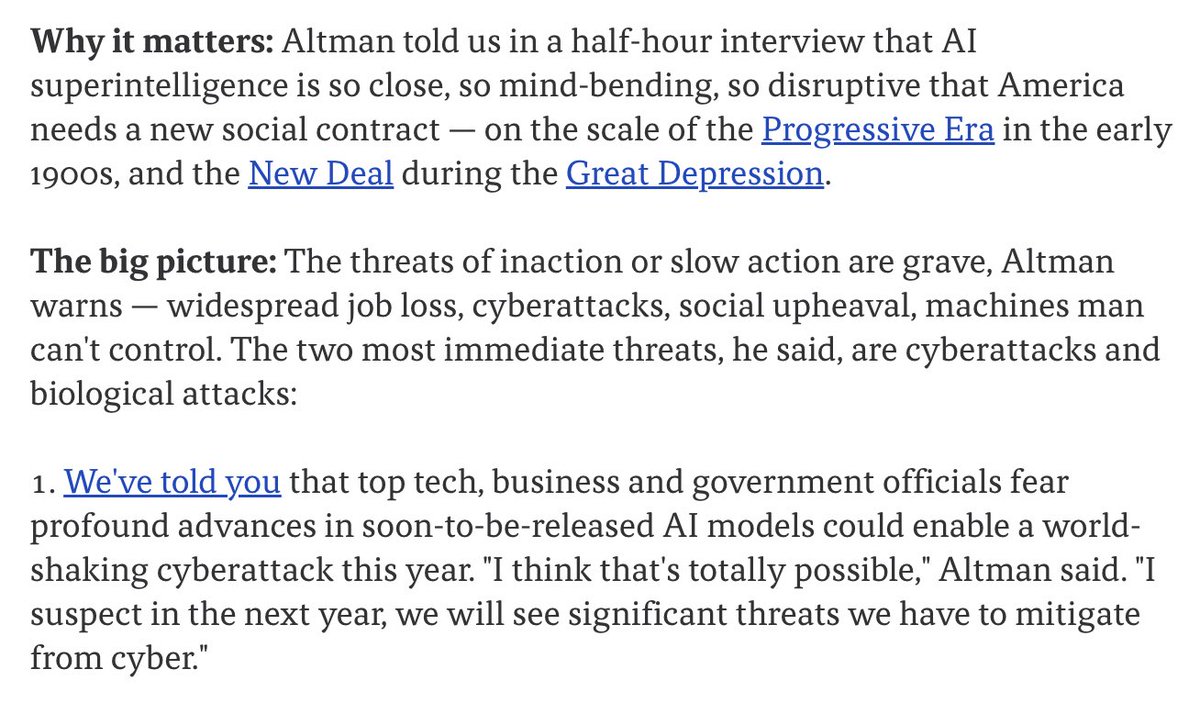
I don't know what Sam Altman saw internally at OpenAI, but it seems that, according to their definition, AGI is here, and superintelligence is incredibly close. AI models that independently conduct scientific research and find novel solutions are already here, and their internal model appears to surpass everything seen before. Chubby♨️ (@kimmonismus) Holy moly: Sam Altman told Axios in a half-hour interview that AI superintelligence is so close, so mind-bending, so disruptive that America needs a new social contract. – It's on the scale of the Progressive Era in the early 1900s, and the New Deal during the Great Depression. – Altman warns: widespread job loss, cyberattacks, social upheaval, machines man can't control – "soon-to-be-released AI models could enable a world-shaking cyberattack this year. "I think that's totally possible," Altman said. "I suspect in the next year, we will see significant threats we have to mitigate from cyber." — https://nitter.net/kimmonismus/status/2041126936097812598#m
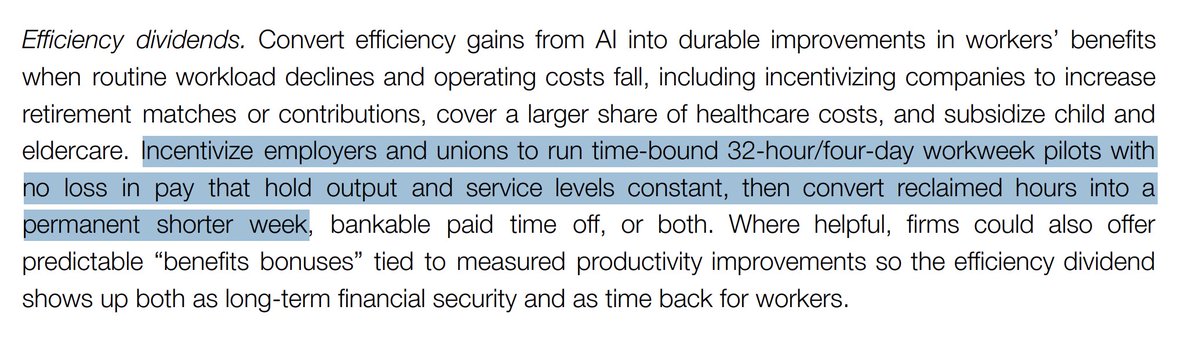
Update: OpenAI officially states they now transition into superintelligence: nitter.net/kimmonismus/status/204… Chubby♨️ (@kimmonismus) Looks like OpenAI reached Superintelligence. OpenAI: "Now, we’re beginning a transition toward superintelligence: AI systems capable of outperforming the smartest humans even when they are assisted by AI." OpenAI just published a 13-page policy blueprint for the "Intelligence Age"- proposing a Public Wealth Fund, 32-hour workweek pilots, portable benefits, a formal "Right to AI," and tax reforms to offset shrinking payroll revenue as automation scales. The document frames superintelligence not as a distant scenario *but an active transition requiring New Deal-level ambition*: new safety nets, containment playbooks for dangerous models, and international coordination modeled on aviation safety institutions. Here are OpenAI's suggestions (tl;dr): Open Economy: -Give workers a formal voice in AI deployment decisions -Microgrants and "startup-in-a-box" for AI-native entrepreneurs -Treat AI access as basic infrastructure (like electricity) -Shift tax base from payroll toward capital gains and corporate income -Public Wealth Fund — every citizen gets a stake in AI growth -Fast-track energy grid expansion via public-private partnerships -32-hour workweek pilots, better benefits from productivity gains -Auto-scaling safety nets triggered by displacement metrics -Portable benefits untied from employers -Invest in care economy as a transition path for displaced workers -Distributed AI-enabled labs to accelerate scientific discovery Resilient Society: -Safety tools for cyber, bio, and large-scale risks -AI trust stack — provenance, verification, audit logs -Competitive auditing market for frontier models -Containment playbooks for dangerous released models -Frontier AI companies adopt Public Benefit Corporation structures -Codified rules and auditing for government AI use -Democratic public input on AI alignment standards -Mandatory incident and near-miss reporting -International AI safety network for joint evaluations and crisis coordination Notably, OpenAI calls for stricter controls only on a narrow set of frontier models while keeping the broader ecosystem open, a clear attempt to position regulation as targeted, not industry-wide. They're backing it with up to $100K in fellowships and $1M in API credits for policy research, plus a new DC workshop opening in May. — https://nitter.net/kimmonismus/status/2041130939175284910#m
Looks like OpenAI reached Superintelligence. OpenAI: "Now, we’re beginning a transition toward superintelligence: AI systems capable of outperforming the smartest humans even when they are assisted by AI." OpenAI just published a 13-page policy blueprint for the "Intelligence Age"- proposing a Public Wealth Fund, 32-hour workweek pilots, portable benefits, a formal "Right to AI," and tax reforms to offset shrinking payroll revenue as automation scales. The document frames superintelligence not as a distant scenario *but an active transition requiring New Deal-level ambition*: new safety nets, containment playbooks for dangerous models, and international coordination modeled on aviation safety institutions. Here are OpenAI's suggestions (tl;dr): Open Economy: -Give workers a formal voice in AI deployment decisions -Microgrants and "startup-in-a-box" for AI-native entrepreneurs -Treat AI access as basic infrastructure (like electricity) -Shift tax base from payroll toward capital gains and corporate income -Public Wealth Fund — every citizen gets a stake in AI growth -Fast-track energy grid expansion via public-private partnerships -32-hour workweek pilots, better benefits from productivity gains -Auto-scaling safety nets triggered by displacement metrics -Portable benefits untied from employers -Invest in care economy as a transition path for displaced workers -Distributed AI-enabled labs to accelerate scientific discovery Resilient Society: -Safety tools for cyber, bio, and large-scale risks -AI trust stack — provenance, verification, audit logs -Competitive auditing market for frontier models -Containment playbooks for dangerous released models -Frontier AI companies adopt Public Benefit Corporation structures -Codified rules and auditing for government AI use -Democratic public input on AI alignment standards -Mandatory incident and near-miss reporting -International AI safety network for joint evaluations and crisis coordination Notably, OpenAI calls for stricter controls only on a narrow set of frontier models while keeping the broader ecosystem open, a clear attempt to position regulation as targeted, not industry-wide. They're backing it with up to $100K in fellowships and $1M in API credits for policy research, plus a new DC workshop opening in May. Chubby♨️ (@kimmonismus) Holy moly: Sam Altman told Axios in a half-hour interview that AI superintelligence is so close, so mind-bending, so disruptive that America needs a new social contract. – It's on the scale of the Progressive Era in the early 1900s, and the New Deal during the Great Depression. – Altman warns: widespread job loss, cyberattacks, social upheaval, machines man can't control – "soon-to-be-released AI models could enable a world-shaking cyberattack this year. "I think that's totally possible," Altman said. "I suspect in the next year, we will see significant threats we have to mitigate from cyber." — https://nitter.net/kimmonismus/status/2041126936097812598#m
Holy moly: Sam Altman told Axios in a half-hour interview that AI superintelligence is so close, so mind-bending, so disruptive that America needs a new social contract. – It's on the scale of the Progressive Era in the early 1900s, and the New Deal during the Great Depression. – Altman warns: widespread job loss, cyberattacks, social upheaval, machines man can't control – "soon-to-be-released AI models could enable a world-shaking cyberattack this year. "I think that's totally possible," Altman said. "I suspect in the next year, we will see significant threats we have to mitigate from cyber." Mike Allen (@mikeallen) 🚨🚨@sama tells me he feels such URGENCY about the power of coming AI models that @OpenAI is unveiling a New Deal for superintelligence – ideas to wake up DC He says AI will soon be so mindbending that we need a new social contract 👇Altman's top 6 ideas axios.com/2026/04/06/behind-… — https://nitter.net/mikeallen/status/2041099089031356468#m
The more you train with humans the more you deliver AI. First Squawk (@FirstSquawk) OPENAI AND ANTHROPIC'S FINANCIAL REPORTS SHOW INCREASING EXPENSES FOR AI MODEL TRAINING. — https://nitter.net/FirstSquawk/status/2041101280245096703#m
One changed the world of social media. The others have done OK. But you don’t write technology books to make money (ours did better than 99% of the field but still weren’t highly profitable) They led to doing keynote speeches in eighty countries which made hundreds of
My AI news system at Aligned News only watches X for AI: https://
alignednews.com/ai It is both better and worse. More focused but not as broad. This is another example of how highly personalized news is on the way and will disrupt everything. Congrats, this rocks!
⚡ AI productivity is not showing up in performance. It is accumulating in foundations. As EY highlights, firms are investing heavily in data, infrastructure, energy, and talent, while measurable productivity gains remain limited. Even optimistic projections show modest GDP impact. 1️⃣ Structural Shift: Productivity is moving from output per hour to outcome quality. AI makes time abundant, shifting the constraint to judgment, accuracy, and oversight. 2️⃣ Authority Redesign: As AI generates outputs, human roles shift from execution to validation. Decision authority becomes the bottleneck, not production capacity. 3️⃣ Delayed Payoff: Organizations are building the prerequisites for productivity, not the results themselves. Without aligning workflows and incentives, gains remain latent. This is why AI looks like a productivity revolution in investment, but not yet in outcomes. The real challenge is not accelerating AI adoption. It is redesigning how organizations measure and control value creation. via EY ey.com/en_gl/megatrends/how-… @corixpartners @Transform_Sec @Corix_JC @ILoveBooks786 @COSTESLionelEr @ramonvidall @RLDI_Lamy @FrRonconi @timo_vi @Nicochan33 @NathaliaLeHen @TCyberCast @arigatou163 @VivMilanoFSL @MathildaLoco @faryus88 @bbailey39 @BindIdeas971 @FmFrancoise @EduFirst @rameshambastha @DonaldGavis @ricardo_ik_ahau @sulefati7 @ozsilverfox @BCAgroup @9SManagement @O_Berard @DavidTaboada @yd_engoue @giuliog @Hajer_Alqassimi @EdwardHarkins @Evanskipropcrim @ranya_artistry @Howie7951 @iamtunslaw @gvalan
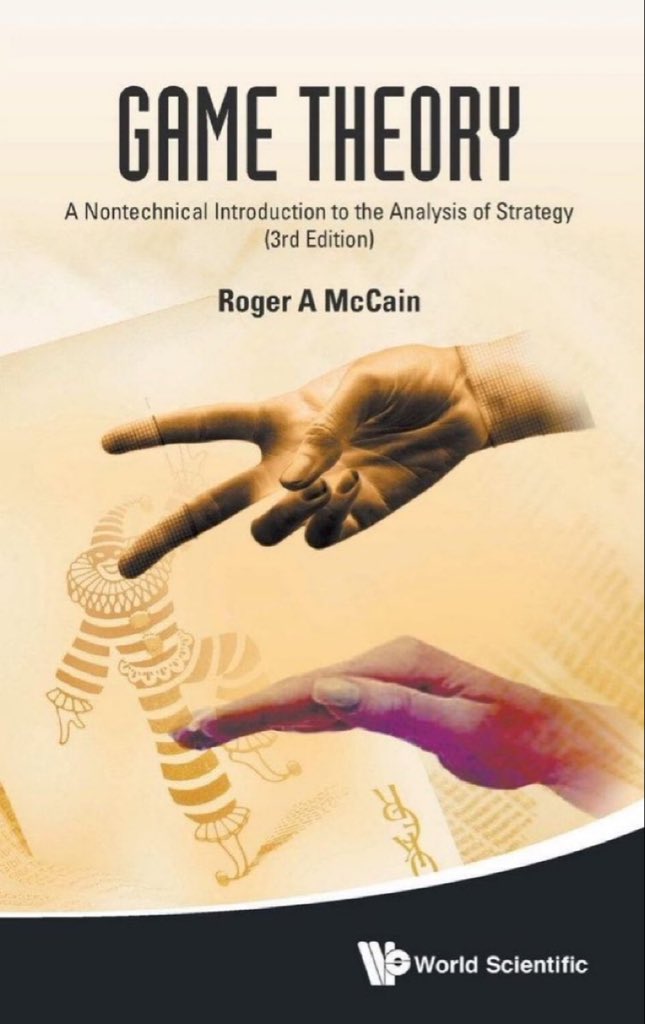
Fascinating reading on Game Theory: amzn.to/2T70A1y 💥🏆 "A Nontechnical Intro to the Analysis of Strategy" (3rd Ed.), covers N-person strategies, Nash Equilibria, auctions, bargaining, dominant strategies, Gamification, Behavioral Economics, Experimental Economics, etc.