/4 HyperExtract turns messy documents into actual knowledge systems. It is an LLM-powered framework for converting unstructured text into strongly typed Knowledge Abstracts. It can extract simple lists, Pydantic models, knowledge graphs, hypergraphs, and spatio-temporal graphs.
@alphasignalai
-
MinerU parses ugly documents into clean Markdown and JSON for LLM workflows
By
–
/5 MinerU parses ugly documents into clean Markdown and JSON for LLM workflows. It supports PDFs, DOCX, PPTX, XLSX, images, and web pages through a VLM + OCR dual engine. It can handle scanned docs, handwriting, formulas to LaTeX, tables to HTML, multi-column layouts, and
-
Agent needs better thinking: 22 ideation methods
By
–
/1 Your agent doesn’t need more prompts. It needs better ways to think. The creative-ideation skill gives Hermes a library of 22 ideation methods inspired by artists, thinkers, and creative frameworks. It reads the user’s situation, chooses the method that fits, then generates
-
Loop engineering automates coding agent workflows
By
–
/2 Prompting agents by hand is starting to look outdated. Loop engineering is a framework for turning coding agents into repeatable workflows. Instead of prompting Grok, Claude Code, Codex, or Cursor one step at a time, you define a recursive goal and let the agent iterate with
-
Headroom compresses agent context to reduce token usage drastically
By
–
/3 Most agent context is too noisy before it even reaches the model. Headroom compresses tool outputs, logs, files, and RAG chunks before they hit the LLM, cutting token usage by 60–95% while keeping the answers intact. It works as a Python/TypeScript library, zero-code proxy,
-
Top AI repos: creative ideation, loop engineering, token cost reduction, extraction
By
–
Top AI Repos of the Week (June 19 – 26) 1. Hermes Creative-Ideation skill: 22 methods to break your agent's creative rut 2. Loop engineering: design the system that prompts agents for you 3. Headroom: cut LLM token costs 60-95% without losing answers 4. Hyperextract: turn
-

DFlash: Drop-in Speculative Decoding for SGLang, vLLM, TensorRT-LLM
By
–
/7 Drop-in for SGLang, vLLM, and TensorRT-LLM. No code refactoring. SGLang:
–speculative-algorithm DFLASH
–speculative-draft-model-path z-lab/Qwen3-8B-DFlash-b16 vLLM: via the Speculators library (
http://
docs.vllm.ai/projects/specu
lators
…, algorithm "dflash") MIT license. ICML 2026 accepted. -
DFlash extracts hidden features from future tokens in LLMs
By
–
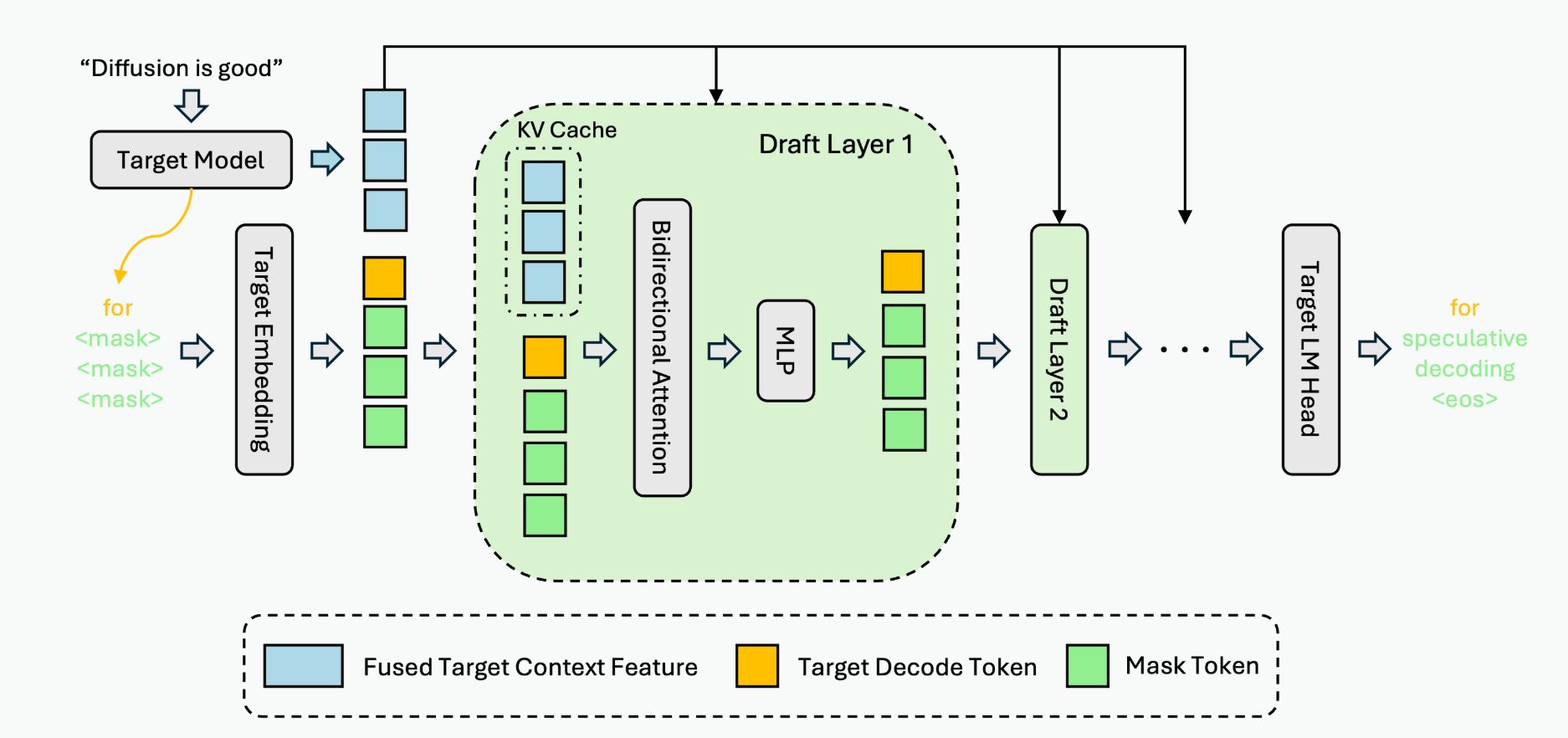
/5 The insight is from Samragh et al. (2025): large autoregressive LLMs already encode information about multiple future tokens in their hidden states. The target model is doing work that the drafter never gets to see. DFlash taps that. It extracts hidden features from uniformly
-
Two metrics: paper speedup and NVIDIA
By
–
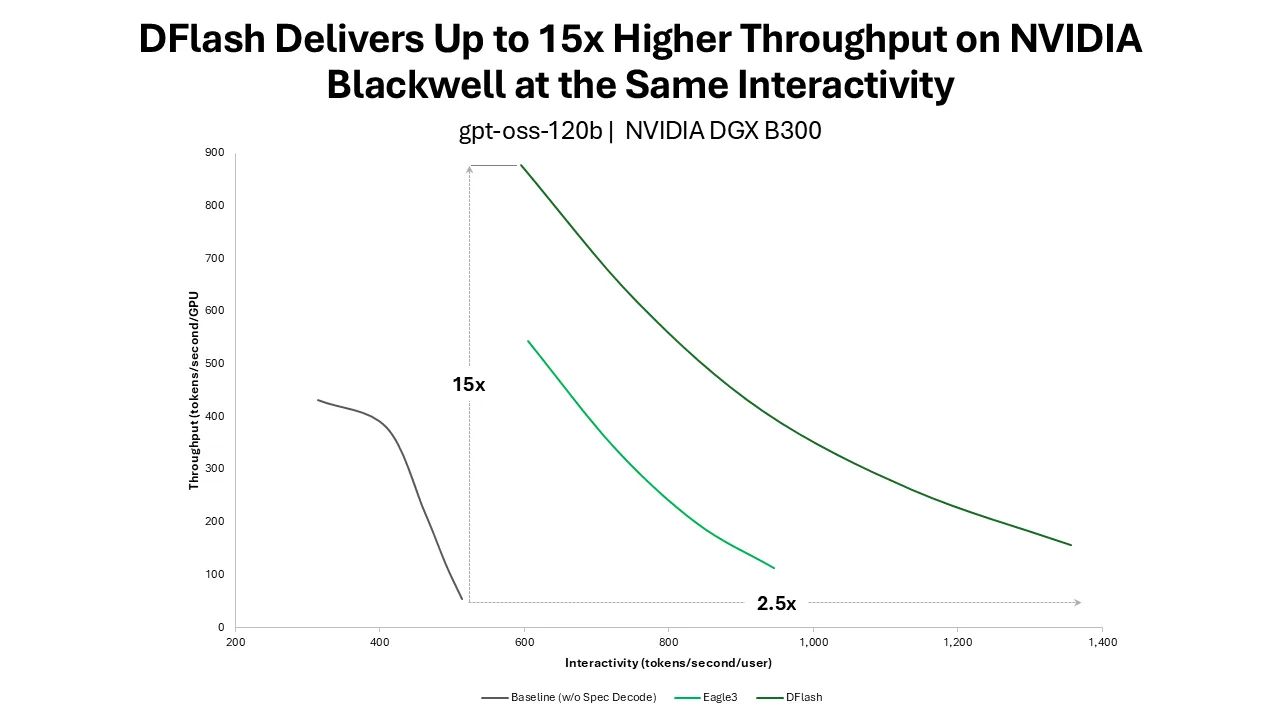
/4 Two metrics. 1. Paper (single-stream lossless latency, Qwen3-8B, Transformers backend): > Average 4.86x speedup over autoregressive baseline
> Peak 6.08x on MATH-500 (τ = 7.87 average acceptance length)
> 2.5x higher than EAGLE-3 at matched draft budget 2. NVIDIA -
DFlash replaces autoregressive draft head with block diffusion model
By
–
/3 DFlash replaces the autoregressive draft head with a block diffusion model. The drafter gets the target model's hidden states injected into the KV cache of every draft layer (not just the first like EAGLE-3). One denoising step. Entire block of 16 tokens produced in a single