AI Dynamics

Global AI News Aggregator

About

CODE

  • GitAgent: Framework-Agnostic AI Agent Definition Standard
    GitAgent: Framework-Agnostic AI Agent Definition Standard

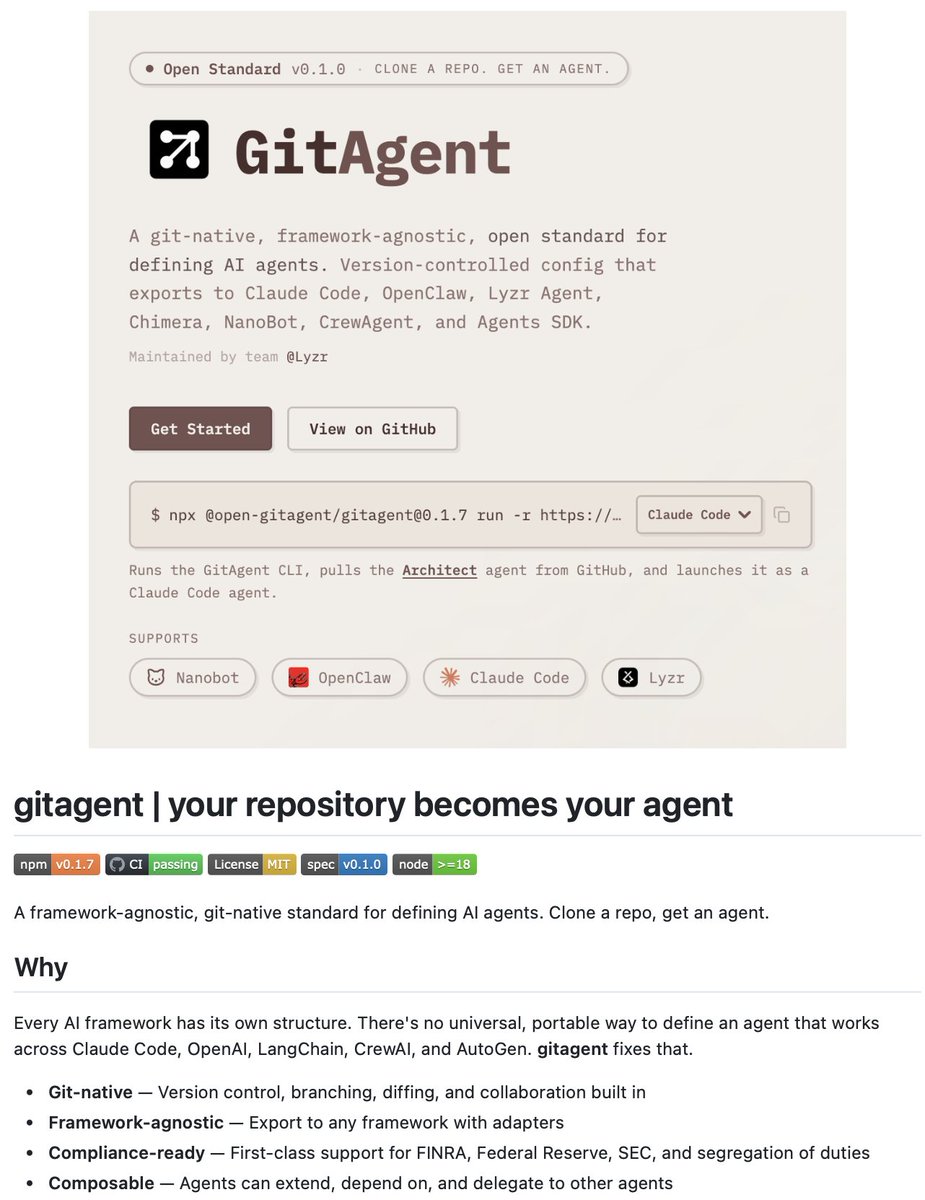
    Turn any git repo into an AI agent! GitAgent is a framework-agnostic standard that lets you define agents as git repositories. Every AI framework has its own structure. Claude Code, OpenAI, LangGraph, CrewAI, AutoGen all use different formats. You build an agent in one framework and it's locked there. No portability. No reuse. GitAgent fixes this. Your repository becomes your agent. Drop two files into a git repo (agent.yaml for the manifest, SOUL. md for identity) and it becomes a portable agent definition. Export it to any framework with adapters. You get git's workflow for free. Version control your prompts. Roll back broken changes with git revert. Fork public agents, customize them, and PR improvements back. Run gitagent validate in GitHub Actions to catch issues before deployment. The structure is flexible. Start with just agent.yaml and SOUL. md. Add skills, tools, workflows, memory, and compliance rules as you need them. Everything is optional except those two core files. It works across frameworks. Export to Claude Code, OpenAI Agents SDK, CrewAI, or as a raw system prompt. Same agent definition, different runtimes. Built for compliance. First-class support for FINRA, Federal Reserve, and SEC requirements. Segregation of duties built into the spec. Define roles, conflict matrices, and handoff workflows in agent.yaml. Link to the Github Repo in comments!

    → View original post on X — @sumanth_077, 2026-03-31 14:07 UTC

  • Python Port of Interesting Project with TypeScript Versions
    Python Port of Interesting Project with TypeScript Versions

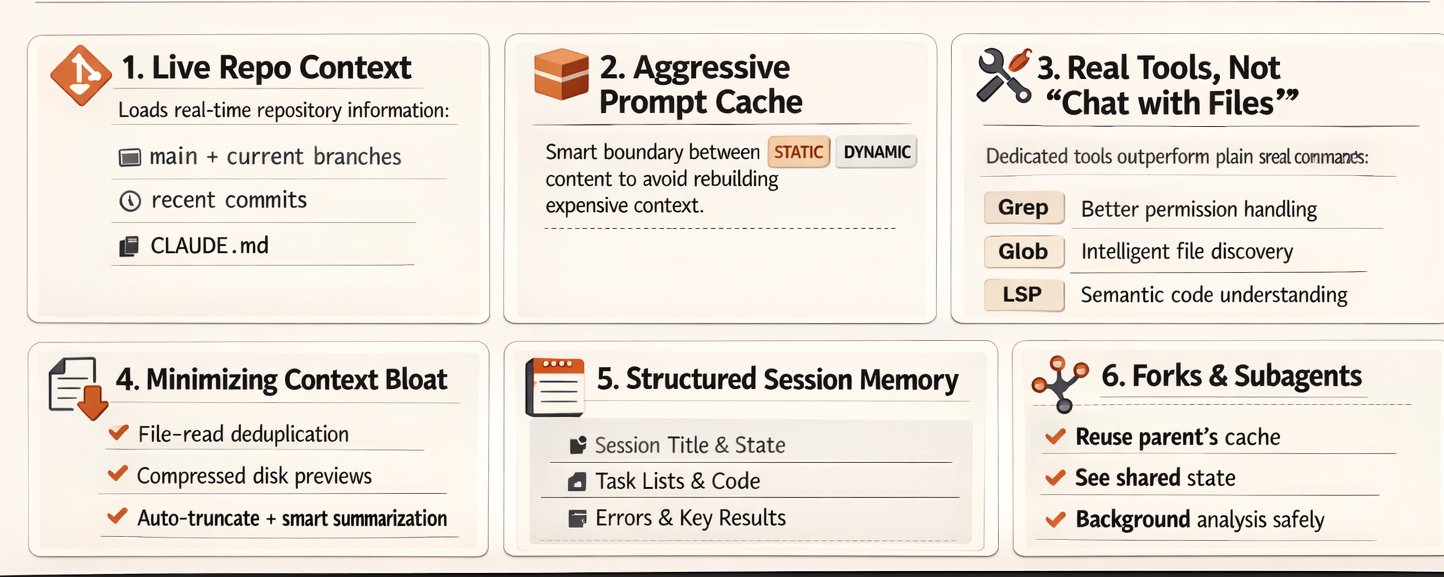
    Looks like this is a Python port. I saw some of the Typescript versions earlier on GitHub as well. Anyways, super interesting. I tried to summarize some of the tidbits

    → View original post on X — @rasbt

  • Claude Code Accidentally Open-Sourced Breaking News
    Claude Code Accidentally Open-Sourced Breaking News

    Breaking!
    Claude Code got “open-sourced”… or should I say, accidentally liberated

    → View original post on X — @jiqizhixin

  • OpenAI Codex Codebase Allegedly Leaked on GitHub

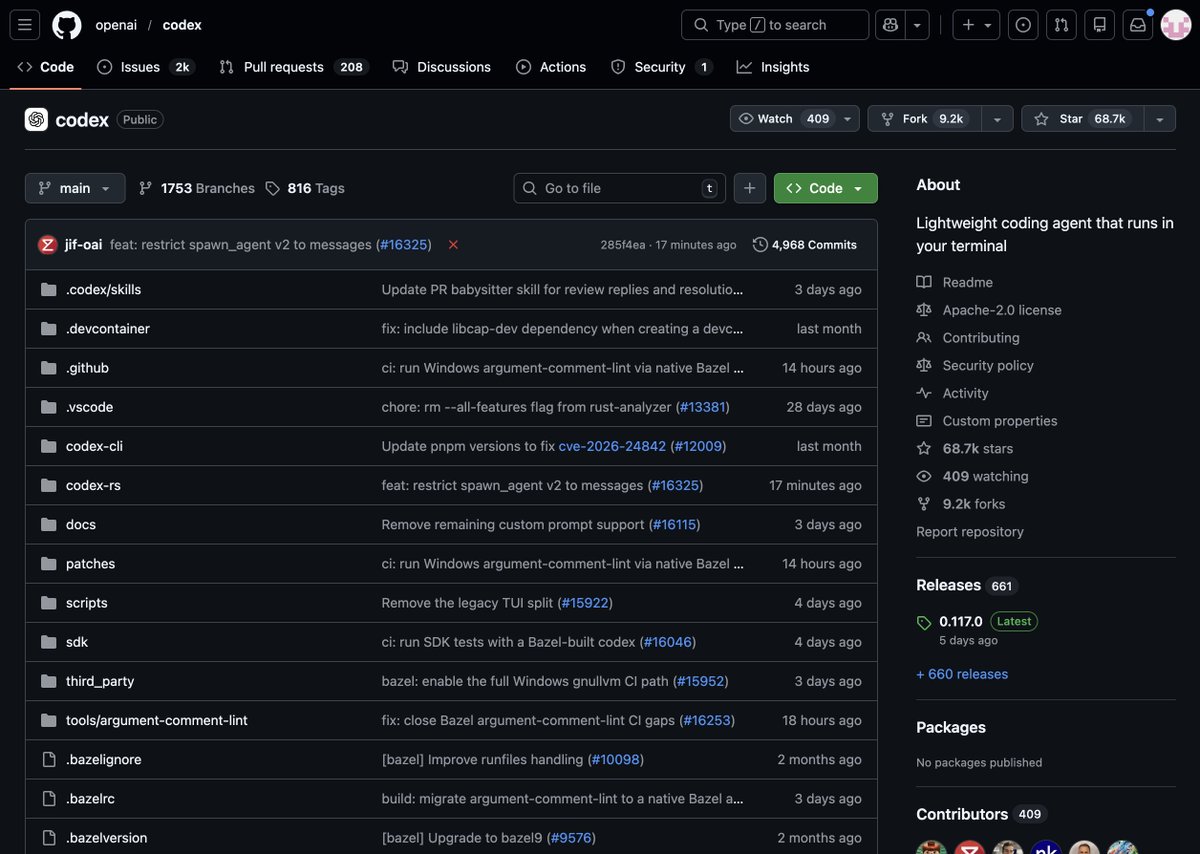
    holy shitt, somebody at OpenAI leaked the entire codex codebase.. github.com/openai/codex

    → View original post on X — @arrakis_ai, 2026-03-31 13:27 UTC

  • Engineering Team Merges 400 Pull Requests Weekly

    We merge an average of 400 PRs/week, so not quite true.

    → View original post on X — @steipete

  • Natural-Language Agent Harnesses: Making AI Agent Control Portable and Inspectable
    Natural-Language Agent Harnesses: Making AI Agent Control Portable and Inspectable

    Agent harnesses are too restrictive. That's because they're still designed as code. What if the harness itself were written in natural language and interpreted by an LLM at runtime? This research explores the idea. The work introduces Natural-Language Agent Harnesses (NLAHs), a structured natural-language representation that externalizes harness logic as a portable, executable artifact. Instead of scattering control flow across controller code, framework defaults, and tool adapters, NLAHs make contracts, roles, stage structure, state semantics, and failure taxonomies explicit and editable. An Intelligent Harness Runtime (IHR) places an LLM inside the runtime loop to interpret and execute these harnesses directly. Why does it matter? Harness design is increasingly decisive for agent performance, but it's buried in code that's hard to transfer, compare, or ablate. NLAHs make the orchestration layer a first-class scientific object. The practical implication: harnesses become portable across runtimes, composable across tasks, and directly inspectable by humans and models alike. Paper: arxiv.org/abs/2603.25723 Learn to build effective AI agents in our academy: academy.dair.ai/

    → View original post on X — @dair_ai, 2026-03-31 13:14 UTC

  • Meta-Harness: Automated System Achieves 6x Performance Improvement
    Meta-Harness: Automated System Achieves 6x Performance Improvement

    NEW Stanford & MIT paper on Model Harnesses. Changing the harness around a fixed LLM can produce a 6x performance gap on the same benchmark. What if we automated harness engineering itself? The work introduces Meta-Harness, an agentic system that searches over harness code by exposing the full history through a filesystem. The proposer reads source code, execution traces, and scores from all prior candidates, referencing over 20 past attempts per step. On text classification, it improves over SOTA context management by 7.7 points while using 4x fewer tokens. On agentic coding, it outperforms all hand-engineered baselines on TerminalBench-2, scoring 37.6% versus Claude Code's 27.5%. This is a big deal! Here is why: The harness around a model often matters as much as the model itself. Meta-Harness shows that giving an optimizer rich access to prior experience, not just compressed scores, unlocks automated engineering that beats human-designed scaffolding. Paper: arxiv.org/abs/2603.28052 Learn to build effective AI agents in our academy: academy.dair.ai/

    → View original post on X — @dair_ai, 2026-03-31 13:13 UTC

  • MiniMax M2.7: First AI That Self-Improves Without Retraining

    The first AI that improves without retraining. (it rewrites its own agent harness) Every developer I know has one thing in common: they obsess over their setup. The terminal, the scripts, the shortcuts. They don't just write code. They constantly refine how they work. The code gets better because the environment gets better. MiniMax just released M2.7, and I think the most interesting thing about it isn't a benchmark number. It's the fact that M2.7 improves its own agent harness. Autonomously. Let's break this down: When you run an AI agent today, it operates inside a "harness." Think of it as the agent's operating environment: the skills it can invoke, the tools it can call, its memory, and the rules it follows. Normally, a human engineer builds this harness, and the agent operates within it. The harness stays fixed. M2.7 treats its harness as something it can rewrite. Here's what the loop looks like: – The agent runs a task and analyzes where things went wrong – It plans changes to its own scaffold: skills, MCPs, memory – It applies those changes, runs evaluations against a benchmark – It compares the results and decides whether to keep or revert – It writes self-criticism into memory so the next round starts smarter Then it loops back and does it again. And again. Think of it like a developer who finishes a project, writes a retrospective, restructures their workflow based on what they learned, and shows up the next day with a better setup. Except the developer here is the model itself. MiniMax ran this self-optimization loop for over 100 rounds internally. Along the way, the model discovered things on its own: it systematically searched for optimal sampling parameters (temperature, penalties), wrote workflow-specific guidelines for itself (like automatically checking for the same bug pattern in other files after a fix), and even added loop detection to avoid getting stuck. No human had to tell it to do any of this. They also tested this in a more controlled setting. They had M2.7 compete in 22 ML competitions from OpenAI's MLE Bench Lite. Each trial ran for 24 hours, fully autonomous. After each iteration, the agent wrote a memory file and performed self-criticism, feeding those insights into the next round. With every round, the ML models it trained achieved higher medal rates. The best run earned 9 gold medals. I've summarized the self-evolving architecture in the graphic below. The reason I find this compelling: this isn't about making a smarter model. It's about making a model that makes itself smarter. The weights never change. What changes is the system around it: better skills, better memory, better workflow rules. And that distinction matters because it means the improvement loop can run continuously without any retraining. We're entering a phase where agents don't just follow instructions. They redesign their own playbook. If you want to learn more, I've shared a link to their official blog post in the next tweet.

    → View original post on X — @akshay_pachaar, 2026-03-31 13:07 UTC
  • Claude Source Code Leaked: Major Security Breach Confirmed

    wtf, biggest leak of the year. This is absolute insane. Claude code source code leaked. That was NOT on my bingo card. x.com/Fried_rice/sta…

    → View original post on X — @kimmonismus