.
@AdamRLucek on how we use traces to build evals for production agents.
AGENTS
-

Using Traces to Build Production Agent Evaluations
By
–
-
Multi-Agent Retention Patterns in Graph-Based AI Systems
By
–
Multi-agent retention is a great extension of this. The execution agent needs a tight working set, the audit agent needs full provenance. Context templates in Graphiti help here. Same underlying graph, but each agent gets a different view scoped by edge types, entity types, and
-

SkillOS: Agents Learn Once, All Level Up
By
–
AI agents shouldn’t start from zero every time. SkillOS captures what works from each job, turns it into a tested Skill, and shares it with every approved Agent. One Agent learns.
All Agents level up. That’s how AI work becomes compounding intelligence. -
Agent Capabilities and Permissions Should Evolve with Sandboxing
By
–
New on the Engineering Blog: The access and permissions we grant agents should evolve with their capabilities. In our own products, we set these parameters through sandboxing, which limits the scope of any potentially destructive actions. Read more:
-
The ‘agent debt’: AI built fast, impossible to fix
By
–
"Agent debt" is a new term, but it was inevitable, an instantiation of AI-driven technical debt that I keep warning about. This is what happens when you build it fast, but truly don't know how to fix it. Good time.
-
MagicPath Introduces Figma Export with AI Agent Integration
By
–
Introducing Figma export in MagicPath.
— Pietro Schirano (@skirano) 26 mai 2026
Design and build with our native agent, or your favorite external one (Codex, Claude Code, etc.).
Explore tons of different directions, then bring your work into Figma as fully editable designs.
As simple as a copy-paste. pic.twitter.com/ON9h0UCXpuIntroducing Figma export in MagicPath. Design and build with our native agent, or your favorite external one (Codex, Claude Code, etc.). Explore tons of different directions, then bring your work into Figma as fully editable designs. As simple as a copy-paste.
-
AI Copilot for Industrial Telemetry Analysis and Documentation
By
–
The system feeds live and historical telemetry into the same copilot connected to ABB's documentation library for analysis.
-
Generative UI: Voice-Controlled AI Agent Interface
By
–
Today, we’re sharing the first of what we’re calling Pika Experiments 🧪 – rough ideas we’ve been playing with behind the scenes.
— Pika (@pika_labs) 26 mai 2026
”Generative UI” is a voice-controlled interface where the agent listens, analyzes the context, and determines the most appropriate visual composition… pic.twitter.com/wdV5CO03L0Today, we’re sharing the first of what we’re calling Pika Experiments – rough ideas we’ve been playing with behind the scenes. ”Generative UI” is a voice-controlled interface where the agent listens, analyzes the context, and determines the most appropriate visual composition
-
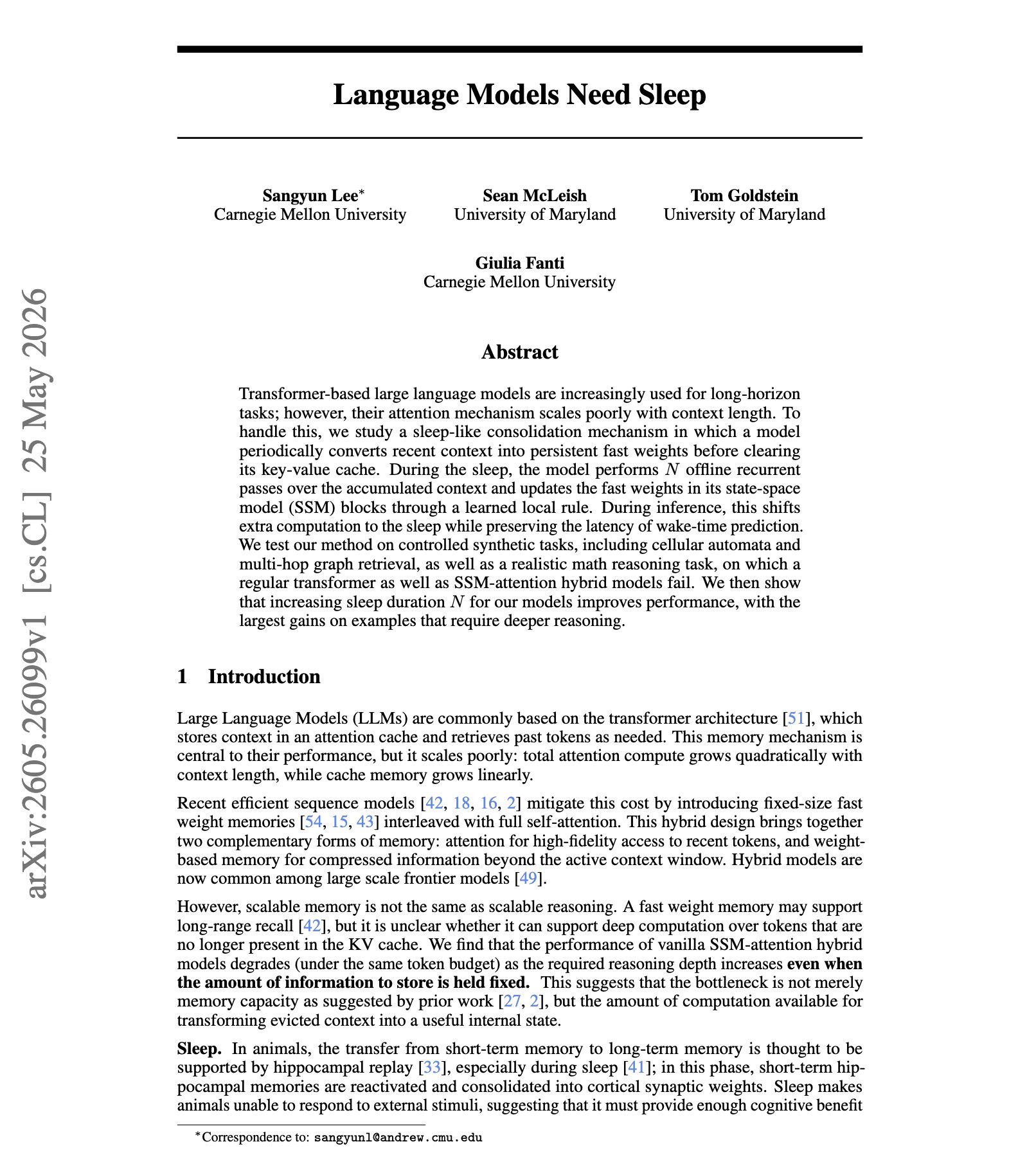
Long-Horizon Agents: Attention Scaling and Sleep Mechanisms
By
–
// Language Models Need Sleep // Let your agents "sleep", folks. On a serious note, this is a fascinating paper on getting the most from long-horizon agents. Here is the problem with agents today: Attention scales badly with context length, so long-horizon agents keep paying a
-
OpenResearch sneak peek: train VPO on ToolRL in one click
By
–
Here’s an early sneak peak of OpenResearch, our brand new feature for reproducing and experimenting on top of papers
— alphaXiv (@askalphaxiv) 26 mai 2026
We put together a template so you can train VPO on ToolRL in one click on a single gpu
Vector Policy Optimization trains models to generate diverse answer sets… pic.twitter.com/MEaGQ1HIYMHere’s an early sneak peak of OpenResearch, our brand new feature for reproducing and experimenting on top of papers We put together a template so you can train VPO on ToolRL in one click on a single gpu Vector Policy Optimization trains models to generate diverse answer sets