
NEW Stanford & MIT paper on Model Harnesses. Changing the harness around a fixed LLM can produce a 6x performance gap on the same benchmark. What if we automated harness engineering itself? The work introduces Meta-Harness, an agentic system that searches over harness code by exposing the full history through a filesystem. The proposer reads source code, execution traces, and scores from all prior candidates, referencing over 20 past attempts per step. On text classification, it improves over SOTA context management by 7.7 points while using 4x fewer tokens. On agentic coding, it outperforms all hand-engineered baselines on TerminalBench-2, scoring 37.6% versus Claude Code's 27.5%. This is a big deal! Here is why: The harness around a model often matters as much as the model itself. Meta-Harness shows that giving an optimizer rich access to prior experience, not just compressed scores, unlocks automated engineering that beats human-designed scaffolding. Paper: arxiv.org/abs/2603.28052 Learn to build effective AI agents in our academy: academy.dair.ai/
TOOLS
-
Minimax M27 Model Release Announcement and Blog Post
By
–
Blog: minimax.io/news/minimax-m27-…
→ View original post on X — @akshay_pachaar, 2026-03-31 13:07 UTC
-
MiniMax M2.7: First AI That Self-Improves Without Retraining
By
–
The first AI that improves without retraining. (it rewrites its own agent harness) Every developer I know has one thing in common: they obsess over their setup. The terminal, the scripts, the shortcuts. They don't just write code. They constantly refine how they work. The code gets better because the environment gets better. MiniMax just released M2.7, and I think the most interesting thing about it isn't a benchmark number. It's the fact that M2.7 improves its own agent harness. Autonomously. Let's break this down: When you run an AI agent today, it operates inside a "harness." Think of it as the agent's operating environment: the skills it can invoke, the tools it can call, its memory, and the rules it follows. Normally, a human engineer builds this harness, and the agent operates within it. The harness stays fixed. M2.7 treats its harness as something it can rewrite. Here's what the loop looks like: – The agent runs a task and analyzes where things went wrong – It plans changes to its own scaffold: skills, MCPs, memory – It applies those changes, runs evaluations against a benchmark – It compares the results and decides whether to keep or revert – It writes self-criticism into memory so the next round starts smarter Then it loops back and does it again. And again. Think of it like a developer who finishes a project, writes a retrospective, restructures their workflow based on what they learned, and shows up the next day with a better setup. Except the developer here is the model itself. MiniMax ran this self-optimization loop for over 100 rounds internally. Along the way, the model discovered things on its own: it systematically searched for optimal sampling parameters (temperature, penalties), wrote workflow-specific guidelines for itself (like automatically checking for the same bug pattern in other files after a fix), and even added loop detection to avoid getting stuck. No human had to tell it to do any of this. They also tested this in a more controlled setting. They had M2.7 compete in 22 ML competitions from OpenAI's MLE Bench Lite. Each trial ran for 24 hours, fully autonomous. After each iteration, the agent wrote a memory file and performed self-criticism, feeding those insights into the next round. With every round, the ML models it trained achieved higher medal rates. The best run earned 9 gold medals. I've summarized the self-evolving architecture in the graphic below. The reason I find this compelling: this isn't about making a smarter model. It's about making a model that makes itself smarter. The weights never change. What changes is the system around it: better skills, better memory, better workflow rules. And that distinction matters because it means the improvement loop can run continuously without any retraining. We're entering a phase where agents don't just follow instructions. They redesign their own playbook. If you want to learn more, I've shared a link to their official blog post in the next tweet.
→ View original post on X — @akshay_pachaar, 2026-03-31 13:07 UTC
-
AI Agents Creating Publication-Ready Charts Using Tufte Principles
By
–
AI agents make charts fast. The output is almost always fine. Correct data, readable axes, nothing you'd actually want to publish. We encoded Tufte's principles as an AI quality bar in Truesight and told an agent to keep revising until it passed. goodeyelabs.com/insights/the…
→ View original post on X — @randal_olson, 2026-03-31 13:00 UTC
-
AI agents for automated browser-based software testing
By
–
Writing test scripts is dead. AI agents now test your app in a real browser.
— AlphaSignal AI (@AlphaSignalAI) 31 mars 2026
Most testing tools can't see what users see.
They check functions, not actual browser behavior.
Expect is an open-source CLI repo that fixes this.
It scans your git diff and hands it to an AI… pic.twitter.com/FXxypZ6KQ1Writing test scripts is dead. AI agents now test your app in a real browser. Most testing tools can't see what users see. They check functions, not actual browser behavior. Expect is an open-source CLI repo that fixes this. It scans your git diff and hands it to an AI
-
First Conference with SKILL.md Submissions
By
–
The first conference where your submission isn't a paper.
— God of Prompt (@godofprompt) 31 mars 2026
It's a SKILL.md file Claude can execute, review, and reproduce end-to-end.
Stanford and Princeton just made reproducibility the submission format.
$50,000 prize pool. 364 winners.
Deadline April 5 👇… https://t.co/4ql4fVGe4QThe first conference where your submission isn't a paper. It's a SKILL.md file Claude can execute, review, and reproduce end-to-end. Stanford and Princeton just made reproducibility the submission format. $50,000 prize pool. 364 winners. Deadline April 5
-
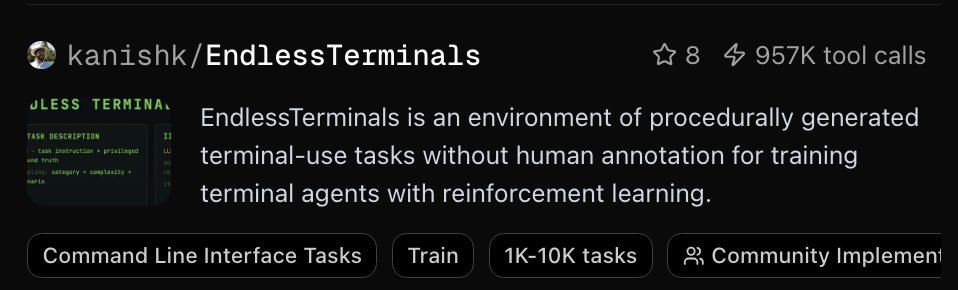
OpenReward: Featured Environments of the Week
By
–
🌍 Environments of the Week It's been a week since we launched @OpenReward. Here are some of our favourite environments this week – some newly added, some heavily used, and some hidden gems. First, the most used environment of the week is EndlessTerminals by @gandhikanishk with 830k+ tool calls. openreward.ai/kanishk/EndlessTerminals 🧵 [Translated from EN to English]
→ View original post on X — @nathanbenaich, 2026-03-31 11:24 UTC
-
Check Axios Supply-Chain Attack Compromise Free Claude Skill
By
–
🚨 Want to quickly check if you've been compromised by the Axios supply-chain attack?
— Charly Wargnier (@DataChaz) 31 mars 2026
Hari (@hrkrshnn) just shipped a free @claudeai skill for us 🙏
/plugin marketplace add cantinasec/plugins
/plugin install cantinasec@cantinasec-plugins
/reload-plugins
/cantinasec:axios pic.twitter.com/XlUdHdDcl7Want to quickly check if you've been compromised by the Axios supply-chain attack? Hari (
@hrkrshnn
) just shipped a free @claudeai skill for us /plugin marketplace add cantinasec/plugins
/plugin install cantinasec@cantinasec-plugins
/reload-plugins /cantinasec:axios -
Softr Launches AI-Native Platform for Real Business Software
By
–
The new Softr has arrived.
— Softr (@softr_io) 31 mars 2026
Today, we're launching the first AI-native platform for building real business software. Not prototypes. Not demos. Software you can build on Monday morning and share with your team and clients before lunch.
Describe what you need, and Softr’s new AI… pic.twitter.com/Dg445bQNZAThe new Softr has arrived. Today, we're launching the first AI-native platform for building real business software. Not prototypes. Not demos. Software you can build on Monday morning and share with your team and clients before lunch. Describe what you need, and Softr’s new AI Co-Builder instantly creates the database, app, and business logic — connected, secure, and ready for real users. In less than 5 minutes! → Secure and fully-functional. Logins, user management, permissions, hosting — built-in and working from the moment you hit publish. → Switch between AI prompting and visual editing at any time. No credits burned just to add text or change a color. → Any non-technical team member can own it and iterate on it. Visual interface, database and workflows you can see and edit — no black box. No developer. Ever. 2025 was prototypes. 2026 is software that actually works. Start building with Softr for free → softr.io/
→ View original post on X — @andreasklinger, 2026-03-31 11:03 UTC
-

Top AI Stories: Sora, Claude, Perplexity, and Stanford Research
By
–
Top stories in AI today: – Inside Sora's $1M-a-day collapse at OpenAI
– Microsoft pits Claude against ChatGPT for research
– Build a travel itinerary with Perplexity Computer
– Stanford exposes AI's people-pleasing problem
– 4 new AI tools, community workflows, and more