Discussed on @Bloomberg Asia TV: As AI models, tools, and architectures become more open, AI adoption will accelerate worldwide. Security imperfections should be approached with caution as open technologies like OpenClaw and the ecosystems mature over time. bloomberg.com/news/videos/20…
TOOLS
-

Ultralytics YOLO Models Export Integration for Metis AIPUs
By
–
From trained model to edge deployment in days, not months. Ultralytics has introduced an updated export integration for Metis AIPUs. Export your YOLO models, compile for Metis hardware, and run inference without PyTorch at the edge. >> Join us on April 8 for an Ultralytics Live session where we'll walk through the integration in action. Stay tuned for details! >> Check out the blog here: eu1.hubs.ly/H0t6rj40 #AxeleraAI #Ultralytics #YOLO #EdgeAI #ComputerVision
→ View original post on X — @axeleraai, 2026-03-31 14:44 UTC
-
Gateway: Unified LLM Traffic Routing API
By
–
Merge launched Gateway, a new way to route all your LLM traffic across OpenAI, Anthropic, Google, and more through one API endpoint, with spend limits and full observability baked in from day one. https://t.co/s2tFPFCFVG pic.twitter.com/XtJ3tPNfx1
— 🚨 AI News | TestingCatalog (@testingcatalog) 31 mars 2026Merge launched Gateway, a new way to route all your LLM traffic across OpenAI, Anthropic, Google, and more through one API endpoint, with spend limits and full observability baked in from day one.
-
Letting Claude Code choose how to build stuff
By
–
Nowadays a lot with Claude Code cause I let it choose how to build stuff 😀
-
MultiGen: Neural Network-Generated Real-Time Multiplayer Game Live
By
–
We built a real-time multiplayer game generated entirely by a neural network—and now you can actually play it.
— Gordon Wetzstein (@GordonWetzstein) 31 mars 2026
In collaboration with @modal, we just launched the live demo for MultiGen, our diffusion-based multiplayer game engine. Grab some friends and try it here 👇 pic.twitter.com/3pnKz1MUrpWe built a real-time multiplayer game generated entirely by a neural network—and now you can actually play it. In collaboration with @modal, we just launched the live demo for MultiGen, our diffusion-based multiplayer game engine. Grab some friends and try it here 👇
→ View original post on X — @sallyeaves, 2026-03-31 14:29 UTC
-

Modern Time Series Analysis with R for Practical Forecasting
By
–
Modern Time Series Analysis with R: Practical Forecasting and Impact Estimation with Tidy, Reproducible Workflows! #BigData #Analytics #DataScience #AI #MachineLearning #IoT #IIoT #PyTorch #Python #RStats #TensorFlow #Java #JavaScript #ReactJS #GoLang #CloudComputing #Serverless
-

Runway Builders: Program for Startups Using Generative AI
By
–
Today we are introducing Runway Builders, a program for Seed to Series C startups building the next generation of products and services with generative video and real-time conversational AI at their core. Participating companies receive complimentary API credits, our highest rate limits and access to a private community. Apply and learn more at the links below. [Translated from EN to English]
-

GitAgent: Framework-Agnostic Standard for Portable AI Agents
By
–
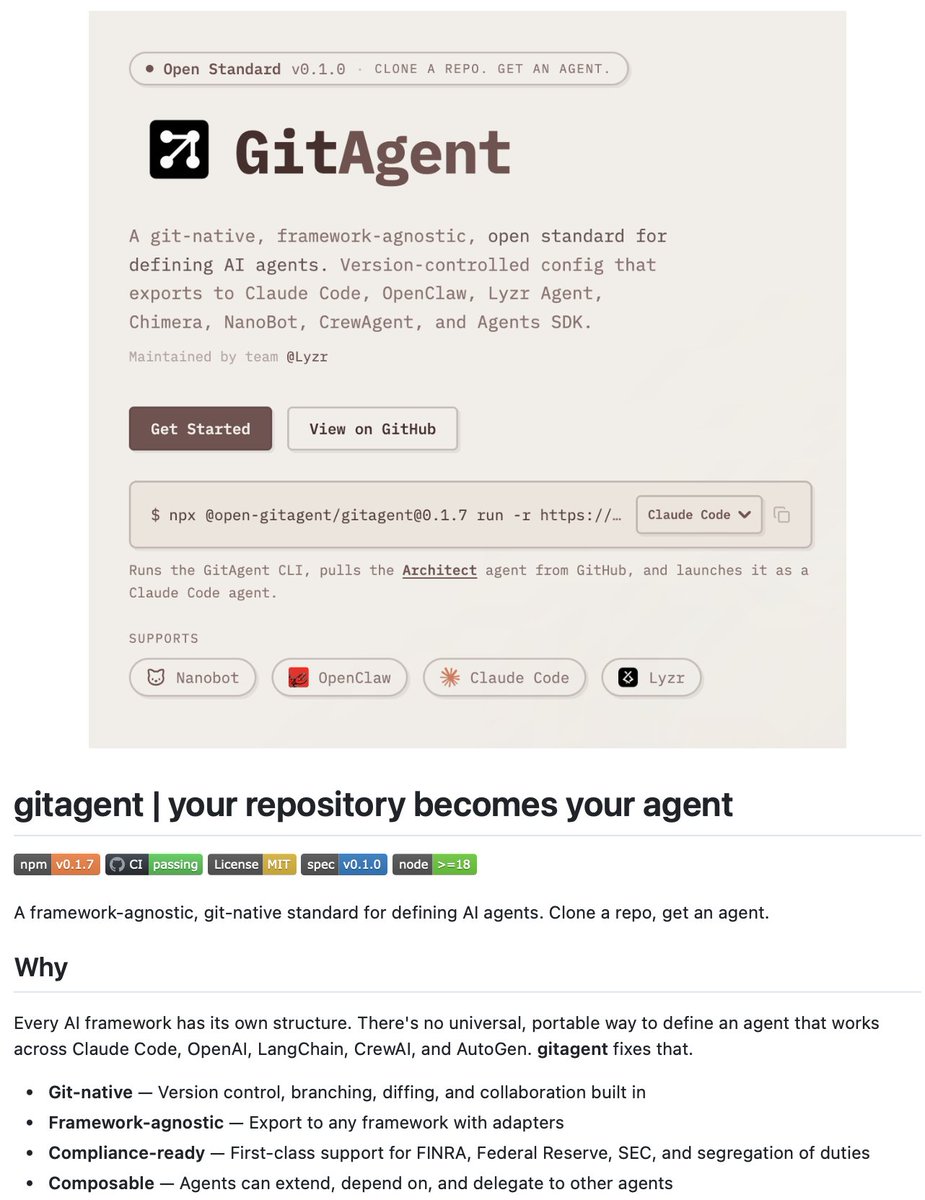
If you found it useful, reshare it with your network Follow me → @Sumanth_077 for more insights and tutorials on AI Engineering! nitter.net/Sumanth_077/status/203… Sumanth (@Sumanth_077) Turn any git repo into an AI agent! GitAgent is a framework-agnostic standard that lets you define agents as git repositories. Every AI framework has its own structure. Claude Code, OpenAI, LangGraph, CrewAI, AutoGen all use different formats. You build an agent in one framework and it's locked there. No portability. No reuse. GitAgent fixes this. Your repository becomes your agent. Drop two files into a git repo (agent.yaml for the manifest, SOUL. md for identity) and it becomes a portable agent definition. Export it to any framework with adapters. You get git's workflow for free. Version control your prompts. Roll back broken changes with git revert. Fork public agents, customize them, and PR improvements back. Run gitagent validate in GitHub Actions to catch issues before deployment. The structure is flexible. Start with just agent.yaml and SOUL. md. Add skills, tools, workflows, memory, and compliance rules as you need them. Everything is optional except those two core files. It works across frameworks. Export to Claude Code, OpenAI Agents SDK, CrewAI, or as a raw system prompt. Same agent definition, different runtimes. Built for compliance. First-class support for FINRA, Federal Reserve, and SEC requirements. Segregation of duties built into the spec. Define roles, conflict matrices, and handoff workflows in agent.yaml. Link to the Github Repo in comments! — https://nitter.net/Sumanth_077/status/2038981420664959188#m
→ View original post on X — @sumanth_077, 2026-03-31 14:07 UTC
-
GitAgent: Framework-Agnostic AI Agent Definition Standard
By
–
Turn any git repo into an AI agent! GitAgent is a framework-agnostic standard that lets you define agents as git repositories. Every AI framework has its own structure. Claude Code, OpenAI, LangGraph, CrewAI, AutoGen all use different formats. You build an agent in one framework and it's locked there. No portability. No reuse. GitAgent fixes this. Your repository becomes your agent. Drop two files into a git repo (agent.yaml for the manifest, SOUL. md for identity) and it becomes a portable agent definition. Export it to any framework with adapters. You get git's workflow for free. Version control your prompts. Roll back broken changes with git revert. Fork public agents, customize them, and PR improvements back. Run gitagent validate in GitHub Actions to catch issues before deployment. The structure is flexible. Start with just agent.yaml and SOUL. md. Add skills, tools, workflows, memory, and compliance rules as you need them. Everything is optional except those two core files. It works across frameworks. Export to Claude Code, OpenAI Agents SDK, CrewAI, or as a raw system prompt. Same agent definition, different runtimes. Built for compliance. First-class support for FINRA, Federal Reserve, and SEC requirements. Segregation of duties built into the spec. Define roles, conflict matrices, and handoff workflows in agent.yaml. Link to the Github Repo in comments!
→ View original post on X — @sumanth_077, 2026-03-31 14:07 UTC
-

Natural-Language Agent Harnesses: Making AI Agent Control Portable and Inspectable
By
–
Agent harnesses are too restrictive. That's because they're still designed as code. What if the harness itself were written in natural language and interpreted by an LLM at runtime? This research explores the idea. The work introduces Natural-Language Agent Harnesses (NLAHs), a structured natural-language representation that externalizes harness logic as a portable, executable artifact. Instead of scattering control flow across controller code, framework defaults, and tool adapters, NLAHs make contracts, roles, stage structure, state semantics, and failure taxonomies explicit and editable. An Intelligent Harness Runtime (IHR) places an LLM inside the runtime loop to interpret and execute these harnesses directly. Why does it matter? Harness design is increasingly decisive for agent performance, but it's buried in code that's hard to transfer, compare, or ablate. NLAHs make the orchestration layer a first-class scientific object. The practical implication: harnesses become portable across runtimes, composable across tasks, and directly inspectable by humans and models alike. Paper: arxiv.org/abs/2603.25723 Learn to build effective AI agents in our academy: academy.dair.ai/