
Increase inference performance by up to 15x without sacrificing responsiveness. DFlash, an open source lightweight block diffusion model designed for speculative decoding, delivers up to 15x higher throughput on NVIDIA Blackwell while maintaining the same user interactivity
TECHNOLOGY
-
AI in 2040: Nearly Optimal Stack, Massive Current Inefficiency
By
–
AI in 2040 will not be built on the stack we use today. It will be much closer to optimal. The current stack exhibits 3-4 orders of magnitude data inefficiency and 4-5 orders of magnitude compute inefficiency. Nearly optimal AI is what
-
Learn Vercel’s new Eve agentic framework with hands-on labs
By
–
Learn to use the new eve agentic framework from Vercel.
— DAIR.AI (@dair_ai) 23 juin 2026
Go try out the hands-on labs now. https://t.co/mC5nsSUNOeLearn to use the new eve agentic framework from Vercel. Go try out the hands-on labs now.
-

ArtiFixer: Generative 3D Scene Reconstruction from Text or Few Views
By
–
ArtiFixer doesn't just clean up 3D meshes—it is a robust generative engine. Even if you entirely drop the initial 3D rendering conditions, the model can rely on text prompts or just a few reference views to reconstruct the high-level structure of the scene and synthesize
-
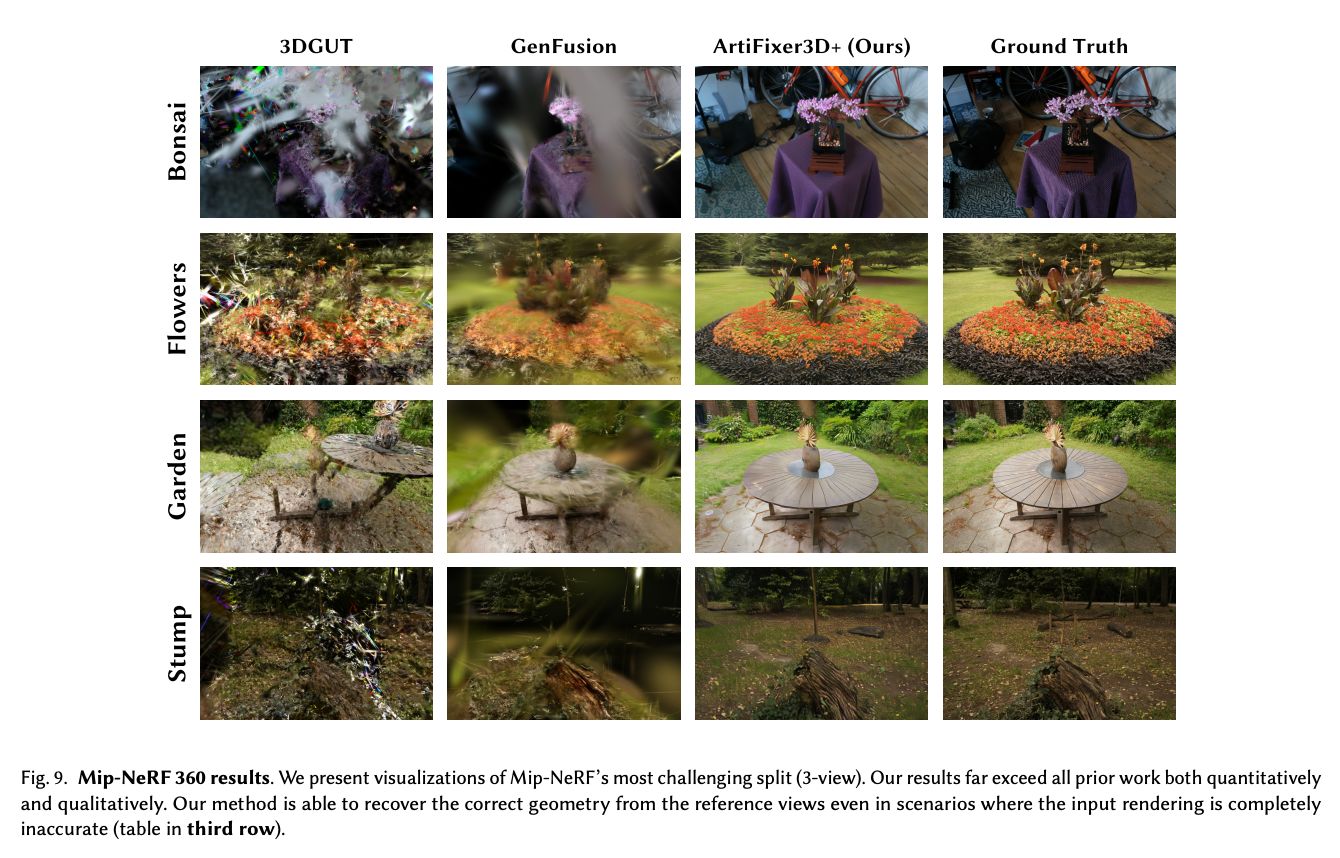
ArtiFixer delivers sharp results, outperforming baselines by 1-3 dB PSNR
By
–
The results are incredibly sharp. When benchmarked on challenging datasets with sparse views like Mip-NeRF 360 and DL3DV, ArtiFixer handles highly degraded initial renderings effortlessly. It outperforms existing baselines (like GenFusion and 3DGUT) by a massive 1–3 dB PSNR
-

ArtiFixer uses DMD to make bidirectional video models 70x faster
By
–
Bidirectional video models provide great coherence but are computationally heavy. ArtiFixer solves this via Self-Forcing-style Distribution Matching Distillation (DMD). By distilling the bidirectional model into a causal auto-regressive one, ArtiFixer achieves up to a 70x
-
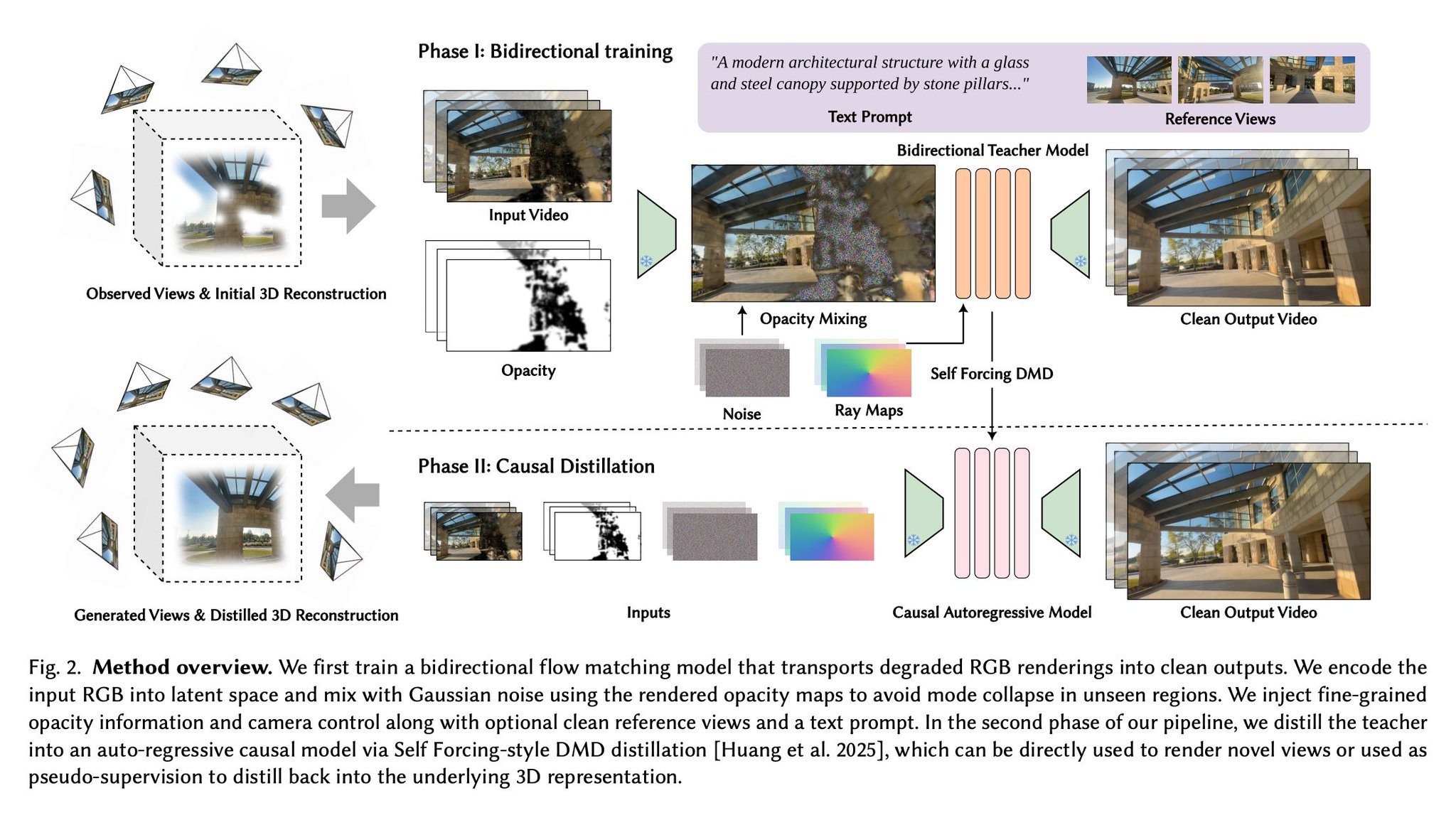
ArtiFixer combines 3D reconstruction and video generation in two phases
By
–
Instead of treating 3D reconstruction and video generation as standalone alternatives, ArtiFixer combines their strengths. > Phase I: Trains a powerful bidirectional generative video model to transport degraded renderings into clean frames.
> Phase II: Distills the teacher model -
NVIDIA Research’s ArtiFixer uses video diffusion to fix 3D reconstruction artifacts
By
–
NVIDIA Research just dropped a game-changer for 3D reconstruction.
— AlphaSignal (@AlphaSignalAI) 23 juin 2026
If you've ever dealt with blurry holes or floating artifacts in 3D Gaussian Splatting, ArtiFixer is the solution.
It uses a powerful auto-regressive video diffusion model to seamlessly repair and extend 3D… pic.twitter.com/5GLByeqf5PNVIDIA Research just dropped a game-changer for 3D reconstruction. If you've ever dealt with blurry holes or floating artifacts in 3D Gaussian Splatting, ArtiFixer is the solution. It uses a powerful auto-regressive video diffusion model to seamlessly repair and extend 3D
-
Over 1 million Android apps created in Google AI Studio last month
By
–
Fun stat: In the last month, people have created more than 1,000,000 native Android apps directly in @GoogleAIStudio
!! Huge amount of progress here and so cool to see the breadth of what folks are building. -
AI Limitations: Latency and Decision Location Drive Edge
By
–
AI isn’t failing because it lacks intelligence.
— Ronald van Loon (@Ronald_vanLoon) 23 juin 2026
In many cases, it’s limited by latency and where decisions happen.
For time-sensitive environments, that’s a critical constraint.
Here’s why AI is moving to the edge, and what it unlocks…
@TMobileBusiness Partner pic.twitter.com/XmoiFQQscvAI isn’t failing because it lacks intelligence. In many cases, it’s limited by latency and where decisions happen.
For time-sensitive environments, that’s a critical constraint. Here’s why AI is moving to the edge, and what it unlocks… @TMobileBusiness Partner