Ignore the noise, follow the signals. Our appetite for Intelligence is infinite. We are severely compute constrained. The ‘token dollar’ will define the next 50 years.
SYSTEMS
-
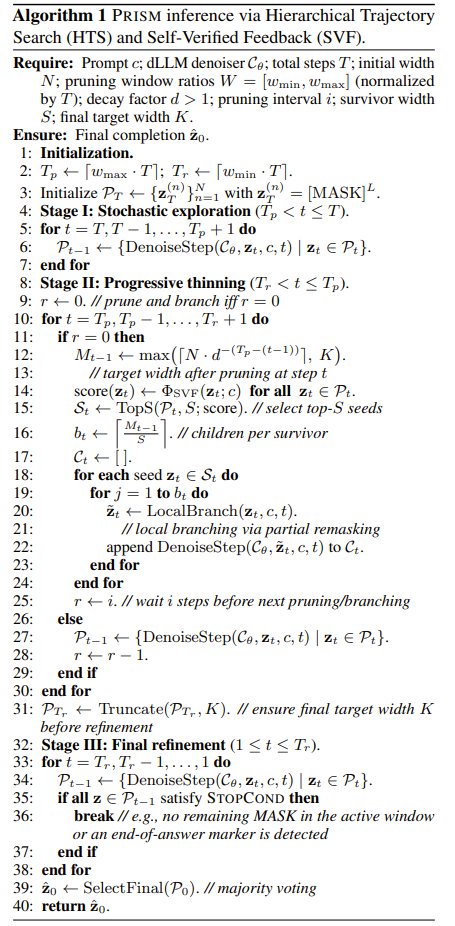
PRISM: Test-time Scaling for Discrete Diffusion LLMs
By
–
What if AI could scale its reasoning without wasting compute? Researchers from NUS, Georgia Tech, and other institutions present PRISM — a test-time scaling method for discrete diffusion language models (dLLMs). It uses hierarchical search to prune and reallocate compute
-

AI-driven perception enables precise robotic navigation
By
–
With 99% accuracy and 400x precision, they can see through boxes and pallets. It’s the difference between a robot that wanders and one that knows where to go.
-
Improving AI stability via deterministic RNG and low-rank perturbations
By
–
of course but EGGROLL’s deterministic RNG exactly reconstructs every low-rank perturbation from seeds making evolutionary paths more auditable/replayable than backprop and Could strengthen persistent AI stability
-

Who controls AI infrastructure and data? Dell AI Factory
By
–
One of the biggest enterprise AI questions right now is simple: who controls the infrastructure and the data? That’s why this matters. Bringing @MistralAI models into the Dell AI Factory with NVIDIA gives enterprises more control over how they train, deploy, and scale AI without
-

MIT’s “Insum” speeds up einsum for sparse datasets
By
–
MIT researchers developed “Insum,” a technique for speeding up computations on datasets replete w/zeros. It rewrites Einstein summation (“einsum”) operations to avoid inefficient handling of zeros, improving memory efficiency & performance: https://
bit.ly/4upJM5s -
AI Tool Saves 120 Work Hours by Automating Task Management
By
–
Rho cut weekly meeting time by 90% with Perplexity Computer. Computer checks Slack, Notion, Jira, Figma, and Google Docs, then flags missing tasks and changes the team needs to see. 120 work hours saved during a 12-week project. Read the customer story:
-

Event: Deploying Long-Running AI Agents at Toronto Tech Week
By
–
We’ll be @ #TorontoTechWeek on 5/27 w/ • Haider Zaidi, Deployed Engineer @LangChain • Jasen Mackie, Senior Principal AI Engineer @Questrade RSVP: https://
luma.com/axp0tudp We'll walk through what it actually takes to deploy long-running agents & the runtime capabilities that -
RAG vs. Cache-Augmented Generation: Optimizing Query Efficiency
By
–
RAG vs. CAG, clearly explained!
— Akshay 🚀 (@akshay_pachaar) 19 mai 2026
RAG is great, but it has a major problem:
Every query hits the vector DB. Even for static information that hasn't changed in months.
This is expensive, slow, and unnecessary.
Cache-Augmented Generation (CAG) addresses this issue by enabling the… https://t.co/WF8cHwTi7v pic.twitter.com/UwQy0ouxHQRAG vs. CAG, clearly explained! RAG is great, but it has a major problem: Every query hits the vector DB. Even for static information that hasn't changed in months. This is expensive, slow, and unnecessary. Cache-Augmented Generation (CAG) addresses this issue by enabling the
-
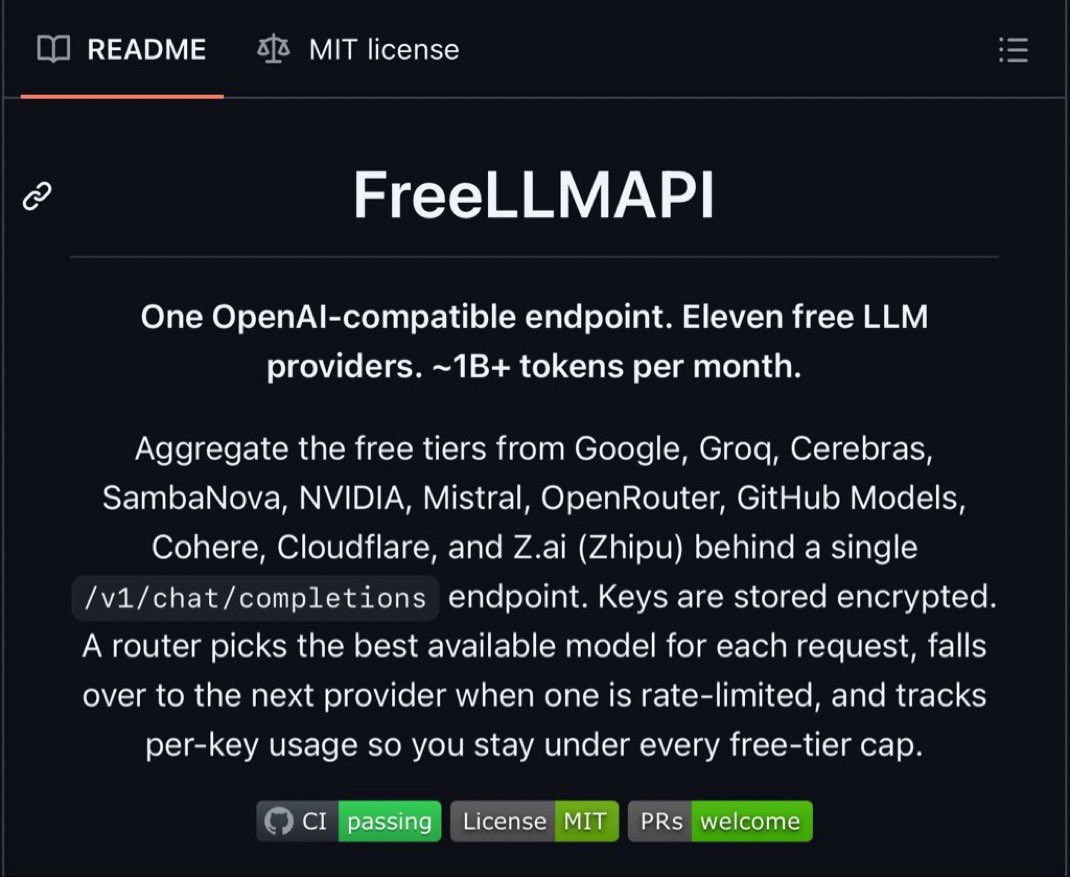
Service pools free tiers of dozens of AI models into one API
By
–
800 million tokens per month. Free. Someone just combined the free tiers of dozens of AI models into a single API. You input your API keys and it automatically manages: • routing between models
• rate limits
• fallback when a provider hits the limit
• load balancing