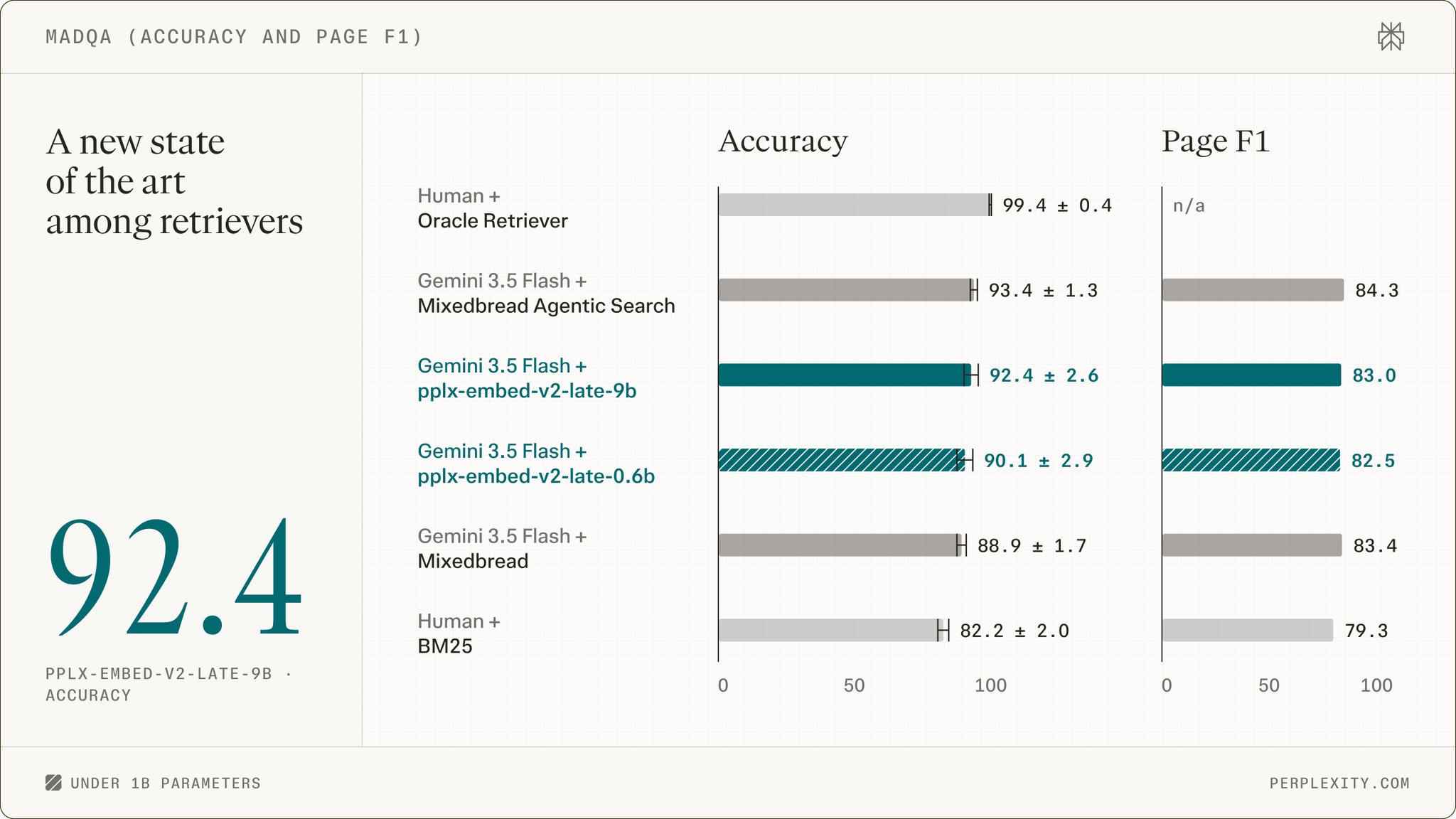
On MADQA, 500 questions over 800 PDFs, it reaches 92.4%, the top result among retrievers.
@perplexity_ai
-
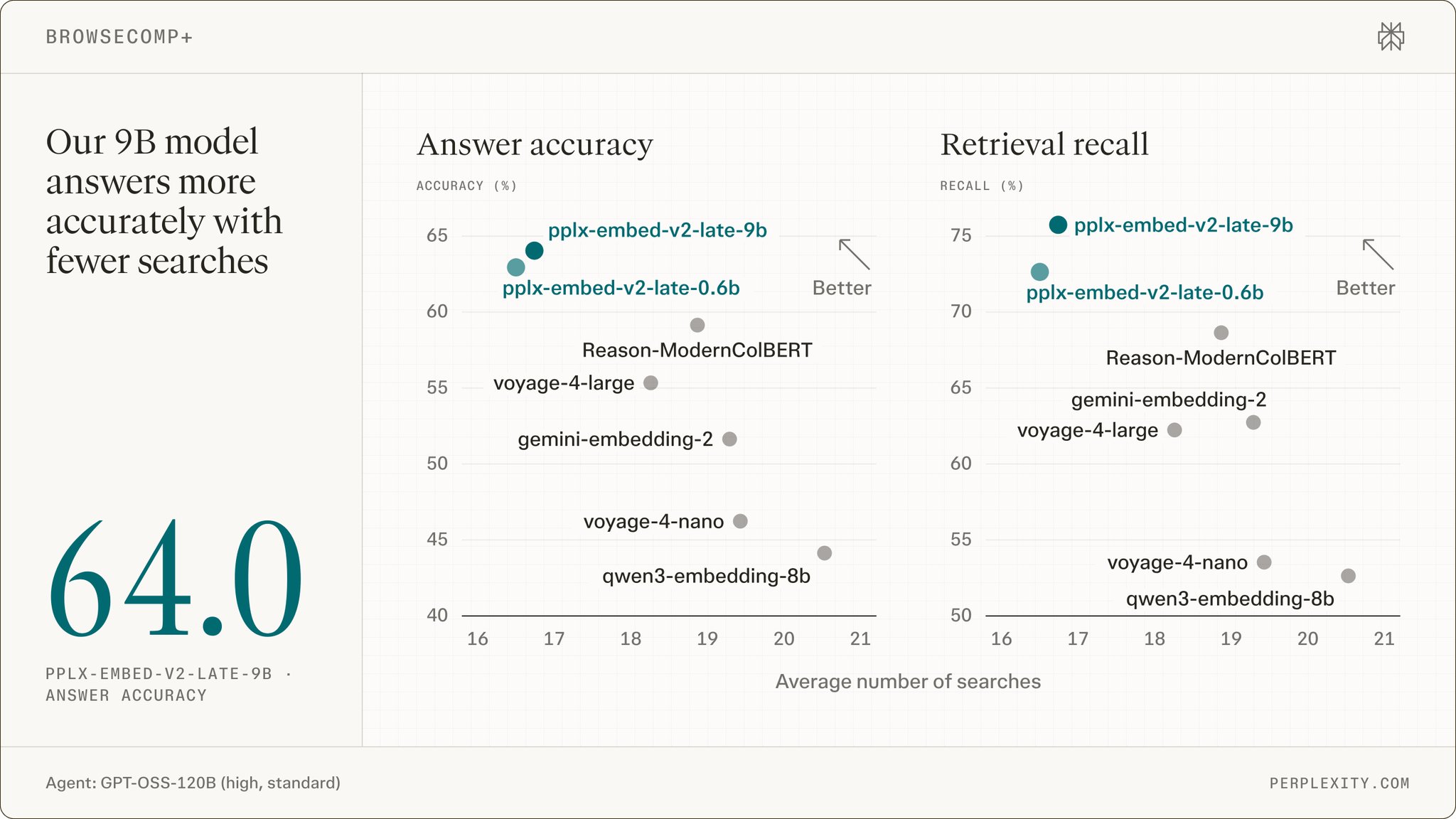
GPT-OSS-120B agent tops BrowseComp+ at 64.0%
By
–
In agentic search, a GPT-OSS-120B agent using the 9B model answers 64.0% of BrowseComp+ questions correctly, 4.9 points ahead of the next ColBERT model, with fewer searches than any baseline.
-
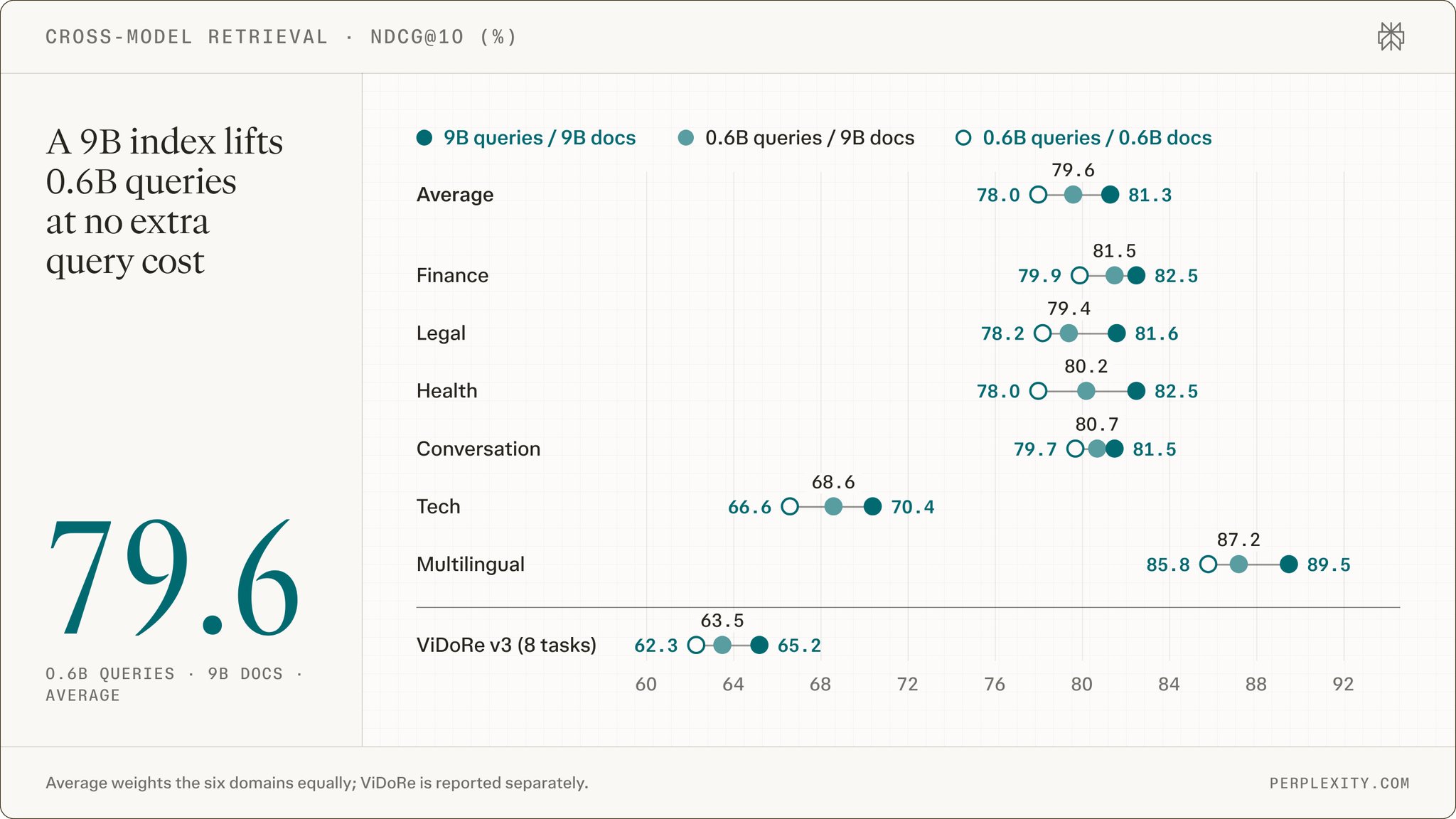
Distilled 9B and 0.6B models share embedding space for retrieval
By
–
Both sizes are distilled token by token from one 18B teacher, so they share one embedding space. A corpus indexed with the 9B model can be searched with 0.6B queries. That lifts ViDoRe v3 from 62.3% to 63.5% with no added query cost.
-
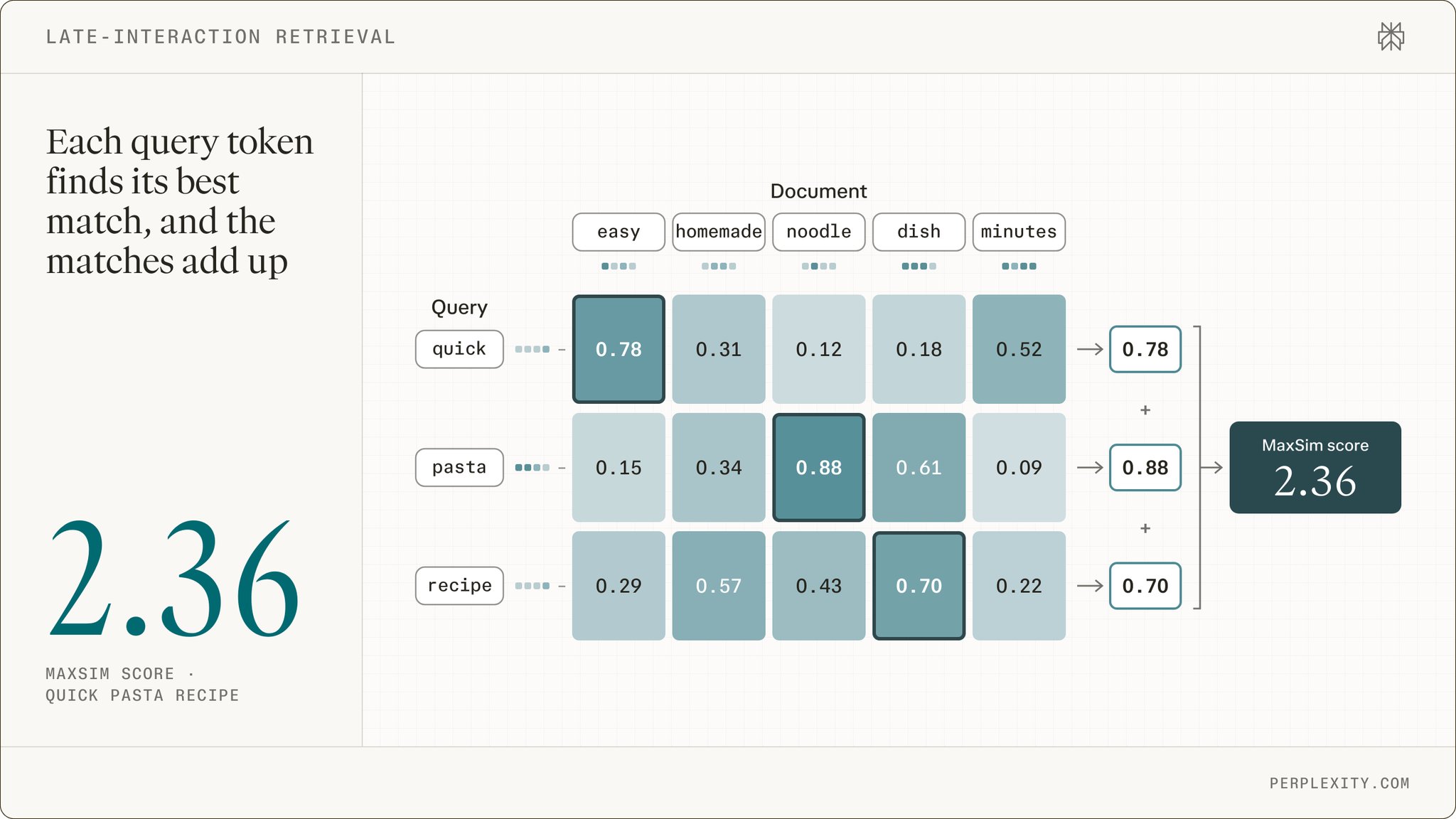
Per-token late-interaction embeddings with MaxSim scoring
By
–
Dense embedding models compress each document into one vector, which loses detail as pages get longer or more visual. pplx-embed-v2-late keeps a 128-dimensional vector per token and scores with MaxSim, so each query token is matched to its closest token in the document.
-
Contextual Embedding Models for Document Retrieval Chunking
By
–
Retrieval systems often split long documents into chunks, but this strips away the surrounding context. Contextual embedding models fix this by encoding the whole document once and pooling chunk vectors afterward. They are usually trained on one gold chunk per query.
-
Perplexity releases contextual embedding model pplx-embed-v2-context-9b
By
–
We built a new way to train contextual embedding models, which encode each chunk of a document with the whole document in view. pplx-embed-v2-context-9b-preview sets a new state of the art on ConTEB and @turbopuffer
's new, privately held context-bench. https://
perplexity.ai/hub/blog/conte
xtual-embedding-beyond-the-gold-passage
… -
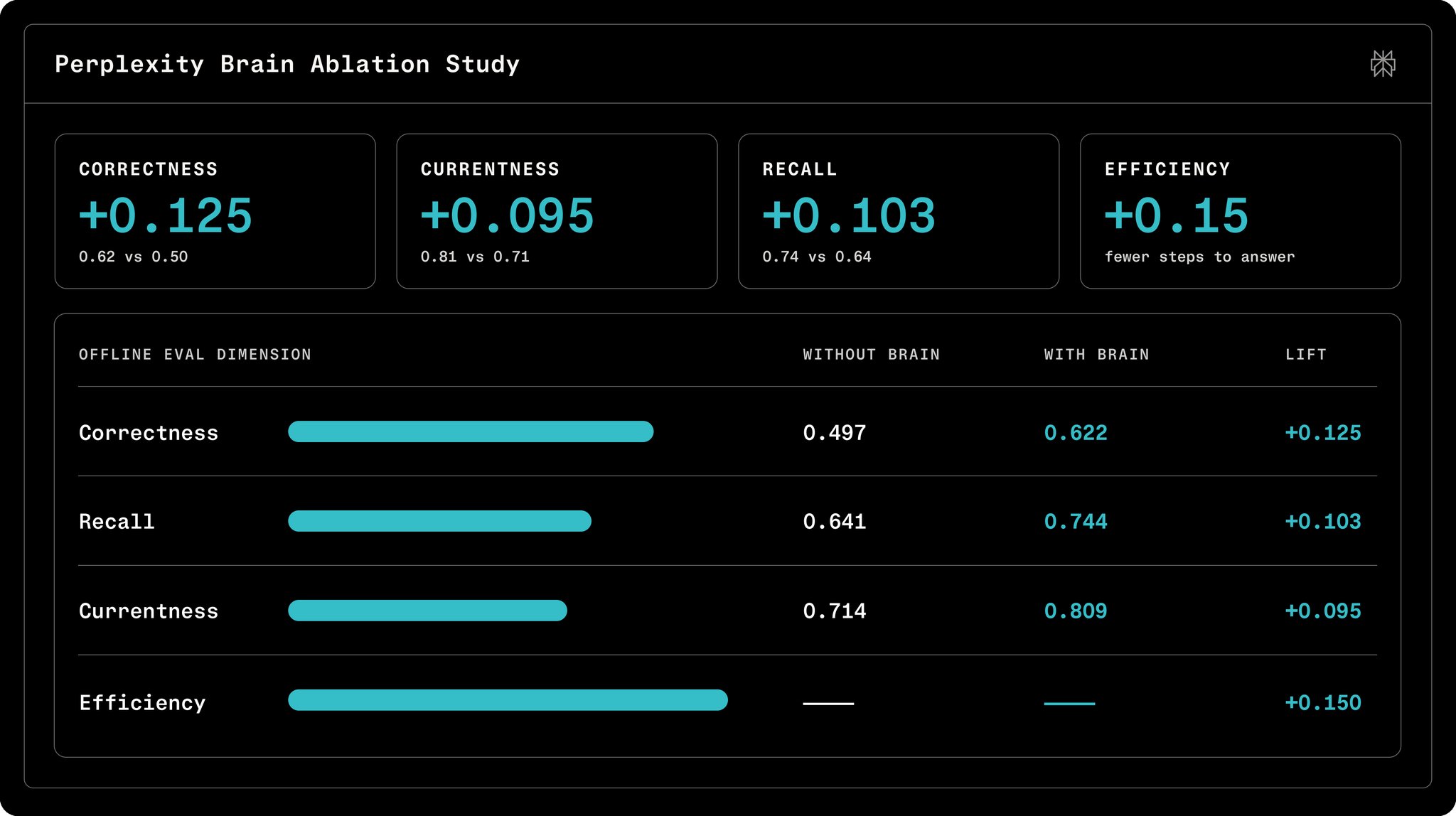
Brain improves accuracy and reduces costs with full context
By
–
With Brain, the computer starts each task with the full context of your projects, decisions, and sources, instead of starting from scratch. On tasks that require past context, Brain improves answer accuracy by 25%, recall by 16%, and reduces costs by 13%.
-
Brain: Continuous Learning Memory for Stateful Computer
By
–
Introducing Brain in Computer.
— Perplexity (@perplexity_ai) 18 juin 2026
Brain is a continuously learning memory system. Every task on Computer plugs into a context graph built by Brain.
It makes Computer more stateful with every run.
Available as a research preview for all Perplexity Max subscribers. pic.twitter.com/Dw4Q7IzmqsIntroduction to Brain in Computer. Brain is a continuous learning memory system. Each task on Computer connects to a context graph built by Brain. This makes Computer more stateful with each execution. Available in research preview for all.
-
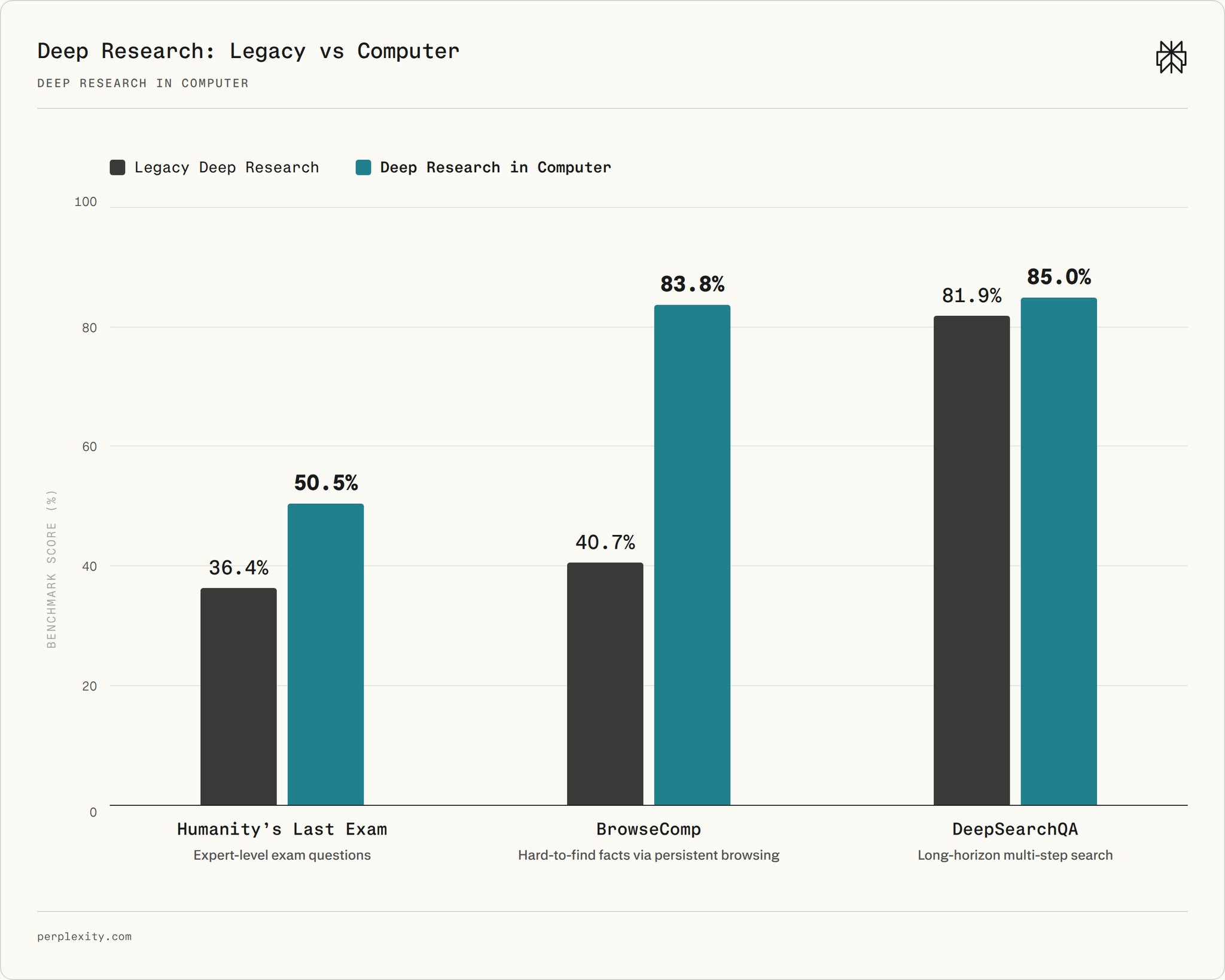
Deep Research in Computer: parallel code-based search
By
–
Deep Research in Computer is based on our Search as Code architecture. The model writes code that assembles the search itself, executing thousands of retrieval steps in parallel, tailored to each question. It surpasses the old Deep Research on all
-
Deep Research integrated as a native capability in Computer
By
–
We're integrating Deep Research as a native skill inside Computer.
— Perplexity (@perplexity_ai) 11 juin 2026
It now connects to the agent harness that powers Computer, with access to search as code generation, long running sandboxes, connectors, tools, and licensed data.
Available now to Pro and Max subscribers. pic.twitter.com/uHpVISkh2PWe are integrating Deep Research as a native capability inside Computer. It now connects to the agent harness that powers Computer, with access to research in the form of code generation, long-lived sandboxes, connectors,