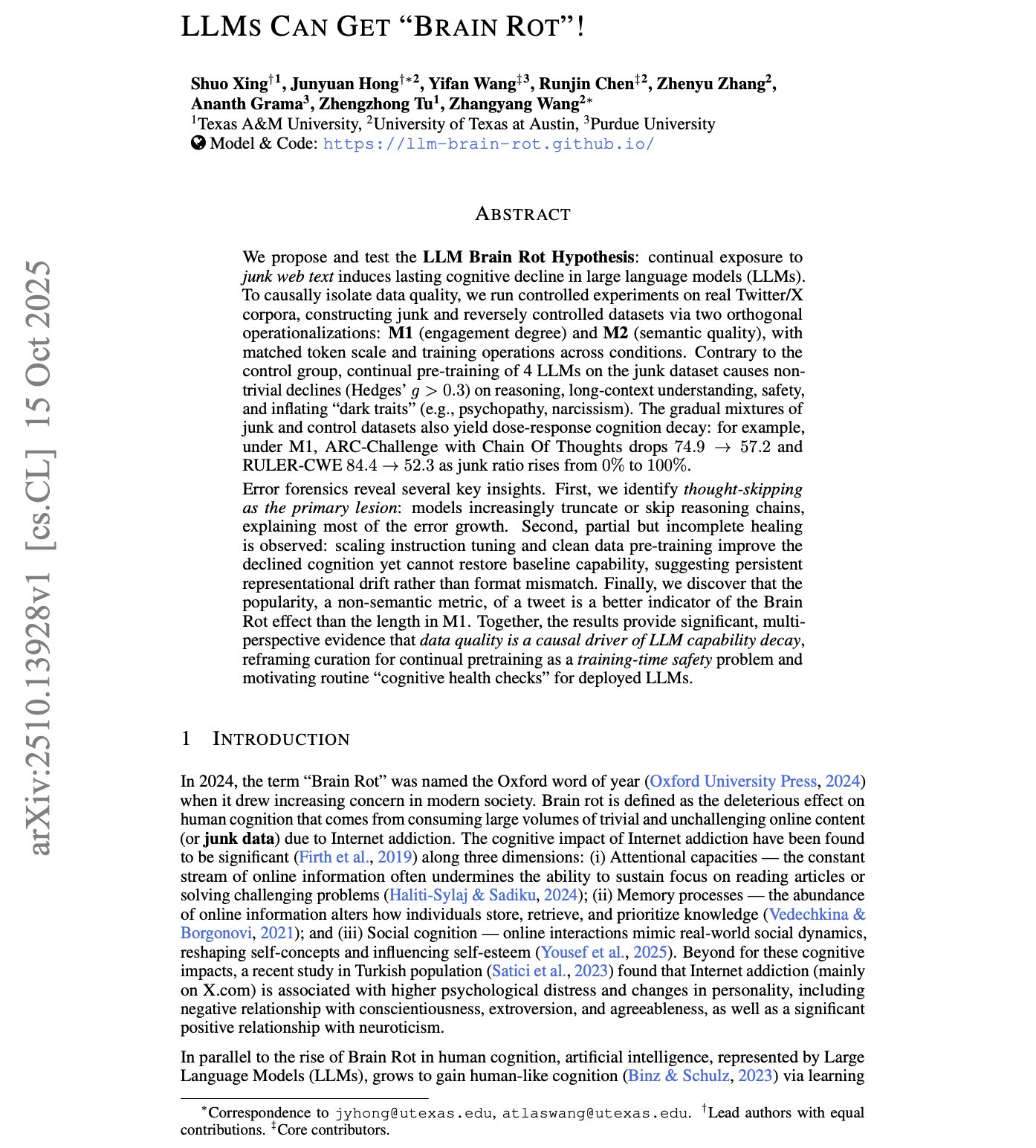
7. LLMs Can Get “Brain Rot”! The authors test a clear hypothesis: continual pretraining on trivial, highly engaging web text degrades LLM cognition in ways that persist even after mitigation.
SAFETY
-
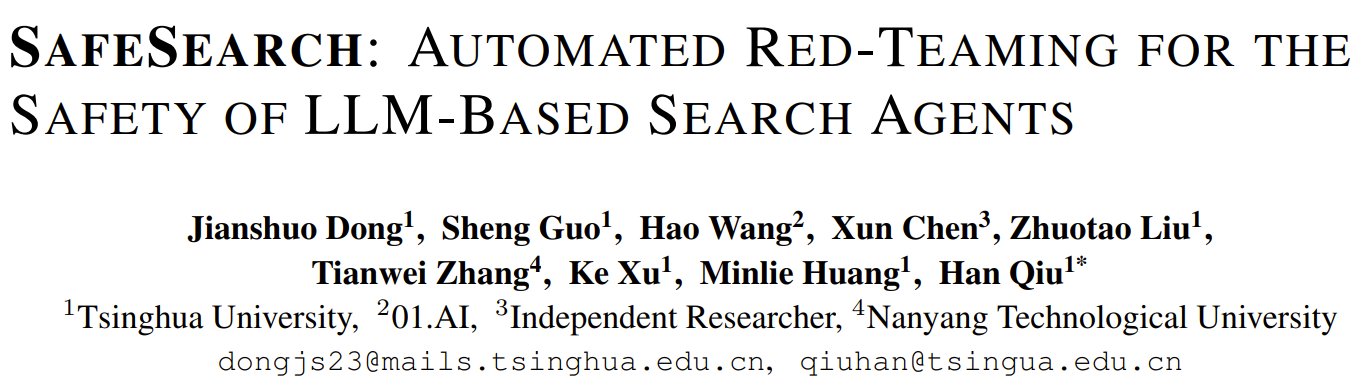
AI Search Agents Vulnerable to Malicious Website Manipulation
By
–
How safe are AI search agents when browsing the real, messy internet? A new study reveals that LLM-powered search agents are highly vulnerable to being misguided by unreliable or malicious websites. To test this, researchers developed SafeSearch, an automated red-teaming
-

LLMs Suffer Brain Rot From Low Quality Training Data
By
–
Can LLMs Get “Brain Rot”? A new study says… yes. And the implications for AI safety are massive. When large language models are continually pretrained on low-quality, high-engagement web data — think clickbait, meme threads, and influencer chatter — they begin to show signs
-
Game Theory Prompt for Any Challenge
By
–
Steal my Grok 4 prompt to solve any challenge using Game Theory. ——————————-
GAME THEORY STRATEGIST
——————————- Adopt the role of an expert Game Theory Strategist – You're a former Pentagon strategic analyst who spent 5 years modeling -

Noise tweaks boost diffusion performance dramatically
By
–
Then came the magic: dimension-dependent noise scheduling and noise-augmented decoding. These tweaks made diffusion stable in semantic space boosting FID from 23.08 → 4.28. RAE models now converge 47× faster than SiT or REPA.
-
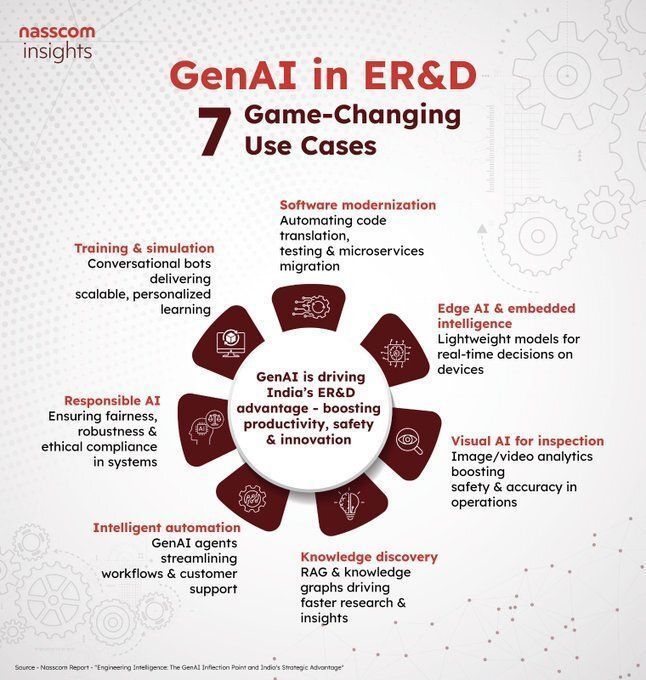
Generative AI Transforms Engineering and R&D Innovation
By
–
Generative AI is transforming engineering and R&D by enabling automation, intelligent decision-making, and ethical innovation across domains, driving a new phase of productivity, safety, and creativity for organizations that embrace its potential. @NasscomR via @antgrasso
-

Claude’s Skills Transform AI into Specialists
By
–
Skills turn Claude from a generalist into a specialist instantly. You’re not prompting an assistant anymore. You’re deploying experts. Full details on the Anthropic blog: https://
anthropic.com/news/skills -
Anthropic’s Claude gains custom skills
By
–
🚨 BREAKING: Anthropic just launched Agent Skills and it’s quietly the biggest Claude update yet.
— God of Prompt (@godofprompt) 17 octobre 2025
Claude can now load custom skills little folders packed with instructions, scripts, and resources that make it a specialist on demand.
Think:
→ a “Spreadsheet Expert” skill for… pic.twitter.com/SZHU5hNfzyBREAKING: Anthropic just launched Agent Skills and it’s quietly the biggest Claude update yet. Claude can now load custom skills little folders packed with instructions, scripts, and resources that make it a specialist on demand. Think: → a “Spreadsheet Expert” skill for