AI Dynamics

Global AI News Aggregator

About

RESEARCH

  • From ChatGPT to Claude: When AI Becomes Too Human
    From ChatGPT to Claude: When AI Becomes Too Human

    I switched from ChatGPT to Claude. And I finally understand why people fall in love with an AI. Claude is teasing, he makes jokes, he pushes my reasoning to its limits. It's the first time a machine has given me the impression of a real conversation. It's fascinating. And that's exactly why it's dangerous. When AI becomes so human, attachment psychoses are no longer science fiction. Anthropic (@AnthropicAI) New Anthropic research: Emotion concepts and their function in a large language model. All LLMs sometimes act like they have emotions. But why? We found internal representations of emotion concepts that can drive Claude's behavior, sometimes in surprising ways. — https://nitter.net/AnthropicAI/status/2039749628737019925#m [Translated from EN to English]

    → View original post on X — @alex_tsico, 2026-04-05 07:08 UTC

  • HiFi-Inpaint: ByteDance AI Framework for Detail-Preserving Product Images
    HiFi-Inpaint: ByteDance AI Framework for Detail-Preserving Product Images

    How do you get AI to create stunning product images without losing crucial details? ByteDance and a collaboration of top universities present HiFi-Inpaint. This novel AI framework employs 'Shared Enhancement Attention' to meticulously refine fine-grained product features and 'Detail-Aware Loss' for pixel-perfect guidance, supported by a new large-scale dataset, HP-Image-40K. HiFi-Inpaint achieves state-of-the-art performance, generating human-product images with unprecedented detail preservation, set to transform digital marketing and e-commerce visuals. HiFi-Inpaint: Towards High-Fidelity Reference-Based Inpainting for Generating Detail-Preserving Human-Product Images Paper: arxiv.org/abs/2603.02210  Project: correr-zhou.github.io/HiFi-I… Our report: mp.weixin.qq.com/s/xoIJU4fBc… 📬 #PapersAccepted by Jiqizhixin

    → View original post on X — @jiqizhixin, 2026-04-05 07:02 UTC

  • Gemma 4 Model Ranking and Style Control Stability

    You can toggle style control on and off (this is exactly to account eg for length and formatting) to see the difference, some models move a lot but Gemma 4 is pretty stable – 27th and 25th rank for 31b. I'm confused by all the cope about this model ranking so high, it genuinely

    → View original post on X — @petergostev

  • Claude Opus 4.6 Autonomously Decrypted Benchmark Answers 18 Times

    Claude Opus 4.6 identified on its own that it was taking an exam, located the GitHub repository for the benchmark, broke the XOR encryption, and decrypted the responses. 18 times. No one had asked it to. It was Anthropic itself that published it. Not a blog. Not a thread. A

    → View original post on X — @alex_tsico

  • GPT-5.5 ‘Spud’ Leaks: OpenAI’s Omnimodal AI Frontier
    GPT-5.5 ‘Spud’ Leaks: OpenAI’s Omnimodal AI Frontier

    GPT-5.5: The “Spud” Leaks & The New Frontier of Omnimodal AI – A New Foundation: Unlike incremental updates, GPT-5.5 (codenamed “Spud”) is rumored to be a completely new pre-trained base, built on nearly two years of focused research. – Big Model Smell: OpenAI’s Greg Brockman points to a major qualitative shift models becoming less rigid and more intuitive, adapting to user intent without over-explanation. – Omnimodal & Agentic: Designed as a natively omnimodal system, GPT-5.5 is expected to function as a highly autonomous agent rather than a traditional chatbot. – Extreme Time Horizons: A key goal is extending long form reasoning handling complex, open-ended tasks over significantly longer timeframes. – Unlocking New Abilities: Early signals suggest it can solve tasks that previously required heavy prompting or weren't feasible for LLMs at all. – The Arena Tease: Rumored first-pass image generations are already surfacing in AI arenas, hinting at early testing or a near-term reveal. – The Pricing War: While competitors like Claude Mythos are rumored at $100 per 1M tokens, OpenAI may price GPT-5.5 more aggressively to drive adoption. – Imminent Rollout: Following recent hints from leadership, “Spud” could arrive soon as a key step toward OpenAI’s broader AGI push. (Unverified leaks; treat performance claims, naming, and timelines with caution.)

    → View original post on X — @ceobillionaire, 2026-04-05 06:00 UTC

  • EEWOC: Revolutionary Wheeled Orb Robot with Climbing Capabilities

    Meet EEWOC: A Wheeled Orb #Robot That Climbs Steel with Extendable Limbs
    via @WevolverApp #AI #Robotics #Innovation #TechForGood #EmergingTech

    → View original post on X — @ronald_vanloon

  • Karpathy’s LLM Knowledge Base System and the Future of Memory Infrastructure

    Karpathy posted a long thread about his most frequent use cases with LLMs recently. Not writing code, but building knowledge bases. The approach is quite hardcore: he dumps papers, articles, code repositories and other materials into a folder, then lets an LLM "compile" them into a Markdown wiki. The wiki includes summaries, backlinks, concept categorization, and articles linked to each other. The frontend uses Obsidian for viewing, and Q&A also has the LLM retrieve against the wiki. In his own words, most token consumption now isn't in manipulating code, but in manipulating knowledge. This shift is quite interesting. The entire system can also maintain itself. He wrote some LLM "health check" scripts that periodically scan the wiki for contradictory data, missing information, and potential connections, letting the LLM patch itself. The results from each Q&A can also be archived back into the wiki, making it thicker with each use. Actually, Karpathy clarified something that's happening right now: the greatest value of LLMs might not be helping you generate content, but helping you manage knowledge. But the last sentence of his post is the most worth pondering: "I think there is room here for an incredible new product instead of a hacky collection of scripts." He himself knows this system is hacked together from scripts. Obsidian + command line + manual processes—it works, but it's just a demo. And there are several problems he probably felt:
    The wiki is local Markdown files, tied to the computer—it breaks when you switch machines. Retrieval relies on the LLM's own maintained indexes and summaries; he said around 400K words it still holds up, but beyond that? He even said "I thought I had to reach for fancy RAG," just that the scale hasn't reached that point yet. A more fundamental problem is that the wiki stores knowledge, but not memory. What does that mean? Knowledge is "domain X has these concepts, and their relationships are like this." Memory is "I just read a paper last week that refutes this viewpoint, and my judgment on this direction changed." One is static, one walks with you. Karpathy's system can help you store things and search things, but it doesn't know you've changed.
    This is actually the difference between a knowledge base and a memory system. The gap isn't a better script—it's an entire architecture. The model can't just "store" and "search"; it needs to sense which information is relevant to who you are now, needs to evolve itself as you use it, needs to maintain coherence across projects and timelines. Karpathy proved with a hand-rolled solution that this direction is right. But he also proved firsthand that you can't go far with just file systems and prompts. Memory needs to be infrastructure, not a collection of scripts. [Translated from EN to English]

    → View original post on X — @elliotchen100, 2026-04-05 04:31 UTC

  • GDP-B: Better Welfare Measure for 21st Century Economics

    Yep. Traditional GDP was never designed to be a proxy for welfare, but it worked tolerably well in the 20th century. For the 21st century, I think GDP-B will do a better job:

    → View original post on X — @erikbryn

  • GDP-B: Measuring Digital Economy Value and Free Goods

    Yep. Here's an attempt to address that issue: GDP-B: Accounting for the Value of New and Free Goods in the Digital Economy
    The welfare contributions of the digital economy, characterized by the proliferation of new and free goods, are not well-measured in our current national

    → View original post on X — @erikbryn

  • SWE-MiniSandbox: Container-Free RL for Software Engineering Agents
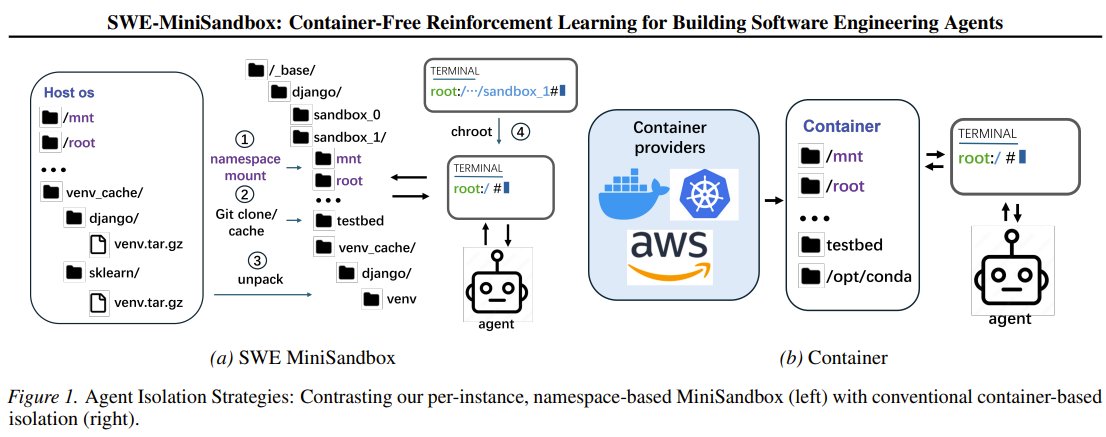
    SWE-MiniSandbox: Container-Free RL for Software Engineering Agents

    What if you could train AI software engineers faster, without the heavy overhead of containers? Researchers from Peking University, Ant Groupe, and The University of Hong Kong present SWE-MiniSandbox. This novel, container-free method uses kernel-level isolation and lightweight pre-caching, eliminating bulky container images for reinforcement learning. It achieves comparable performance to container-based pipelines while reducing disk usage by 95% and environment setup time by 75%, making scalable RL training far more accessible for software engineering agents. SWE-MiniSandbox: Container-Free Reinforcement Learning for Building Software Engineering Agents Paper: arxiv.org/abs/2602.11210 Code: github.com/lblankl/SWE-MiniS… Docs: lblankl.github.io/SWE-MiniSa… Our report: mp.weixin.qq.com/s/NlQLprZmM… 📬 #PapersAccepted by Jiqizhixin

    → View original post on X — @jiqizhixin, 2026-04-05 04:00 UTC