AI Dynamics

Global AI News Aggregator

About

RESEARCH

  • ASI-Evolve: AI System Achieving Self-Improving Automated Research
    ASI-Evolve: AI System Achieving Self-Improving Automated Research

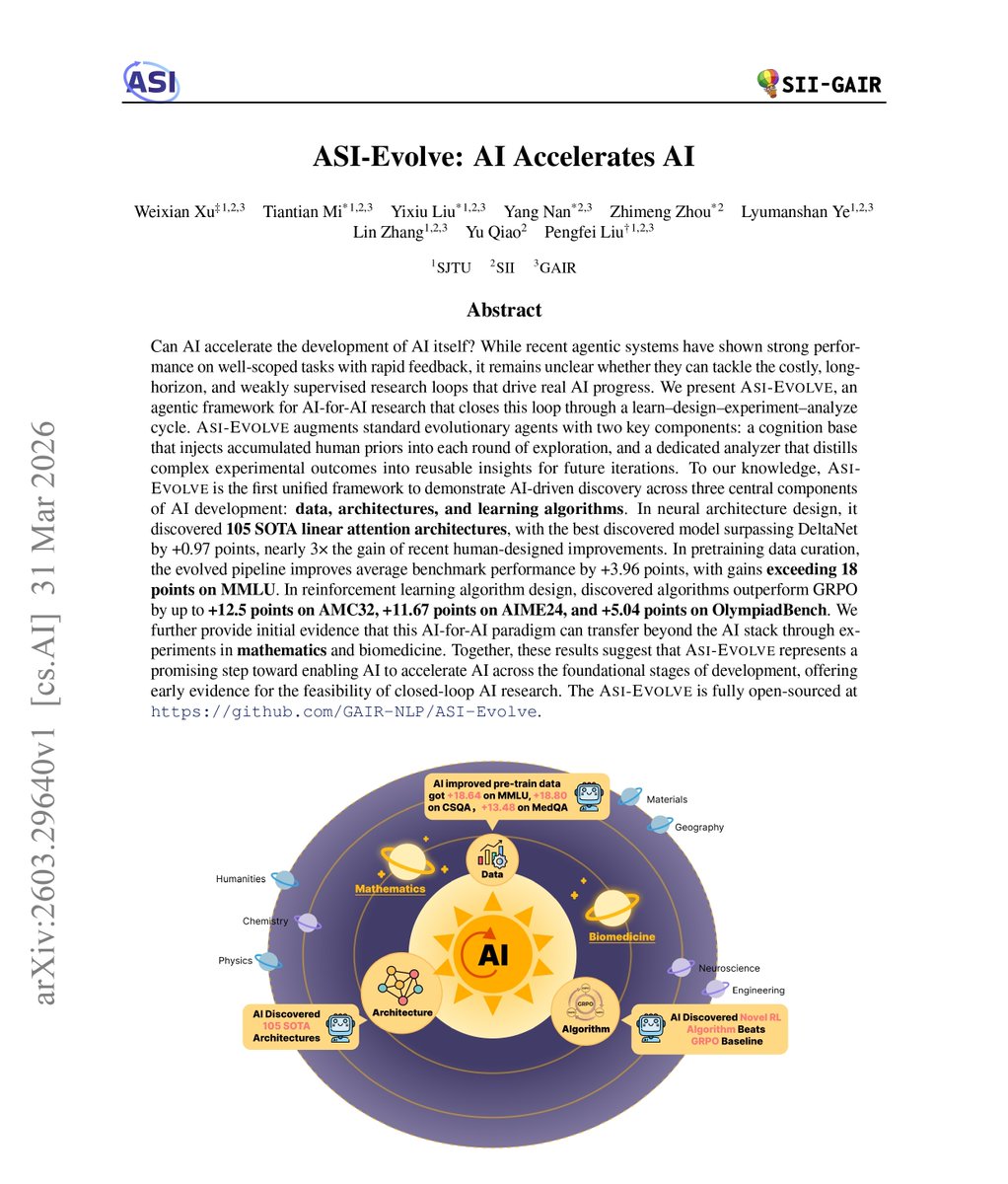
    wow, insane AI news We may have just crossed the line where AI research becomes automated and self improving. This paper introduces ASI-Evolve, a system where AI doesn’t just use tools… it becomes the researcher. Instead of humans designing better models, AI now runs a full scientific loop on itself: learns from past research designs new ideas runs experiments analyzes results improves itself… again and again It already produced real results: Discovered 100+ new neural architectures Beat human designed improvements by ~3x Improved training data pipelines significantly Invented new RL algorithms outperforming existing ones AI/acc

    → View original post on X — @deeplearn007, 2026-04-06 16:25 UTC

  • Building Open-Source Frontier Agents Through Crowdsourced Dataset Sharing
    Building Open-Source Frontier Agents Through Crowdsourced Dataset Sharing

    We keep saying we want open-source frontier agents. Fine. Then let’s build the dataset. @badlogicgames, creator of Pi, just shared some of his agent traces used to build Pi on @huggingface. I’m now sharing some of mine too, exporting them from @hermes, @opencode, and Claude via @tracesdotcom, and I’ll keep going. Why this matters: one of the biggest bottlenecks for open-source agent models is the data. And all of us are generating that data every day through our conversations with agents. If enough builders share even a slice of their traces publicly, we can create the largest crowdsourced open dataset for agents. Time to put your tokens where your mouth is and give a chance for open source to win!

    → View original post on X — @clementdelangue, 2026-04-06 16:22 UTC

  • Meta Harnesses: Automated Framework Optimization for AI Tasks
    Meta Harnesses: Automated Framework Optimization for AI Tasks

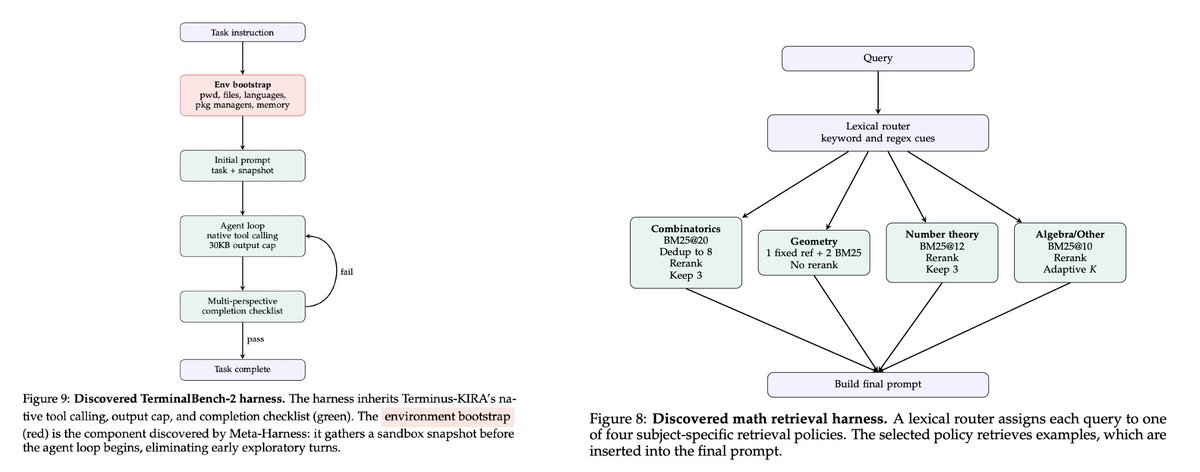
    Meta Harnesses is Autoresearch on steroids. Something I've been exploring recently is to get long running agents to hill climb on a verifiable task to continuously improve without my intervention. Karpathy's Autoresearch did this pretty well on specific tasks, but this weekend I tried Meta Harnesses which moves one level of abstraction up. What does Meta Harness do? Autoresearch can be used in harness like Claude Code / Codex to generate experiments to try, evaluate results, and continue looping. Meta Harness generates a harness itself that optimizes on a task or a set of task. Here, we define a harness as "a single-file Python program that modifies task-specific prompting, retrieval, memory, and orchestration logic". The idea is that LLMs are very powerful today, but to harness [pun intended] their power, you need to give it the right prompts and context. Meta Harnesses automates coming up with the right prompts and the right way to retrieve context to solve a problem. Where did this idea come from? This is from a paper from Stanford and the author of DSPy written last week. The paper shows fantastic performance on 3 tasks: text classification, math reasoning (IMO level problems) and coding (Terminal Bench 2.0), far outperforming traditional harnesses. The discovered harnesses are interesting: math for example, splits up the logic into different categories (Combinatorics, Geometry, Number Theory, Algebra) and prompts and looks at the context differently. The coding harness, amongst other things, pre-processes the tools available in the environment to save exploratory turns. When should you use and not use it? Meta Harnesses seem pretty useful for tackling a specific but wide set of problems where the result is verifiable. In contrast, when I tried it on a specific task like Chess, it arbitrarily divides the problem into separate tasks – opening, mid game, end game, and creates different approaches for each. This "works" but isn't really clean because we believe there should be one approach that does all three. It does far better on things like examinations (JEE, Gaokao) where it splits problems into categories and tackles each category with different strategies. This paper covers a pretty light version of what a harness means. In the future, we can split up tasks into harnesses that have access to specific kinds of data, specific toolchains and various models to get even better results. Overall, pretty cool applied AI approach to hillclimb a verifiable task in a specific domain with variety within the problem space.

    → View original post on X — @askalphaxiv, 2026-04-06 16:22 UTC
  • OSGym: Scalable Infrastructure for Computer Use AI Agents
    OSGym: Scalable Infrastructure for Computer Use AI Agents

    How do you train AI agents that can use computers like humans? Introducing OSGym: Scalable OS Infrastructure for Computer Use Agents. It’s large-scale training made possible by extensive infra optimization: • 1024 OS sandboxes running in parallel • $0.23 / sandbox / day (90% cost down) • 1420 trajectories per minute • 37× faster disk provisioning • 88% less physical disk usage • RAM-bound orchestration (10× scalable than CPU-bound) 🧵

    → View original post on X — @mit_csail, 2026-04-06 16:22 UTC

  • Statistics and Machine Learning: Tom Mitchell interviews Michael I. Jordan

    New podcast episode for you! The field of Statistics enters the Machine Learning conversation, as @tommmitchell talks with Michael I. Jordan of @inria_paris! Watch here: piped.video/BfBxS2rEH3k

    → View original post on X — @stanfordhai, 2026-04-06 16:18 UTC

  • Hugging Face and SAIR Foundation Collaborate on AI Science Competitions

    We’re excited to announce our collaboration with @huggingface. Through SAIR competitions, we aim to provide open data, benchmarks, tools, and models, and expand the frontier of AI x Science through collective contributions from the community. SAIR on Hugging Face: huggingface.co/SAIRfoundatio…

    → View original post on X — @huggingface, 2026-04-06 15:56 UTC

  • OpenAI’s $121B compute spending sparks AI infrastructure crunch concerns

    OpenAI projecting $121 billion in compute spending for AI research in 2028, with costs climbing to $125 billion annually by 2030. All signs point to the coming compute crunch. The AI companies with their own physical infrastructure, who create electricity generation as core

    → View original post on X — @ninadschick

  • LLMs and Rhetoric: Persuasive Machines Indifferent to Truth

    Persuasive machines: large language models and the art of rhetoric
    link.springer.com/article/10…
    ✍️ @David_Gunkel via "AI & Society on @SpringerNature 👉 "What LLMs do not do, is care about the truth of the matter. They are not designed to know whether what they say is true, only whether it is likely, fitting, coherent, and contextually appropriate given the prompt and the data on which they have been trained"
    💡 "The problem with LLMs is not simply that they sometimes get things wrong. It is that they operationalize at scale a mode of discursive activity long regarded with suspicion in the Western philosophical tradition: rhetoric" @Corix_JC @ahier @sim010101 @maponi @sallyeaves @CEO_AISOMA @dinisguarda @JagersbergKnut @Shi4Tech @FernandaKellner @EstelaMandela @sulefati7 @SusanHayes_ @PVynckier [Translated from EN to English]

    → View original post on X — @nicochan33, 2026-04-06 15:49 UTC

  • Key aspect for next generation AI model development

    Justo. Es quizás el aspecto más importante a prestar atención en el desarrollo de los próximos modelos.

    → View original post on X — @dotcsv

  • AI and LLMs: Accelerating Scientific Discovery and Knowledge Generation
    AI and LLMs: Accelerating Scientific Discovery and Knowledge Generation

    NEW VIDEO on DOTCSV! On the main channel! And with one of the most important topics that can be discussed… Is AI accelerating science?
    Can an LLM generate new knowledge?
    … Today we talk about the BIG LOOP

    → View original post on X — @dotcsv