OmniManip: Towards General Robotic Manipulation via Object-Centric Interaction Primitives as Spatial Constraints https://
omnimanip.github.io https://
arxiv.org/abs/2501.03841
RESEARCH
-
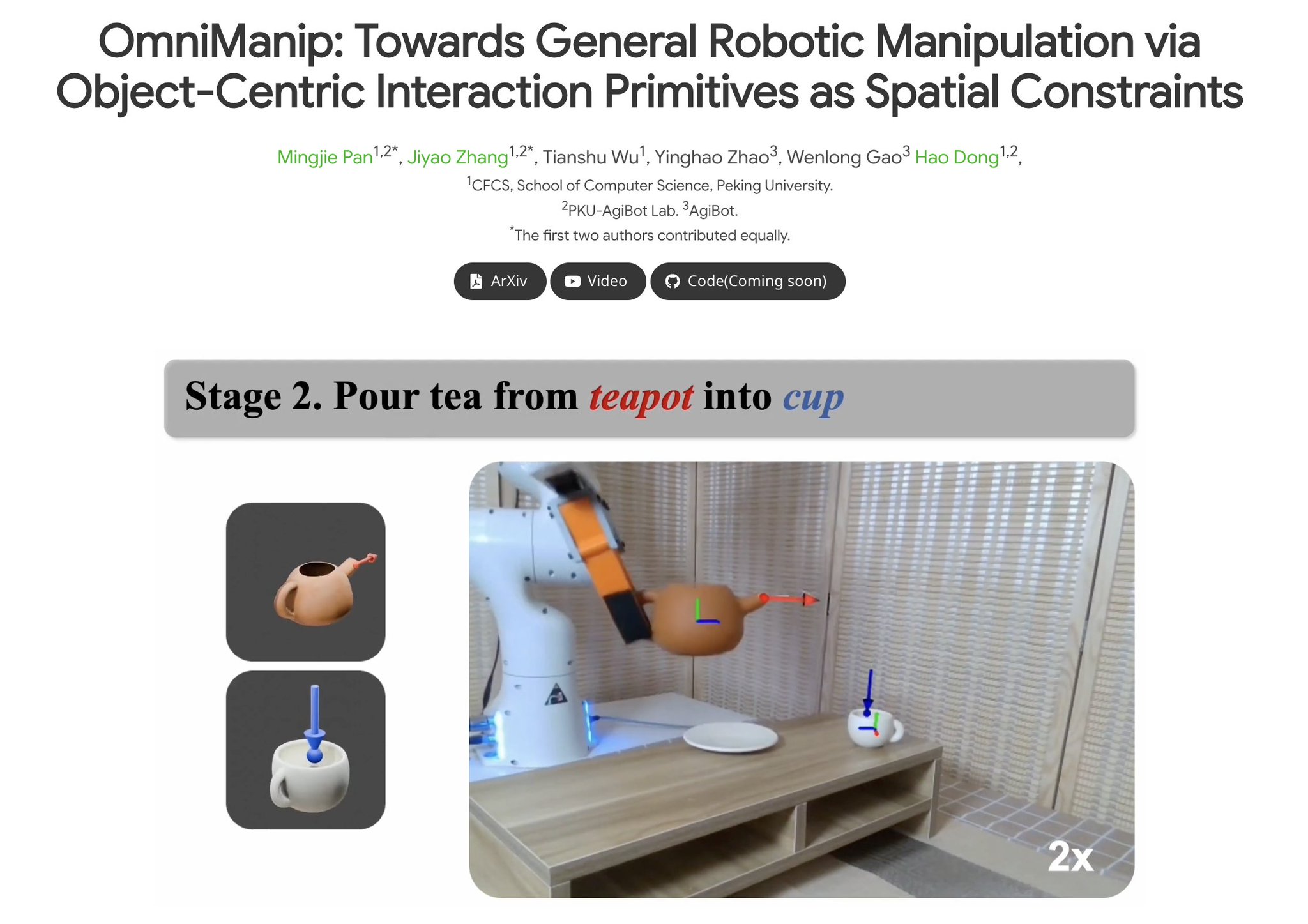
OmniManip: General Robotic Manipulation via Spatial Constraints
By
–
-
Quantum Search: Exploring Simultaneous Path Solutions
By
–
🔍 The Magic of Quantum Search – Imagine Finding Every Hidden Path at Once!
— Pascal Bornet (@pascal_bornet) 22 janvier 2025
Ever wondered how you could solve a puzzle by checking every possible solution simultaneously? That's the mind-bending power of quantum search! Unlike traditional computers that check one path at a time,… pic.twitter.com/hQYBYjIUiSThe Magic of Quantum Search – Imagine Finding Every Hidden Path at Once! Ever wondered how you could solve a puzzle by checking every possible solution simultaneously? That's the mind-bending power of quantum search! Unlike traditional computers that check one path at a time,
-
Michael I. Jordan Wins Frontiers of Knowledge Award in Machine Learning
By
–
Congratulations to BAIR faculty member Michael I. Jordan who has been awarded the Frontiers of Knowledge Award in the Information and Communication Technologies category "… for core contributions in Machine Learning that have pioneered the development of biometrics and
-
CAG vs RAG vs Hybrid: Choosing the Right Data Approach
By
–
So, Which One Should You Use?
• CAG: Perfect for smaller, static datasets where speed and simplicity matter most.
• RAG: The go-to for large, dynamic datasets where real-time retrieval is a must.
• Hybrid: Why not combine both? Use CAG for frequent queries and RAG for edge -
CAG Approach Eliminates Retrieval Latency in AI Systems
By
–
Why is this CAG thing exciting:
• There's no retrieval latency. It just answers much faster.
• It's much simpler, with no complex retrieval pipelines or anything to build, really.
• Avoids retrieval-related mistakes (obviously, since there's no retrieval) -
CAG Preloads Knowledge into Long-Context Model Memory
By
–
On the other hand, CAG preloads all the necessary knowledge into a long-context model’s memory in its KV cache. A complicated way of saying the database here is pre-computed into the model's initial state.
-
RAG vs CAG: Understanding Two Augmented Generation Approaches
By
–
So you are wondering between these two options: Retrieval-Augmented Generation (RAG) Cache-Augmented Generation (CAG) What are those?
-
CAG vs RAG: New Approaches to Reduce AI Hallucinations
By
–
AI keeps evolving, and so do the ways we integrate knowledge into language models. CAG (Cache-Augmented Generation) is the new "hot sauce" for tackling hallucination and speeding up AI responses. But where does it fit alongside RAG (Retrieval-Augmented Generation)?
-

Gemini 2.0 Flash Thinking Achieves 73.3% AIME Math Score
By
–
Our latest update to our Gemini 2.0 Flash Thinking model (available here: https://
goo.gle/4jsCqZC) scores 73.3% on AIME (math) & 74.2% on GPQA Diamond (science) benchmarks. Thanks for all your feedback, this represents super fast progress from our first release just this past -
Stanford AI Director: Guiding AI Development in Positive Direction
By
–
WATCH: @StanfordHAI co-director James @landay spoke with @Axios @inafried at @DLDConference
, joining innovators and visionaries at the event's 20th year. "We need to make sure we guide AI in a positive way, because it won't end up being good by itself."