
Beyond these insights, researchers found that developers in different countries (mainly the US & China) are taking markedly different approaches to agent development.
RESEARCH
-
Agent Data Protocol Accepted to ICLR 2026 Oral Presentation
By
–
Updates: Excited to share that Agent Data Protocol (ADP) is accepted to ICLR 2026 Oral! 🎉 We also added support for 3 new datasets: SWE-Play, MiniCoder, and Toucan, bringing us to 3M trajectories supported. If you're training agentic LMs, try ADP + tell us what dataset/agent format you want next. PRs & requests welcome. Let's make this the open standard for agent training data 🔥 🚀Original post: nitter.net/yueqi_song/status/1983… 📄Read our paper: arxiv.org/abs/2510.24702 🌐Check our project website: agentdataprotocol.com
-

Meta’s Sphere Encoder Revolutionizes Image Generation Speed
By
–
"Image Generation with a Sphere Encoder" This paper from Meta shows that you can skip diffusion sampling by training a Sphere Encoder whose latents are forced to uniformly fill a hypersphere. So generation now becomes: sample one random point -> decode This cuts hundreds of
-
KLong: Training LLM Agents for Extremely Long-Horizon Tasks
By
–
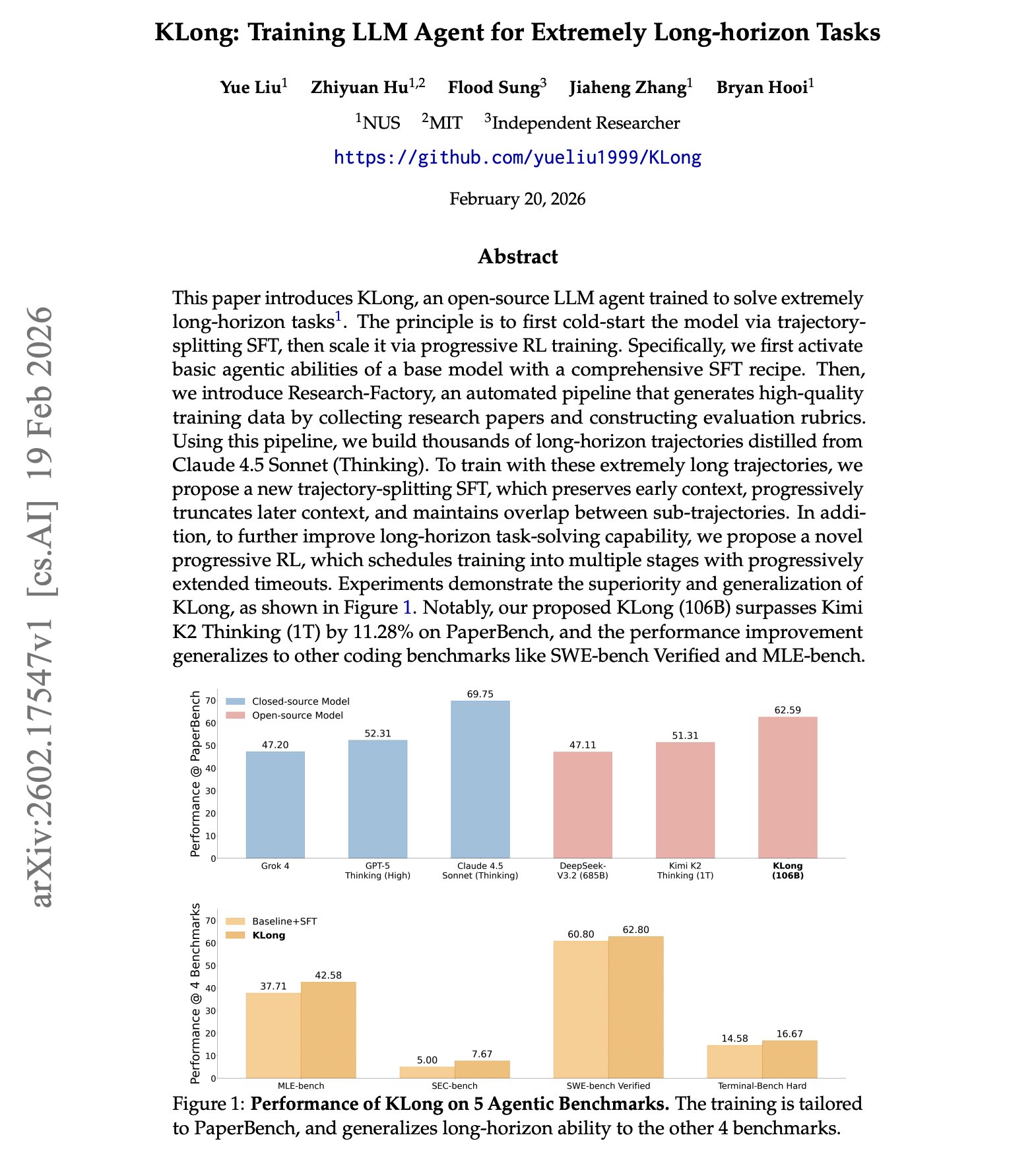
Training LLM agents for extremely long-horizon tasks remains an open challenge. Most agent training pipelines struggle with extended-duration trajectories. Context gets lost, rewards are sparse, and the learning signal degrades over long sequences. KLong tackles this with a
-
AI Impact on Professional Roles and Developer Growth Trends
By
–
Do you extend that same rationale to, say, marketing roles? Science? Education? Is there a line of expertise that goes away? And what is your data for not having more builders (your last statement) – all codex and Claude code and openclaw signs are pointing in the opposite
-

AAAS 2026 Highlights: Science, Policy, and Research Innovation
By
–
✨ New Article: #AAASmtg Highlights! ✨ @aaas is where science and policy meet, and this year’s Science @ Scale theme brought big ideas from across the research landscape. From climate and public health to biomedical innovation, it was inspiring to step outside our usual orbit—and even convert a few particle physicists into organ‑on‑chip fans. This year, we saw real momentum for non‑animal, human‑relevant science. SAO’s Gabby Vidaurre, PhD delivered a standout Postdoc Talk on our Research Modernization NOW #SciPol roadmap, and AI‑driven innovations took center stage—from lung‑ultrasound interpretation to exposome analytics. The SNAP Coalition made AAAS history with the first‑ever graduate student–led plenary, and science‑integrity icon @MicrobiomDigest reminded us why integrity is essential to all of what we do. ⬇️ Read the full recap, also featuring @AnimaAnandkumar of @CaltechEAS, @ThomasHartung19 of @jhucaat, and researchers from @ASU, @asuhealth, and @tue_mech: linkedin.com/pulse/sao-actio…
→ View original post on X — @animaanandkumar, 2026-02-20 15:20 UTC
-
Dynamic Multi-Agent Systems with Population Growth and Adaptation
By
–
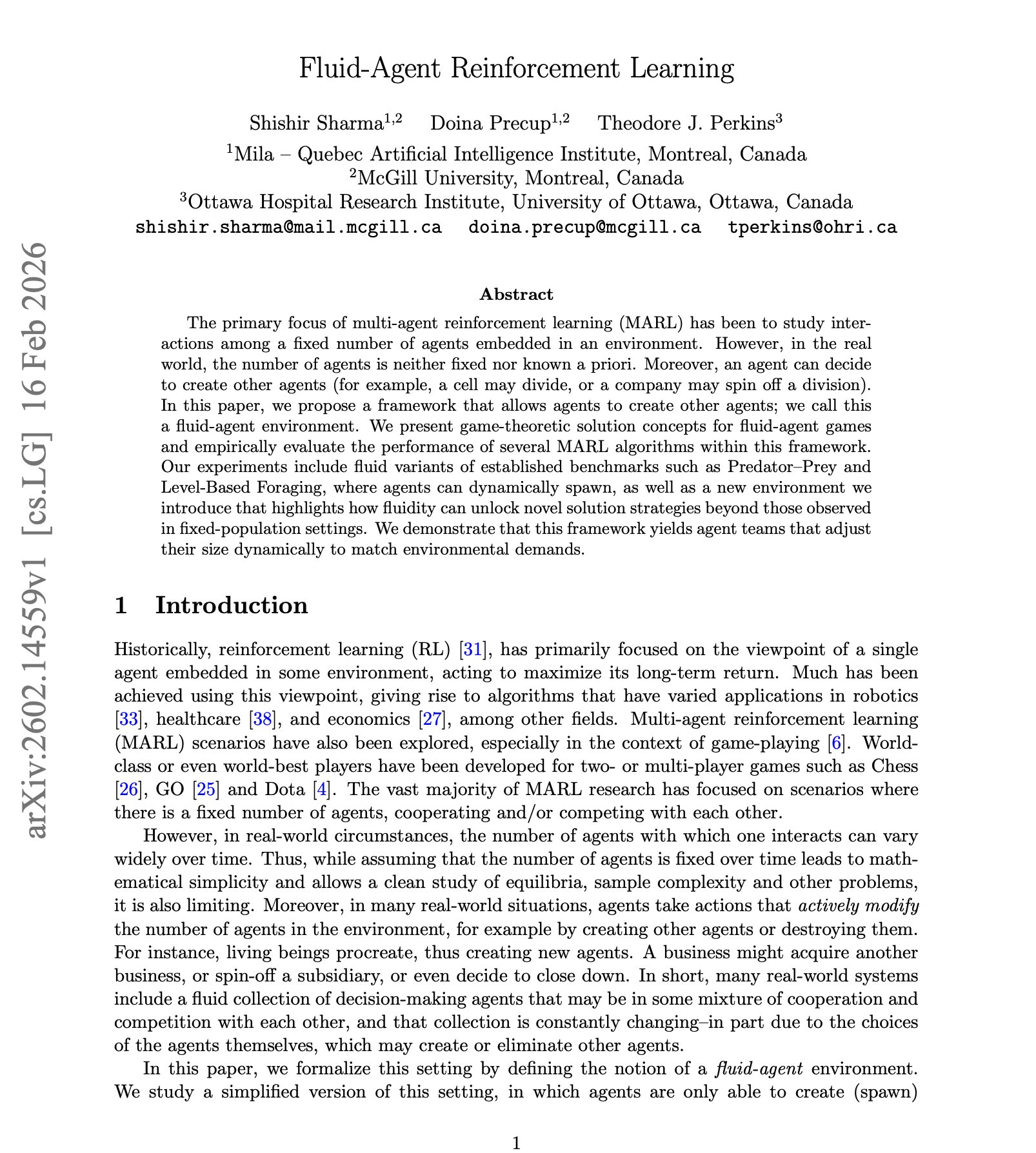
Interesting new work on dynamic multi-agent systems. Traditional multi-agent RL assumes a fixed number of agents. But real-world scenarios often involve populations that grow, split, or shrink dynamically, such as cell division, team expansion, or organizational scaling.
-
Language Models Acquire Reasoning Through Reinforcement Learning Training
By
–
The models will acquire some amount of verbal reasoning just from the language modelling objective. But reinforcement learning training that specifically targets reasoning paths does give you something quite different.
-
Recursive Tape for Variable-Length Symbolic Model Computations
By
–
The model needs some recursive tape to perform variable-length symbolic computations. You could do this with activations, but it's somewhat nice to be able to read the trace. Then we need it to actually move purposefully, and use that tape well.
-
Gemini models reasoning behavior and objective function optimization
By
–
This gets tricky and I'll have trouble answering well in non-premium tweets. If you use a Gemini model and turn off the reasoning, it will 'reason' in the output space instead if you let it. What matters is the objective function and the training protocol