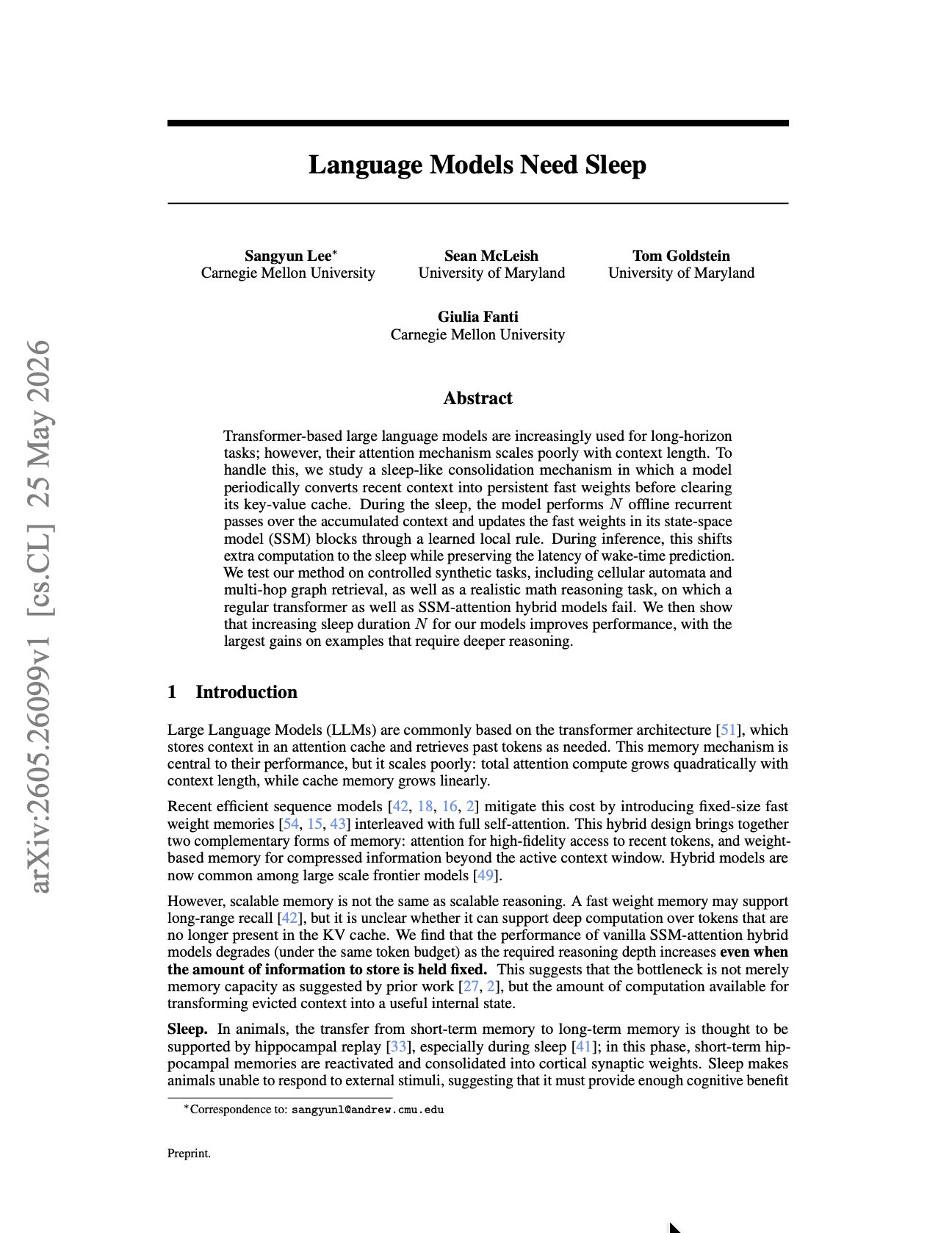
Language models may not need longer context. They may need sleep. A fascinating new paper by Sangyun Lee, Sean McLeish, Tom Goldstein, and Giulia Fanti proposes one of the most biologically resonant ideas in long-context AI: sleep-like memory consolidation. The problem is
RESEARCH
-
Scalable Memory vs. Reasoning in AI Models
By
–
The key distinction: scalable memory ≠ scalable reasoning. A model can store evicted context in fixed-size fast weights and still fail if it has not spent enough computation transforming that context into a useful state. That is why the “sleep” phase is interesting: it moves
-
Sleep-like memory consolidation for AI models
By
–
Language models may not need longer context. They may need sleep. A fascinating new paper by Sangyun Lee, Sean McLeish, Tom Goldstein, and Giulia Fanti proposes one of the most biologically resonant ideas in long-context AI: sleep-like memory consolidation. The problem is
-
Gary Marcus reaffirms his neuro-symbolic AI stance from 2001
By
–
J'ai en effet dit tout cela, et j'ai littéralement des milliers de preuves, remontant à mon livre de 2001 et à mon célèbre article *Deep Learning is Hitting a Wall* qui plaidait fortement pour compléter l'apprentissage profond avec des outils neuro-symboliques. Veuillez lire mon
-
Functional vs Distributional Geometry in Hierarchical Concept Spectral Analysis
By
–
The key distinction here is subtle but important: Functional geometry asks what a representation can do. Distributional geometry asks where that representation came from. This paper shows that at least part of hierarchical concept geometry can be explained by the spectral
-
Semantic structure vs. function: A caution for mechanistic interpretability
By
–
The line that stayed with me: semantic structure may be useful for function without being driven by function. That is a powerful caution for mechanistic interpretability. Some beautiful structures inside models may be less like “designed concepts” and more like the linear
-

Paper: Semantic Hierarchies Are Geometric in Language Models
By
–
What looks like ontology may be eigenspectrum. A beautiful new paper by Andres Nava and Matthieu Wyart gives a mechanistic account of one of the most striking facts about language models: semantic hierarchies appear geometrically. An owl is a bird.
A bird is an animal.
An -

AI Latency for Cloud Robotics and Edge Embodiment
By
–
Agreed: Latency is now low enough to support robot inference in the cloud, and edge is where embodiment transforms and safety checks should be performed: https://
arxiv.org/abs/2205.09778 -
MiniMax M2 Technical Report: Attention Mechanism Analysis
By
–
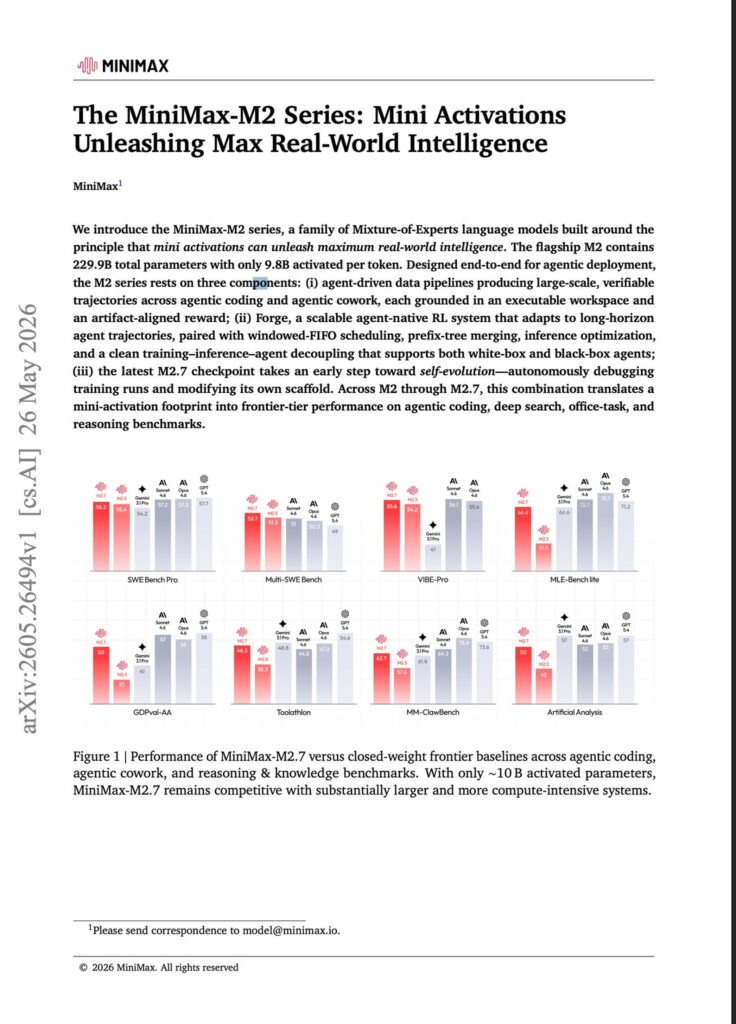
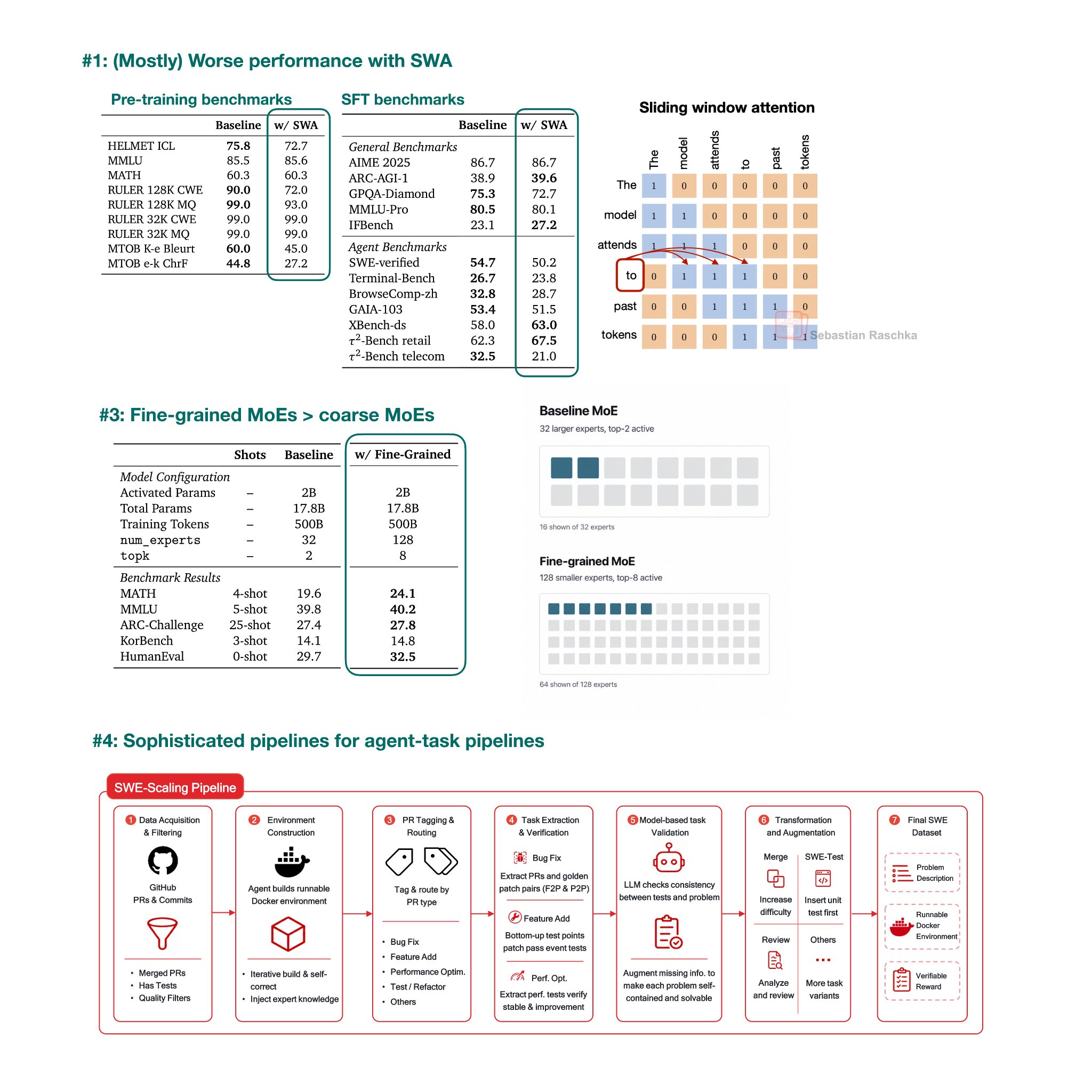
The MiniMax M2 series was one of the most widely used open-weight LLM series earlier this year. Now, we got a technical report with some interesting tidbits. I summarized some of them below: 1. Full attention as an anti-trend?: They tried hybrid sliding-window attention
-
AI advantage from faster leaner systems, not better prompts
By
–
The next AI advantage won't come from a better prompt. It'll come from a faster, leaner system underneath the model. Her's Law and the Tau Scaling Law framework are worth understanding deeply if you're making AI infrastructure decisions. @huawei is leading this thinking. What