
How should AI agents talk to each other? There's no one-size-fits-all answer. As we deploy multi-agent systems in robotics, autonomous vehicles, and distributed AI, choosing the right communication architecture becomes a first-order design decision. The problem: Multi-agent RL
MACHINE LEARNING
-

Free MLops Repository with Talks Books and Papers
By
–
This repository on ML operations has free talks, books, papers and more: https://
bit.ly/MLops Developed by @visenger -

SP3F: Improving LLM Reasoning in Lower-Resource Languages
By
–
We introduce SP3F: an algorithm to improve LLM reasoning in lower-resource languages (e.g., Indonesian, Bengali, and Swahili), no manual data collection needed! SP3F produces models that out-perform fully post-trained models across multiple tasks and languages🧵 [1/N]
-
LobeHub: multi-model, direct API, agent marketplace, 70k GitHub stars
By
–
Claude Cowork: $200/month. One model. macOS only.
Manus: VM-based browsing. Slow. Unstable. Expensive. LobeHub:
→ Multi-model support (switch freely)
→ Direct API access (faster, more accurate)
→ Agent marketplace to discover and remix
→ 70k GitHub stars foundation More -
Biological Brain Sparsity and GPU Simulation Challenges
By
–
You can argue that bio brains have vastly more weights that are mostly sparse, because the space of neurons that could have been connected to is very large, with synapses exploring and getting pruned. Simulating bio connectivity would be expensive on GPUs! Bio neurons look good
-
No-Code AI and Top 10 Machine Learning Trends 2025
By
–
How could you use no-code AI to boost your projects? Top 10 Machine Learning Trends to Watch in 2025 https://
graphite-note.com/machine-learni
ng-trends/
… #AI #MachineLearning #IoT #WMC26 #5G -
Attention not fundamental; geometric evolution needed for hidden representations
By
–
This isn't claiming attention is dead. But it proves attention isn't fundamental. "What one fundamentally needs is not attention itself, but a sufficiently expressive geometric evolution mechanism for hidden representations." The era of exploring geometric alternatives to
-
What if intelligence needs no attention? Grassmann flows answer
By
–
The philosophical shift is profound: Before: "How do we make attention cheaper/faster?" Now: "What if we don't need attention at all?" The real question: What's the minimal geometric structure needed for intelligence? Attention is ONE answer. Grassmann flows prove it's not
-
Depth and local windows reduce Grassmann trails, replacing attention
By
–
The deeper you go, the better it gets. At 6 layers: Grassmann trails by 15%
At 12 layers: Grassmann trails by only 11% The model learns to approximate richer interactions through depth and local multi-scale windows. This is proof of concept that attention isn't necessary. -
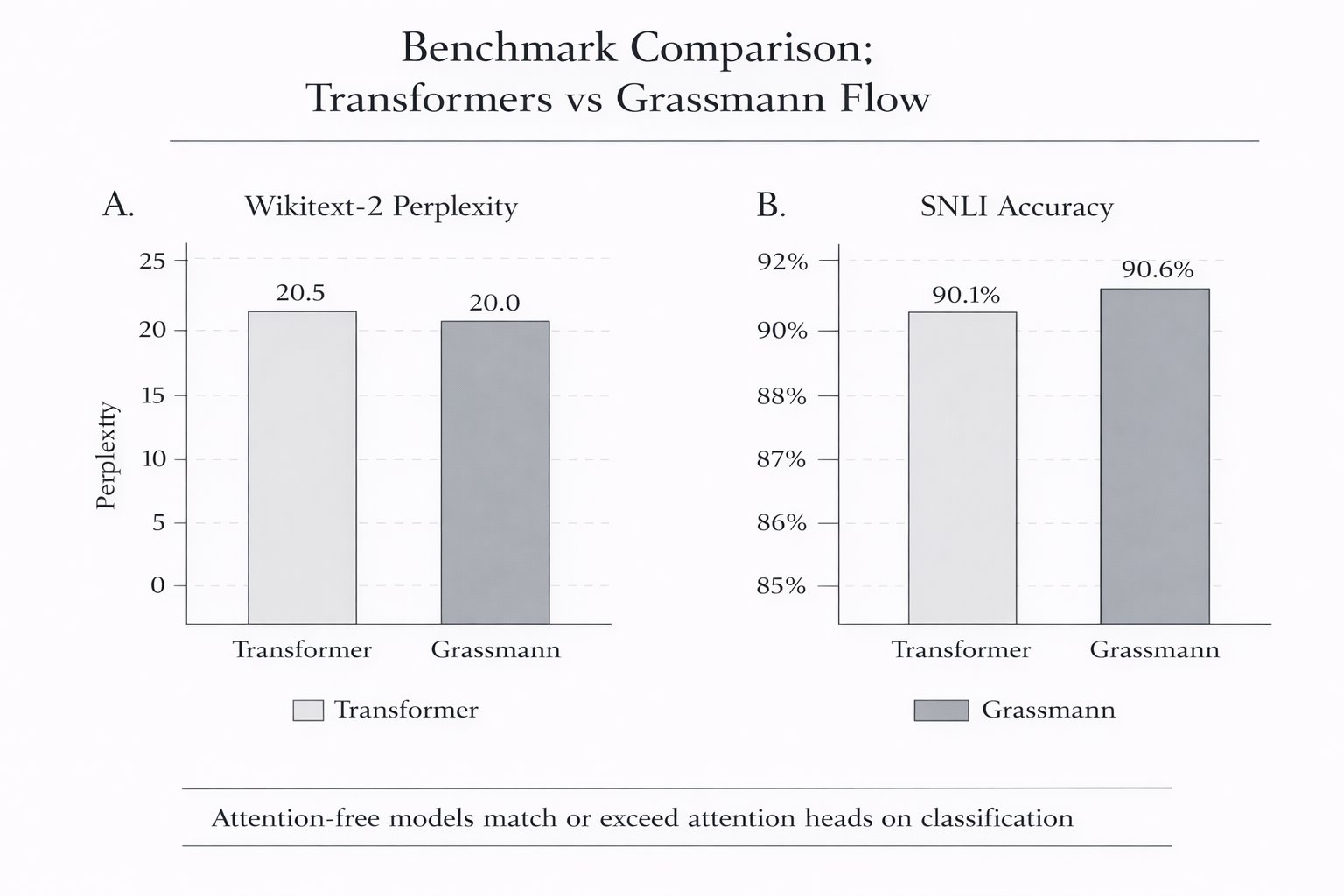
Grassmann model trails in perplexity but leads in SNLI accuracy
By
–
Does it actually work in practice? Wikitext-2 (language modeling): 13M param Grassmann model: 275.7 perplexity
13M param Transformer: 248.4 perplexity
Gap: ~11% behind SNLI (natural language inference): Grassmann head: 85.50% validation accuracy
Transformer head: 85.45%