Same architecture but better performance
MACHINE LEARNING
-
PDR Framework: Parallel Reasoning Agents for Complex Scientific Queries
By
–
Reasoning doesn’t have to mean longer chains of thought:
— Anirudh Goyal (@anirudhg9119) 8 avril 2026
PDR = draft in parallel → distill into a compact workspace → refine, and shift the Pareto frontier.https://t.co/4Sca6dFu4Q https://t.co/kk0fYpc8Y1 pic.twitter.com/PvevaX9ngYReasoning doesn’t have to mean longer chains of thought: PDR = draft in parallel → distill into a compact workspace → refine, and shift the Pareto frontier. arxiv.org/abs/2510.01123 Alexandr Wang (@alexandr_wang) 3/ we’re also releasing contemplating mode, which orchestrates multiple agents that reason in parallel designed to handle complex scientific & reasoning queries. in our testing we found it competitive w/ other extreme reasoning models such as Gemini Deep Think & GPT Pro. — https://nitter.net/alexandr_wang/status/2041909381667958855#m
-

Muse Spark: Multi-Agent Collaboration for Test-Time Reasoning Scaling
By
–
To spend more test-time reasoning without drastically increasing latency, we can scale the number of parallel agents that collaborate to solve hard problems. While standard test-time scaling has a single agent think for longer, scaling Muse Spark with multi-agent thinking enables
-

Reinforcement Learning Stack Achieves Stable, Predictable Model Capability Gains
By
–
Reinforcement learning leverages compute to scalably amplify model capabilities. Though large-scale implementation is often prone to instability, our new stack delivers smooth, predictable gains, showing log-linear growth in pass@1 and pass@16 (at least 1 success across 16
-
Reinforcement Learning Optimizes Model Reasoning with Token Efficiency
By
–
RL trains our models to "think" before they answer, a process known as test-time reasoning. To serve this capability to billions of users and efficiently use tokens, we rely on two key levers: thinking time penalties to optimize token use and multi-agent orchestration that boosts… pic.twitter.com/oHHap4NAg3
— AI at Meta (@AIatMeta) 8 avril 2026RL trains our models to "think" before they answer, a process known as test-time reasoning. To serve this capability to billions of users and efficiently use tokens, we rely on two key levers: thinking time penalties to optimize token use and multi-agent orchestration that boosts
-
Scaling Properties of Muse Spark: Pretraining, RL, and Reasoning
By
–
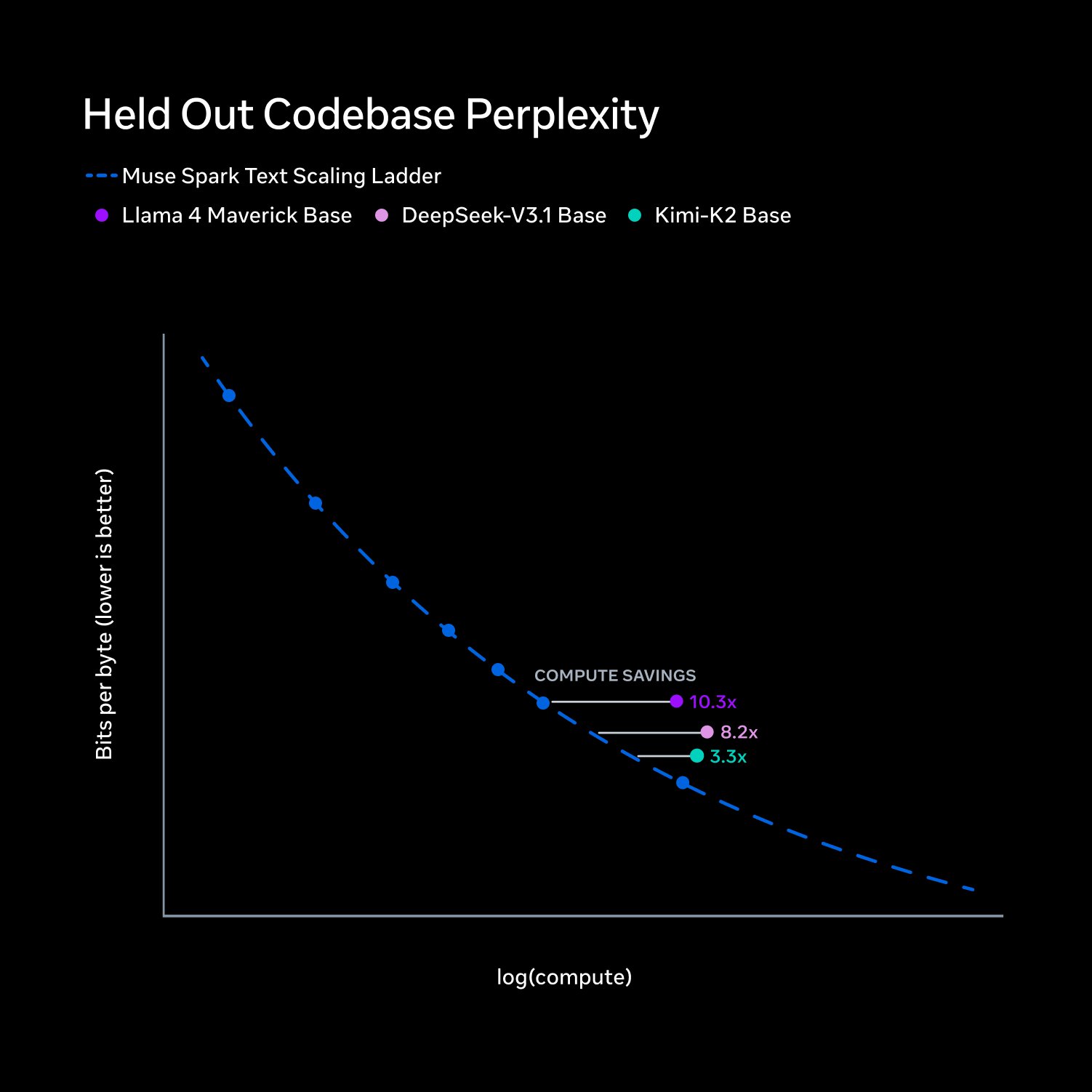
To build personal superintelligence, our model’s capabilities should scale predictably and efficiently. Below, we share how we study and track Muse Spark’s scaling properties along three axes: pretraining, reinforcement learning, and test-time reasoning. Let’s start with
-
Meta’s Muse Spark: Multimodal AI Model with Impressive Reasoning Benchmarks
By
–


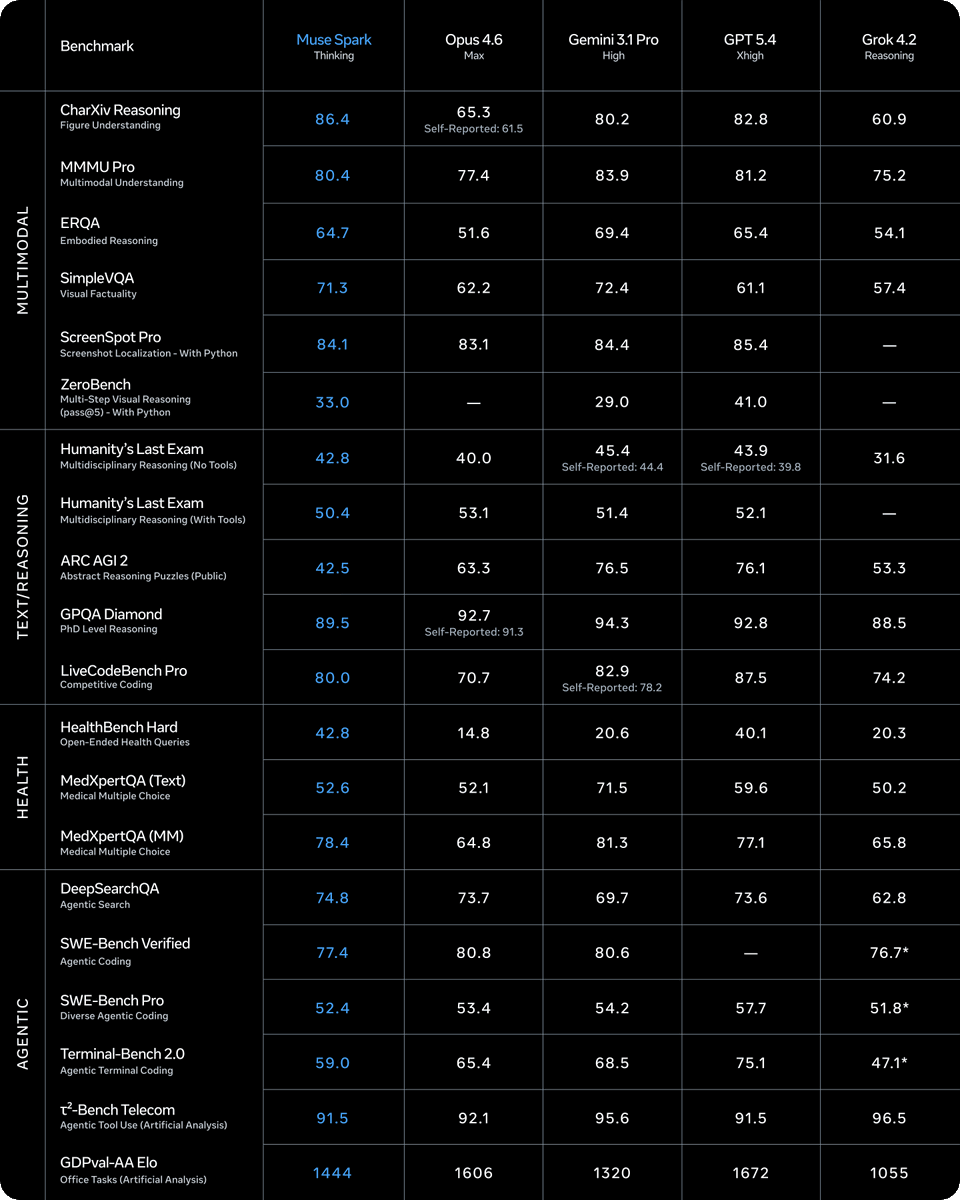
Meta Superintelligence Labsjust dropped Muse Spark, their first model after a full nine-month rebuild of their AI stack. the tl;dr (summary) It's a natively multimodal reasoning model that now powers Meta AI. It's competitive on reasoning and multimodal benchmarks, introduces a multi-agent "Contemplating mode," and Meta frames it as step one on a scaling ladder toward "personal superintelligence." Where it's strong: -Multimodal perception and visual reasoning (visual STEM, entity recognition, localization) -Health reasoning, built with input from 1,000+ physicians -Test-time reasoning efficiency, using thinking time penalties to compress reasoning tokens -Contemplating mode hits 58% on Humanity's Last Exam and 38% on FrontierScience Research, putting it in the ballpark of Gemini Deep Think and GPT Pro -Pretraining efficiency: reaches the same capability as Llama 4 Maverick with over 10x less compute Where it's weaker (Meta's own admission): -Long-horizon agentic systems -Coding workflows Key scaling findings: -RL compute scales smoothly with log-linear growth on pass@1 and pass@16 -Multi-agent orchestration scales performance without proportional latency increase -Phase transition behavior on AIME: the model first extends reasoning, then compresses it under length penalties, then extends again for higher accuracy My take: very good model, really surprised what meta offered here. And keep in mind: 99% of all instagram / facebook user dont need an LLM for doing academic reserach but for everyday reasoning. Well done, meta! Chubby♨️ (@kimmonismus) Lol what?! Meta has been cooking! These benchmarks are really freaking good holy!! — https://nitter.net/kimmonismus/status/2041918006779957407#m
→ View original post on X — @kimmonismus, 2026-04-08 16:42 UTC
-
CaP Evolution: Agentic Coding and Large Models as Primitives
By
–
Thx Stephen! But quite a bit has changed since 2022…agentic coding is evolving rapidly now and CaP can incorporate large models as primitives. We’re working on extensions and will share updates soon. https://t.co/XHlfRSkME3
— Ken Goldberg (@Ken_Goldberg) 8 avril 2026Thx Stephen! But quite a bit has changed since 2022…agentic coding is evolving rapidly now and CaP can incorporate large models as primitives. We’re working on extensions and will share updates soon. Stephen James (@stepjamUK) 𝗙𝗿𝗼𝗻𝘁𝗶𝗲𝗿 𝗹𝗮𝗻𝗴𝘂𝗮𝗴𝗲 𝗺𝗼𝗱𝗲𝗹𝘀 𝗰𝗮𝗻 𝗽𝗮𝘀𝘀 𝗹𝗮𝘄 𝗲𝘅𝗮𝗺𝘀. 𝗧𝗵𝗲𝘆 𝗰𝗮𝗻 𝘄𝗿𝗶𝘁𝗲 𝗽𝗿𝗼𝗱𝘂𝗰𝘁𝗶𝗼𝗻 𝗰𝗼𝗱𝗲. 𝗕𝘂𝘁 𝗮𝘀𝗸 𝘁𝗵𝗲𝗺 𝘁𝗼 𝘄𝗿𝗶𝘁𝗲 𝗮 𝗽𝗿𝗼𝗴𝗿𝗮𝗺 𝘁𝗵𝗮𝘁 𝗰𝗼𝗻𝘁𝗿𝗼𝗹𝘀 𝗮 𝗿𝗲𝗮𝗹 𝗿𝗼𝗯𝗼𝘁, 𝗮𝗻𝗱 𝘁𝗵𝗲𝘆 𝘀𝘁𝗶𝗹𝗹 𝗳𝗮𝗹𝗹 𝘀𝗵𝗼𝗿𝘁 𝗼𝗳 𝗮 𝗵𝘂𝗺𝗮𝗻 𝗲𝘅𝗽𝗲𝗿𝘁. That's the core finding from CaP-X, a new framework from NVIDIA, UC Berkeley, Stanford, and CMU that systematically benchmarks coding agents for robot manipulation. The underlying idea is not new. Code as Policy has been around since 2022/2023, and it is best understood as a modern evolution of Task and Motion Planning – a classical robotics paradigm where engineers manually decompose high-level goals into structured programs combining perception, planning, and control. What has changed is that instead of a human writing that code, a language model does it. It works well when the abstractions are high-level. It degrades significantly when models have to reason at the level human engineers actually work at: raw perception outputs, IK solvers, collision constraints. Here is what the research actually shows: 𝗧𝗵𝗲 𝗮𝗯𝘀𝘁𝗿𝗮𝗰𝘁𝗶𝗼𝗻 𝗴𝗮𝗽 𝗶𝘀 𝗿𝗲𝗮𝗹. Performance drops as you move from high-level primitives to low-level APIs. Not because the models lack intelligence, but because the scaffolding disappears. 𝗠𝘂𝗹𝘁𝗶-𝘁𝘂𝗿𝗻 𝗳𝗲𝗲𝗱𝗯𝗮𝗰𝗸 𝗿𝗲𝗰𝗼𝘃𝗲𝗿𝘀 𝗺𝗼𝘀𝘁 𝗼𝗳 𝘁𝗵𝗮𝘁 𝗹𝗼𝘀𝘀. Multi-turn feedback with execution traces and structured observations dramatically improves performance. Raw images alone actually hurt. 𝗥𝗟 𝗼𝗻 𝗮 𝘀𝗺𝗮𝗹𝗹 𝗺𝗼𝗱𝗲𝗹 𝘁𝗿𝗮𝗻𝘀𝗳𝗲𝗿𝘀 𝘇𝗲𝗿𝗼-𝘀𝗵𝗼𝘁 𝘁𝗼 𝘁𝗵𝗲 𝗿𝗲𝗮𝗹 𝘄𝗼𝗿𝗹𝗱. A 7B model fine-tuned with RL in simulation transfers zero-shot to a real Franka robot by reasoning over structured APIs. The takeaway is simple. The bottleneck is not model size. It is the feedback loop, the abstraction layer, and the system around the model. Credit: @letian_fu, Justin Yu, Karim El-Refai, Ethan Kou, @HaoruXue, @DrJimFan, and the full team across @nvidia, @UCBerkeley, @Stanford, and @CMU_Robotics And of course @AGIBOTofficial for providing the hardware in the attached video! What do you think is holding Code as Policy back from production deployment? Paper link in comments. — https://nitter.net/stepjamUK/status/2041878733531849153#m
→ View original post on X — @ken_goldberg, 2026-04-08 16:41 UTC
-
5 AI Model Architectures Every Engineer Should Know
By
–
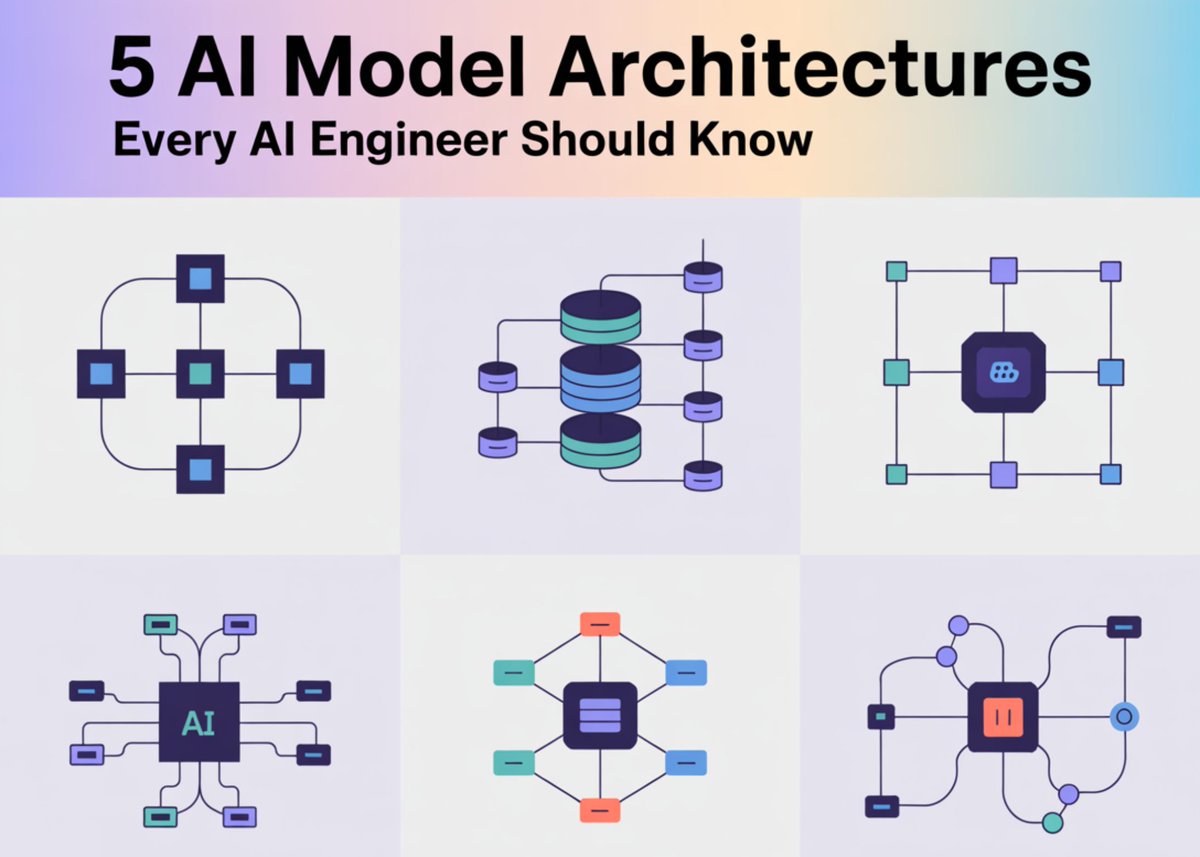
5 #AI Model Architectures Every AI Engineer Should Know by Arham Islam @Marktechpost Learn more: bit.ly/4s5g1pA #LLM #ArtificialIntelligence #GenerativeAI #ML #MachineLearning
→ View original post on X — @ronald_vanloon, 2026-04-08 16:25 UTC
-
Domain Experts as Essential AI Partners for Actionable Insights
By
–
Their deep, contextual knowledge of physical processes is the ingredient that turns raw data into actionable insight. They're not obstacles, they're essential partners.