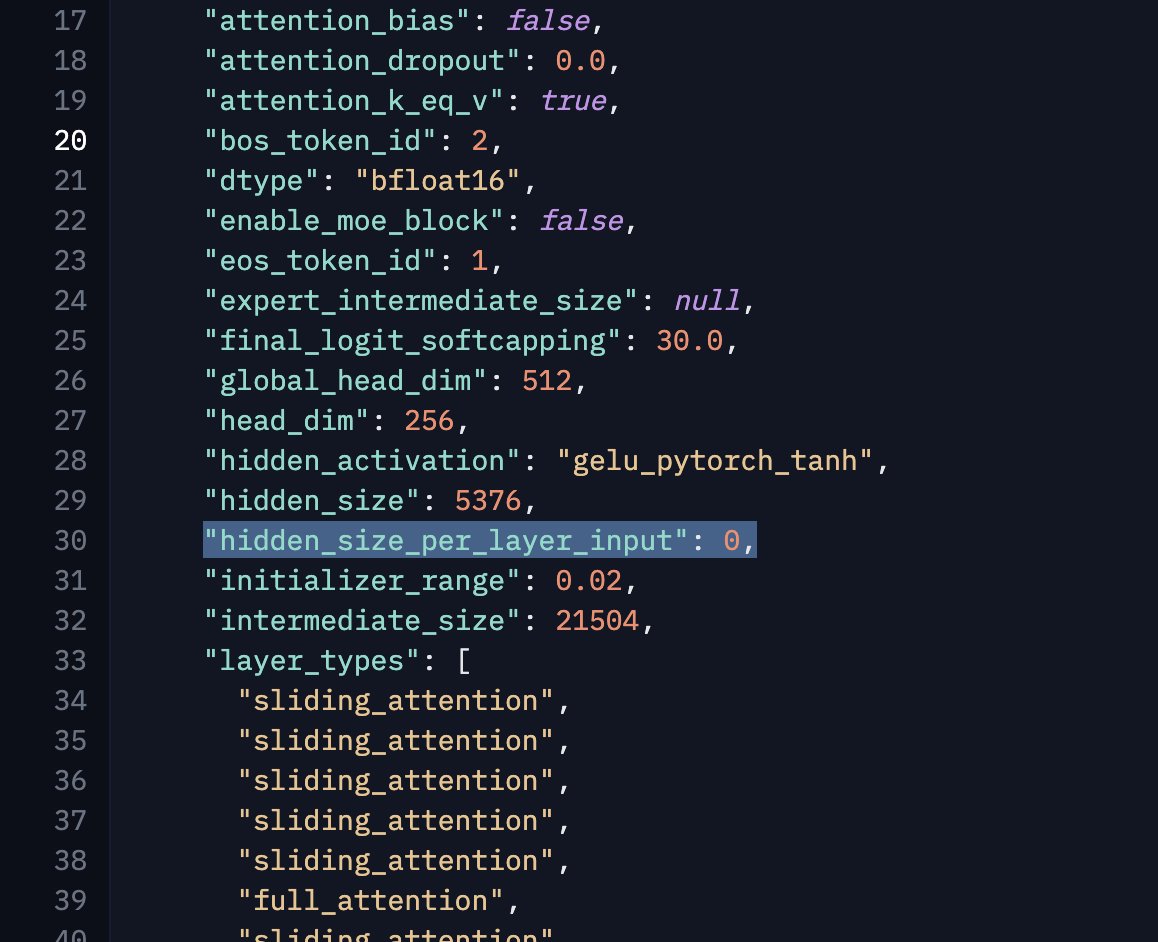
I saw the per-layer embeddings in the code, but I don't think they were used in the final models. Maybe it was a left-over from some internal experiments.
CODE
-
Bilingual AI Interpreter for Data Quality Integration Systems
By
–
Think of it as having a bilingual interpreter who also happens to be a data quality expert working 24/7 between your systems.
-
PAIOBot Secures AI Agents Without Exposed Ports
By
–
Stop exposing local ports just to run AI agents.
— Charly Wargnier (@DataChaz) 3 avril 2026
🚨 @PAIOBot fixes that OpenClaw nightmare.
Invisible security out of the box:
→ 50% less token usage
→ Device-locked access
→ ZERO exposed ports
*AND* the setup takes <60s.
I’m following fosho 👀pic.twitter.com/IUUrja0Fgv https://t.co/wNY42ykkdkStop exposing local ports just to run AI agents. @PAIOBot fixes that OpenClaw nightmare. Invisible security out of the box:
→ 50% less token usage
→ Device-locked access
→ ZERO exposed ports *AND* the setup takes <60s. I’m following fosho -
Comprehensive Open-Source Claude Code Agentic Framework Released
By
–
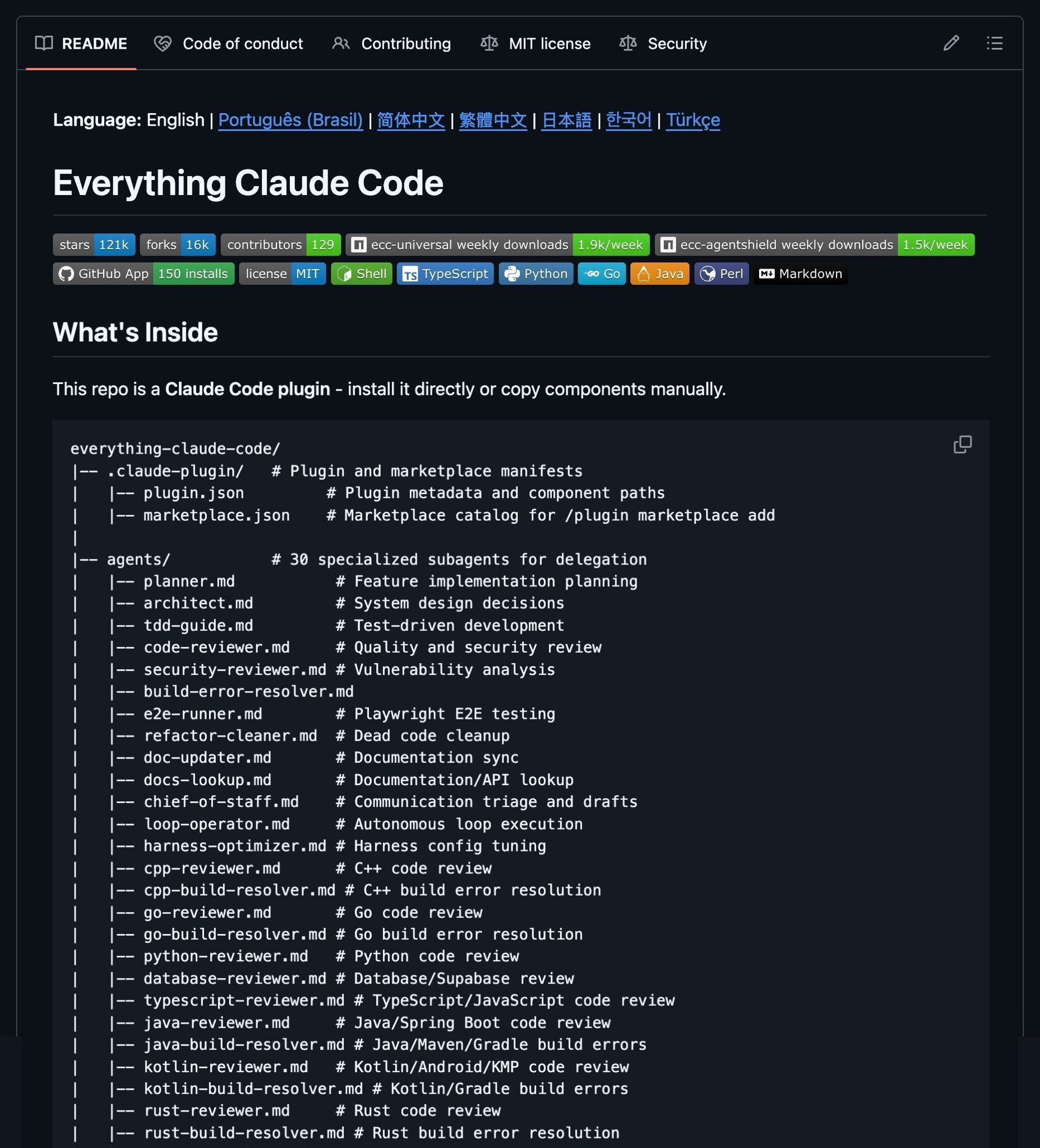
The most complete Claude Code setup ever built is now free. 27 agents. 64 skills. 33 commands. All open-source. It started as a hackathon project. Ten months of daily use turned it into a full operating system for AI coding. The agents handle planning, code review, build
-
Replit Canvas Launches AI Design Tool Built on tldraw
By
–
We're excited to have partnered with @tldraw to bring Replit canvas to life- built on their best-in-class infrastructure. With Replit canvas you can:
• Generate multiple design variants with AI
• Collaborate in real time
• Fine-tune with a visual editor
• Turn designs into -
AI Coding Agents Reach Inflection Point in November 2025
By
–
My biggest takeaways from @simonw
: 1. November 2025 was an inflection point for AI coding. GPT 5.1 and Claude Opus 4.5 crossed a threshold where coding agents went from “mostly works” to “almost always does what you want it to do.” Software engineers who tinkered over the -

CCTV Object Detection: Offloading Pi 5 to Metis Compute Board
By
–
Offloaded CCTV object detection from a Pi 5 to a Metis Compute Board. Pi fan stopped screaming. ~30 FPS across two 1080p cameras, ~196ms latency. Zone filtering, Home Assistant webhooks, phone snapshots in 1-2 seconds. Full tutorial + code. #HomeAssistant #EdgeAI 📹 eu1.hubs.ly/H0t23Nx0 @raspberry_pi
→ View original post on X — @axeleraai, 2026-04-03 13:45 UTC
-
EdgeClaw 2.2 Launches Three New Claude Code Features
By
–
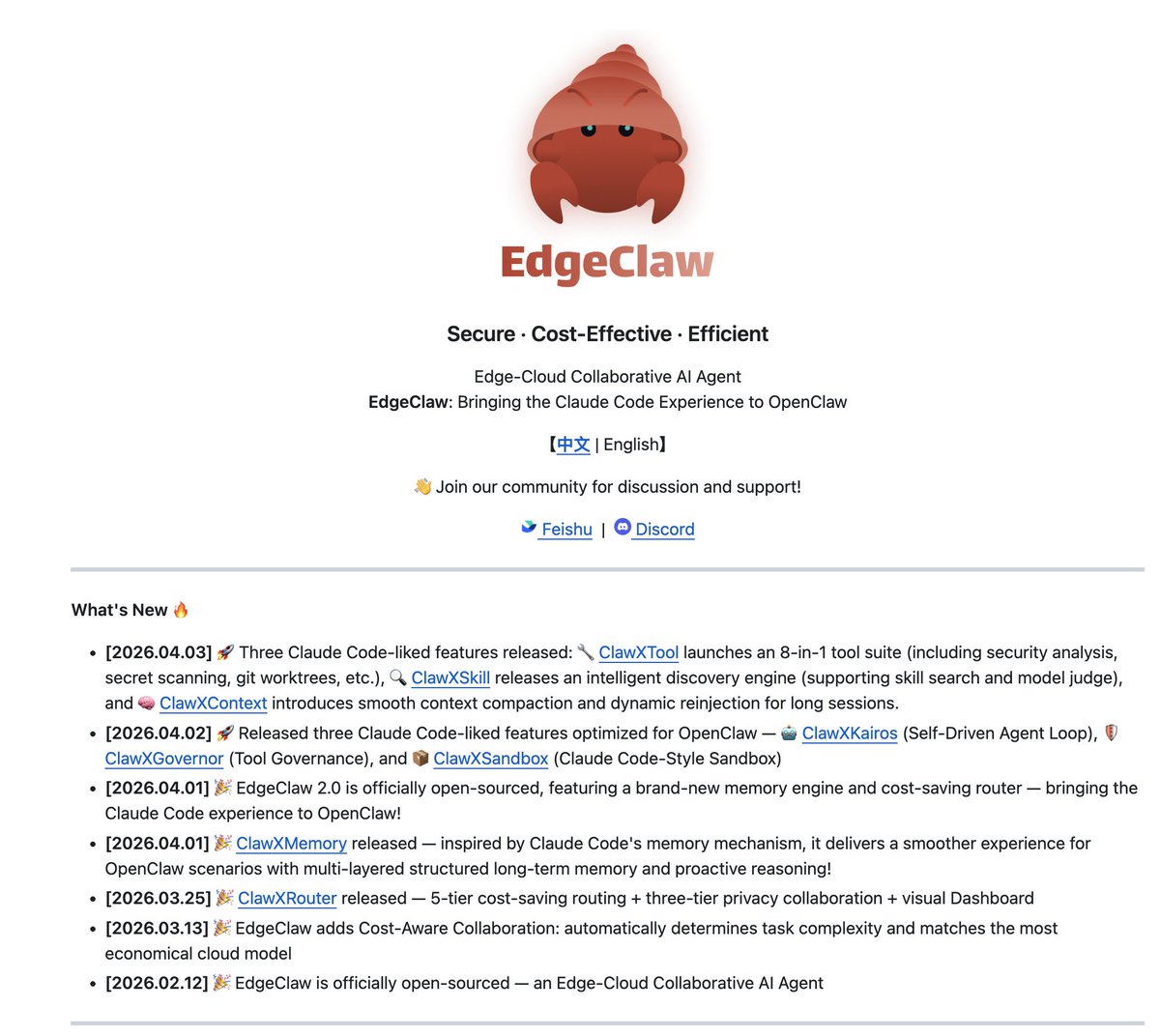
🚀 [OpenClaw x Claude Code DAY 3 – Almost Done!] 🚀 Three more CC features—including the highly requested Buddy—are now live in EdgeClaw 2.2! 🦞 Try it now: github.com/OpenBMB/EdgeClaw Here is what we shipped today: 👇 ⚡️ ClawXskills: Progressive, high-efficiency skill calling. The loading phase now consumes just 15% of the original tokens! 🧠 ClawXcontext: Hierarchical context compression with on-demand expansion. Say goodbye to context bloat and lost information! 🐾 ClawXBuddy: Draw a random "blind box" to get your own unique companion pet! (Warning: No abandoning allowed! 🙅♂️❤️) The reconstruction of CC features is complete, but EdgeClaw’s evolution has just begun. We will keep pushing boundaries! 🌊🚀 #ClaudeCode #OpenClaw #EdgeClaw #LLMs #OpenSource
→ View original post on X — @aihighlight, 2026-04-03 13:39 UTC
-
NVIDIA Quantizes Gemma 4 31B with NVFP4 Compression Technology
By
–
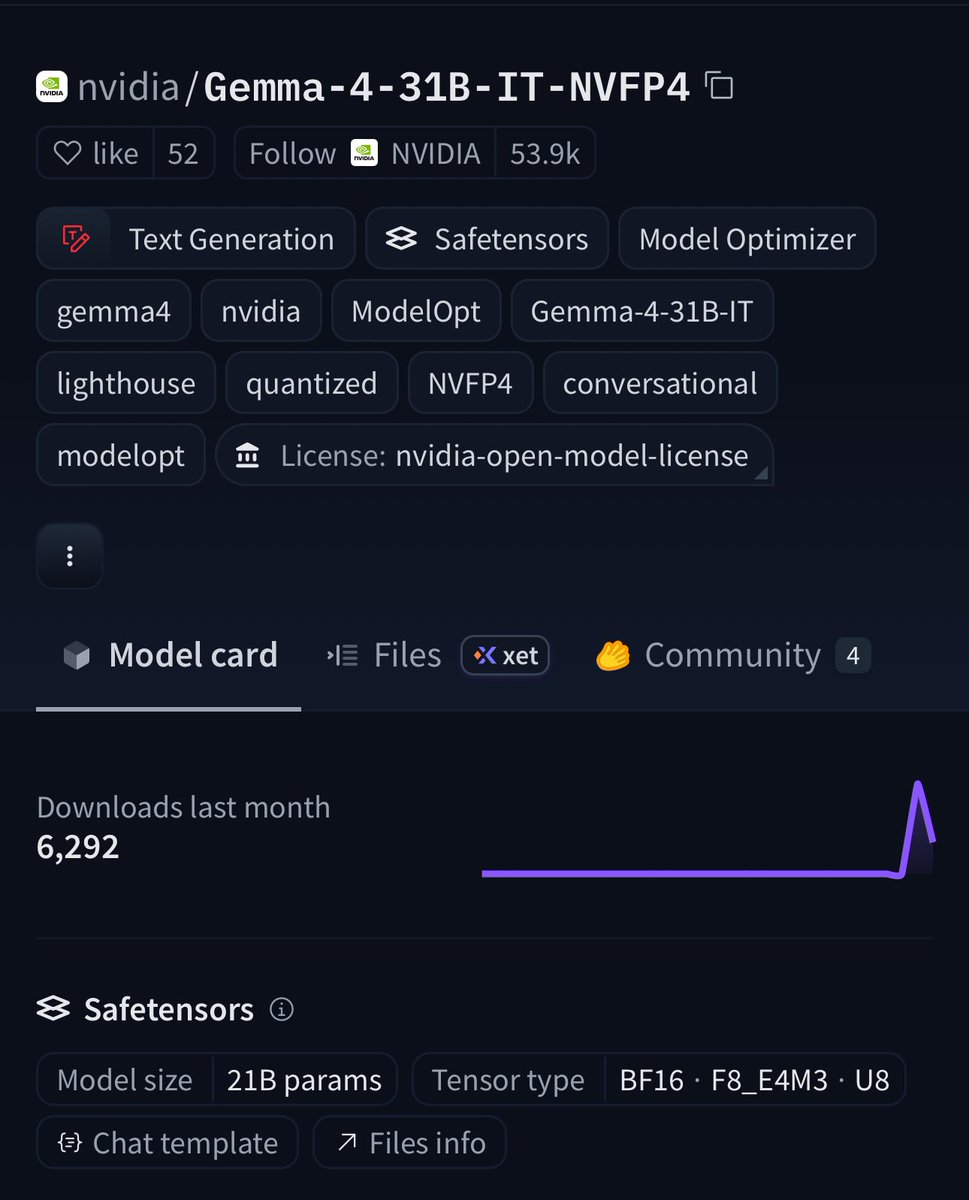
BREAKING:🚨 NVIDIA just quantized Gemma 4 31B on Hugging Face 🔥 NVFP4 compression = 4x smaller weights with frontier-level accuracy. ✅99.7% of baseline on GPQA (75.46% vs 75.71%). 📈256K context window. 🧐Multimodal (text + images + video). vLLM-ready + Blackwell optimized. VRAM requirements: ⚡️Weights only: ~16–21 GB 🚀Everyday use: Runs on 24 GB GPUs 📈Full 256K context = 32 GB VRAM sweet spot (RTX 5090-class consumer GPUs) This is the 31B-class frontier model you can actually run locally on a high-end rig. Try it today👉 huggingface.co/nvidia/Gemma-…
→ View original post on X — @huggingface, 2026-04-03 13:30 UTC
-
YOLOv11: The Next Leap in Real-Time Object Detection
By
–
🐍 YOLOv11: The Next Leap in Real-Time Detection
— Satya Mallick (@LearnOpenCV) 3 avril 2026
For nearly a decade, the YOLO family kept pushing real-time object detection forward. In 2024, YOLOv11 arrived faster, more accurate, and easier to deploy. 🚀
With improved multi-scale fusion, streamlined inference, and models… pic.twitter.com/4T0rz9yv6x🐍 YOLOv11: The Next Leap in Real-Time Detection For nearly a decade, the YOLO family kept pushing real-time object detection forward. In 2024, YOLOv11 arrived faster, more accurate, and easier to deploy. 🚀 With improved multi-scale fusion, streamlined inference, and models sized for both edge devices and maximum accuracy, YOLOv11 stayed true to the YOLO philosophy: fast enough for real-time, accurate enough for production, simple enough to deploy everywhere. ⚡ #YOLOv11 #ComputerVision #DeepLearning #AI #ObjectDetection #MachineLearning #AIResearch #DataScience 🤖
→ View original post on X — @learnopencv, 2026-04-03 13:26 UTC