
AI coding agents are fast but reckless. They skip specs, tests, and security. Google engineer just open-sourced a fix. Agent Skills is a free repo that brings 19 engineering skills and 7 slash commands to any AI coding agent. It works by encoding what senior engineers
CODE
-
Vibe Coded Email App with Dial-Up Modem Works First Try
By
–
✉️ Vibe coded a POP3 and SMTP text-based email app for https://t.co/rltvxoEavc that uses the dial-up modem to check and send emails and it worked on the first try
— @levelsio (@levelsio) 11 avril 2026
It's internal email only so web@pieter.com to web@pieter.com and the same email box as on https://t.co/RRYOCWqRQq… https://t.co/JwzsqzGTkv pic.twitter.com/FMI2FwaGEpVibe coded a POP3 and SMTP text-based email app for http://
os.pieter.com that uses the dial-up modem to check and send emails and it worked on the first try It's internal email only so web@pieter.com to web@pieter.com and the same email box as on http://
pieter.com -

NVIDIA OpenShell: Secure Sandbox Runtime for AI Agents
By
–
AI agents that can read files, install packages, and call APIs need more than intelligence.
— Satya Mallick (@LearnOpenCV) 11 avril 2026
They need boundaries.
NVIDIA's play:
OpenShell → secure sandbox runtime for AI agents
Nemo Claw → plugs Open Claw into that sandbox
Already supports Claude Code, Codex, OpenCode
The… pic.twitter.com/y9KLGFNisVAI agents that can read files, install packages, and call APIs need more than intelligence. They need boundaries. NVIDIA's play: OpenShell → secure sandbox runtime for AI agents Nemo Claw → plugs Open Claw into that sandbox Already supports Claude Code, Codex, OpenCode The agentic AI infra story nobody's covering ↓ #AgenticAI #NVIDIA #OpenShell #NemoClaw #AIAgents #AISafety #OpenClaw #AIEngineering
→ View original post on X — @learnopencv, 2026-04-11 10:33 UTC
-
Comparing coding AI models: Claude Opus outperforms GPT and others
By
–
"Generally, the code specialized RL'd models end up cheating and lying more; I call it RL-fry […] Reward hacking as the default mindset." Anthropic models are less fried, should be obvious to anyone who reviews the slop they generate. nitter.net/alexjc/status/20385610… Alex J. Champandard 🌱 (@alexjc) My End-Of-Month "Use Remaining Coding Credits" Report: planning and building a Cython virtual machine from scratch for a complete well-specified functional stack language: * Opus 4.6 is so aligned, it makes decisions closer to what you (an expert) would make, results in code qualitatively better also quantitatively faster — and it sparks joy thru interactions with a nice mindset. Novel ideas emerge from that! I had stopped using Opus in favor of cheaper tokens, the extra distance helped me appreciate it more, but I'm now questioning the decision how I allocated my time/tokens… * GPT 5.4 is basically autistic: unable to understand broad context, infer intent, make good ambiguous choices, instead only solves clearly defined problems — and it takes a lot of patience to deal with all those symptoms and more. It pushes the mental burden on you to overspecify and then manage its behavior. In the end, it planned and built a worse solution that was slower than Opus and harder to extend. (Using 'autism' as a cognitive and behavioral diagnostic here, but separately and on top of that I feel GPT 5.4 inherited a frustrating personality and occasionally bad attitude from its training too.) After the prototypes, I used GPT 5.x to clean up Opus 4.6 work to great success, it's solid for local well-defined tasks with measurable outcomes. * Composer 2 broke in Cursor IDE three times due to a reproducible worktree bug, but once I got around that it one-shotted a somewhat functional solution only 3x slower than Claude's! But then asking for minor improvements it tripped over its feet and from there struggled reasoning with tricky bugs / implications. From there it was sassy/gaslighting about the problems. Then eventually found a solution 40% faster than Claude on one benchmark, but all shortcuts and hacks. (Could be a useful sub-frontier model because it sits in a different token pool and price point, but it's not yet clear how it distinguishes itself from GPT 5.x in the small tasks category.) * GLM 5.1 couldn't figure out Cursor's new terminal output / reading mechanisms at all. The tool calls show up OK in the frontend, but disappears when clicked now (another UI bug). Apparently, result is not shown to the LLM somehow. It could be a bug in the way Zai implement their OpenAI endpoint, because it's specific to that model… (This works for GLM 4.7 and 5.0 — but I will try again separately in `pi`). * Generally, the code specialized RL'd models end up cheating and lying more; I call it RL-fry, like silicon valley CEOs' vocal fry but for model cognition. Reward hacking as the default mindset, it's why I think non-code specific models are nicer to work with… (Only Anthropic gets this, others incorrectly play 'catchup' exclusively through RL score maxxing.) * I used Codex 5.3 during most of the month for well-defined work, but I'm not entirely convinced. GPT 5.2 (non-codex) has been for me great value for money in fixing bugs, minor local features, etc. However, the more expensive 5.x series gets the better Claude looks: must be 3x-4x cheaper for me to justify putting up with OpenAI model mindset. * It becomes more important than ever to have reliable dispatching for Pareto-optimal use of tokens depending on the task you have. The GPT models should likely not be considered interactive by default, need to prompt them very strictly then they become usable — ideally they should not respond with words to users, only provide verifiable facts (due to attitude and misalignment)! — https://nitter.net/alexjc/status/2038561083003133955#m
-
Ultraplan uses same tokens and rate limits as plan mode
By
–
Btw, Ultraplan uses roughly the same number of tokens (and subscription rate limits) as plan mode! See the docs for more: code.claude.com/docs/en/ultr…
-

/ultraplan: Build implementation plans in cloud while coding locally
By
–
🚨 Claude Code users, your workflow is about to get significantly faster.
— Charly Wargnier (@DataChaz) 11 avril 2026
The new `/ultraplan` is incredibly mighty 🔥
Instead of locking up your terminal, Claude now lets you build and refine your implementation plans in the cloud while you keep working locally.
Here is… pic.twitter.com/REQkMPmvz3🚨 Claude Code users, your workflow is about to get significantly faster. The new `/ultraplan` is incredibly mighty 🔥 Instead of locking up your terminal, Claude now lets you build and refine your implementation plans in the cloud while you keep working locally. Here is exactly how to use it: → Type /ultraplan followed by your prompt in your local terminal → Keep coding while Claude researches your codebase in the cloud → Open the generated session link in your browser to leave inline feedback → Click to approve the plan and teleport it back to your terminal The finalized plan is injected right back into your local session, ready to be built ↓
-
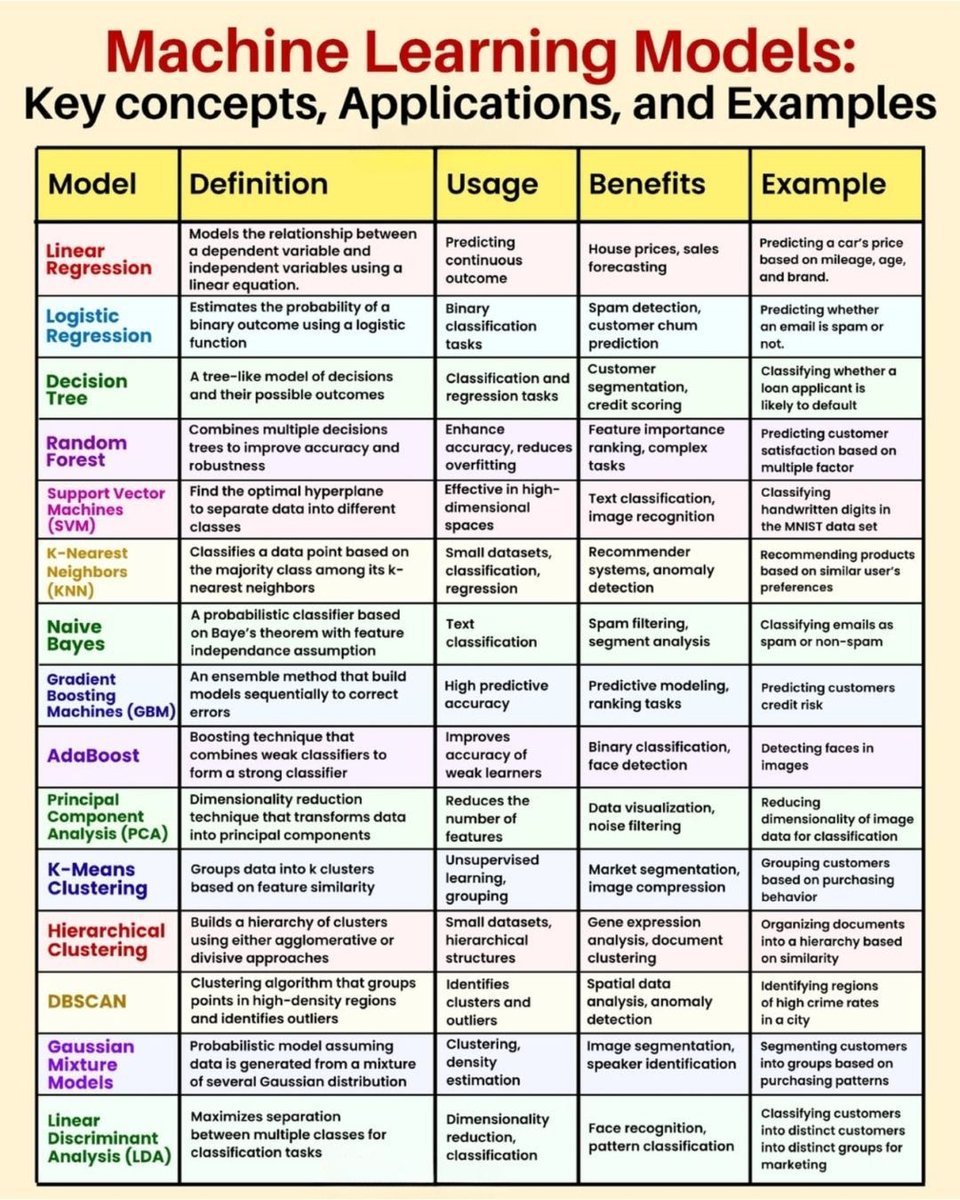
Machine Learning Models Explained by Python Developer
By
–
#MachineLearning Models Explained by @Python_Dv #AI #ArtificialIntelligence #ML #MI
→ View original post on X — @ronald_vanloon, 2026-04-11 08:45 UTC
-
Team credits for modelling and training project
By
–
And for the record all I did was to help create an environment for them to do their thing. All credit to @zalanborsos Matt Sharifi, Marco Tagliasacchi, @jonasro_ Lukas Zilka, Damien Vincent and Khuram Shahid for the modelling and training, Nathan Luong and his excellent shipping
-
Codex Open Source Program Access Setup
By
–
hey John – happy to help you get set up with Codex for Open Source program! Please DM me your ChatGPT email
-
Plugins and MCPs causing higher startup time issues
By
–
That’s undesirable – could it be that you’ve added a few plugins/ MCPs which have higher startup time?