AI Dynamics

Global AI News Aggregator

About

AI

  • Andrej Karpathy’s LLM Wiki: Persistent Memory vs Traditional RAG
    Andrej Karpathy’s LLM Wiki: Persistent Memory vs Traditional RAG

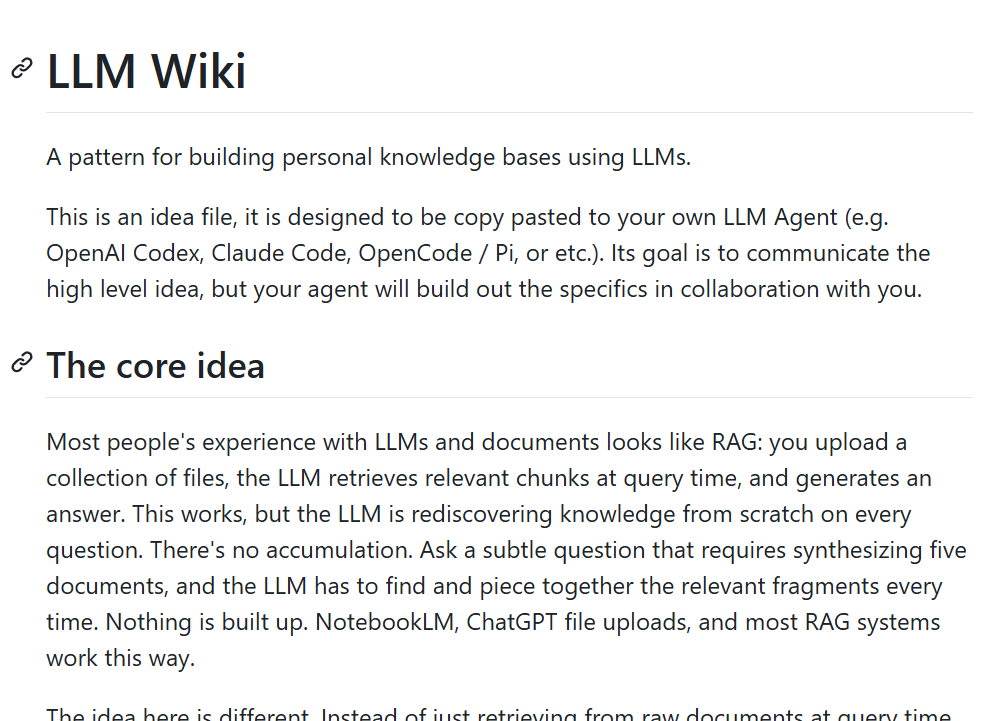
    🚨 Andrej Karpathy just dropped something that could replace a lot of RAG workflows. It's called LLM Wiki. The idea is simple: Most AI systems retrieve context from scratch every time you ask a question. LLM Wiki doesn't. It builds a persistent knowledge base that gets better every time you add a new source. So instead of: • search docs
    • pull fragments
    • answer
    • forget everything
    • repeat it does this: • ingest a source
    • extract the important ideas
    • update entity pages
    • revise topic summaries
    • connect related concepts
    • flag contradictions
    • keep compounding the knowledge over time That shift matters. RAG is great for retrieval. But a lot of people are really trying to build memory. Not just "find me the right chunk again."
    More like: "help me build an evolving model of this topic over time." That's what this is. Karpathy's examples are strong too: • personal knowledge
    • long-horizon research
    • books and topics
    • internal company knowledge
    • meeting transcripts
    • customer calls Basically, anything where the knowledge should accumulate, not reset every session. The best way to think about it: Obsidian is the IDE.
    The LLM is the programmer.
    The wiki is the codebase. You don't manually maintain the system. You feed it sources, ask questions, and the AI keeps the structure alive. That's a much bigger idea than "better RAG." 100% open source. [Translated from EN to English]

    → View original post on X — @scobleizer, 2026-04-06 15:06 UTC

  • New Scaling Laws for 350M Model Training Tokens
    New Scaling Laws for 350M Model Training Tokens

    FACT: If you don't train your 350M model on 28T tokens, you're not optimal Nicholas Roberts (@nick11roberts) That new LFM2.5-350M is super overtrained, right? And everyone was shocked about how far they pushed it? As it turns out, we have a brand new scaling law for that! 🧵 [1/n] — https://nitter.net/nick11roberts/status/2041141606305124486#m

    → View original post on X — @maximelabonne, 2026-04-06 15:05 UTC

  • Karpathy’s Second Brain Idea Just Killed RAG
    Karpathy’s Second Brain Idea Just Killed RAG

    Karpathy's Second Brain idea just killed RAG. LLMs can now turn papers, repos, and notes into a living wiki that keeps getting smarter. And people are already doing wild use cases with it. 10 examples: [Translated from EN to English]

    → View original post on X — @montreal_ai, 2026-04-06 15:03 UTC

  • OpenAI Superintelligence: New Policy Blueprint for Intelligence Age
    OpenAI Superintelligence: New Policy Blueprint for Intelligence Age

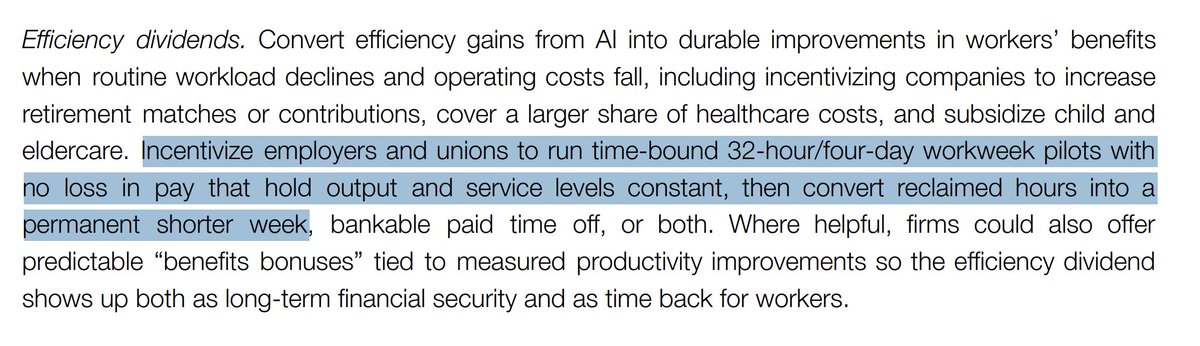
    OpenAI is preparing ready to launch their new and next generation of models. They are about to revolutionizing science & economy. "A very significant step forward" compared to their current models. Imho this is preparing people for the launch, very very soon, maybe even this week. Chubby♨️ (@kimmonismus) Looks like OpenAI reached Superintelligence. OpenAI: "Now, we’re beginning a transition toward superintelligence: AI systems capable of outperforming the smartest humans even when they are assisted by AI." OpenAI just published a 13-page policy blueprint for the "Intelligence Age"- proposing a Public Wealth Fund, 32-hour workweek pilots, portable benefits, a formal "Right to AI," and tax reforms to offset shrinking payroll revenue as automation scales. The document frames superintelligence not as a distant scenario *but an active transition requiring New Deal-level ambition*: new safety nets, containment playbooks for dangerous models, and international coordination modeled on aviation safety institutions. Here are OpenAI's suggestions (tl;dr): Open Economy: -Give workers a formal voice in AI deployment decisions -Microgrants and "startup-in-a-box" for AI-native entrepreneurs -Treat AI access as basic infrastructure (like electricity) -Shift tax base from payroll toward capital gains and corporate income -Public Wealth Fund — every citizen gets a stake in AI growth -Fast-track energy grid expansion via public-private partnerships -32-hour workweek pilots, better benefits from productivity gains -Auto-scaling safety nets triggered by displacement metrics -Portable benefits untied from employers -Invest in care economy as a transition path for displaced workers -Distributed AI-enabled labs to accelerate scientific discovery Resilient Society: -Safety tools for cyber, bio, and large-scale risks -AI trust stack — provenance, verification, audit logs -Competitive auditing market for frontier models -Containment playbooks for dangerous released models -Frontier AI companies adopt Public Benefit Corporation structures -Codified rules and auditing for government AI use -Democratic public input on AI alignment standards -Mandatory incident and near-miss reporting -International AI safety network for joint evaluations and crisis coordination Notably, OpenAI calls for stricter controls only on a narrow set of frontier models while keeping the broader ecosystem open, a clear attempt to position regulation as targeted, not industry-wide. They're backing it with up to $100K in fellowships and $1M in API credits for policy research, plus a new DC workshop opening in May. — https://nitter.net/kimmonismus/status/2041130939175284910#m

    → View original post on X — @kimmonismus, 2026-04-06 15:03 UTC

  • New research proves AI models store copyrighted training data
    New research proves AI models store copyrighted training data

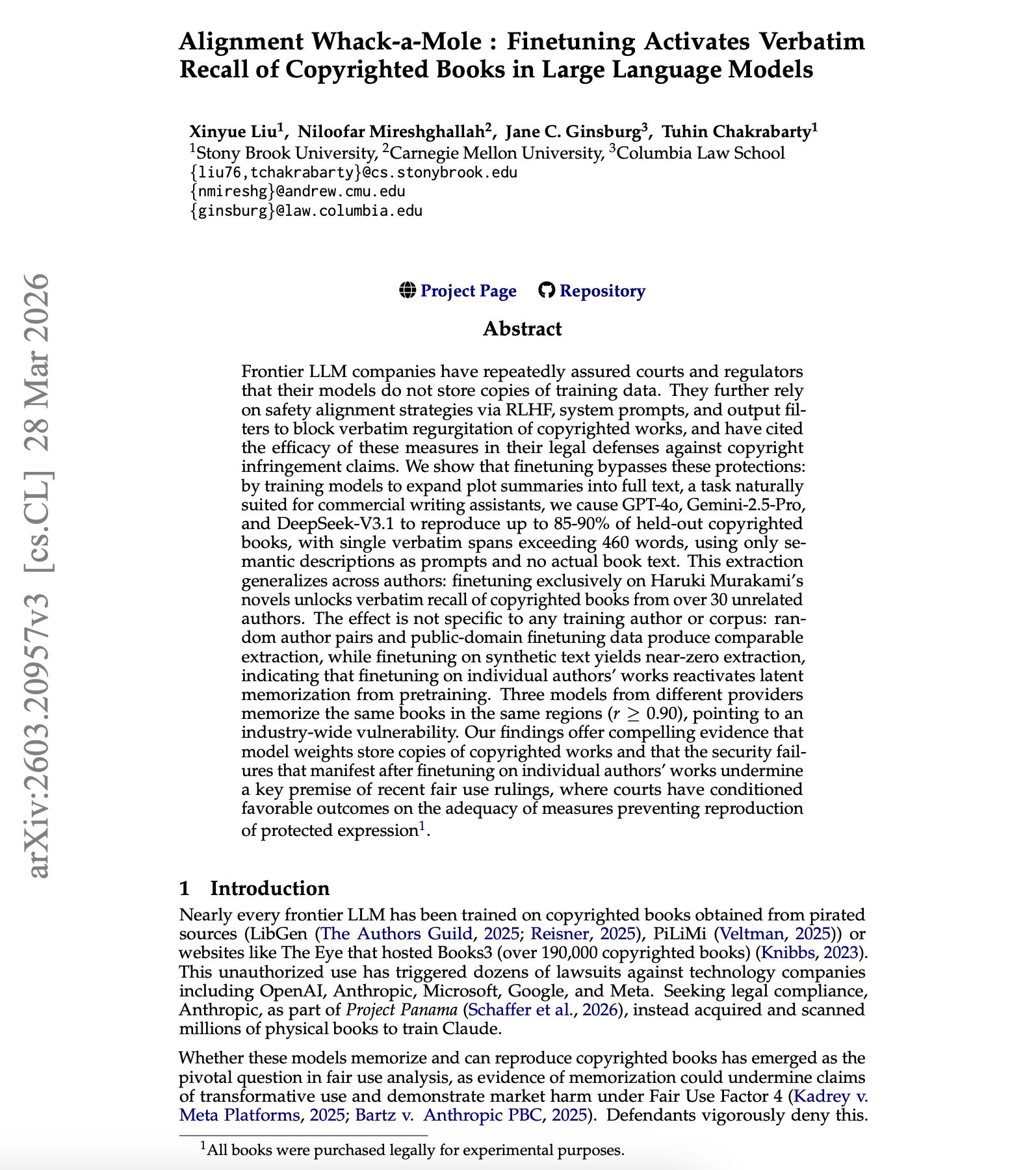
    Every author who sued OpenAI just got the smoking gun they needed. AI companies told courts their models don't store copyrighted books. A new paper just proved they do. Researchers fine-tuned GPT-4o, Gemini, and DeepSeek on a simple task. Expand plot summaries into full

    → View original post on X — @alphasignalai

  • Platform Launch: 72 Workflows Outpaces Typical Tool Offerings

    72 workflows on day one is not a small launch. Most tools ship with five and call it a platform.

    → View original post on X — @aihighlight

  • Index Trap: Architecture Matters More Than Tuning High-Ingestion Systems

    Indexes aren’t the problem. Unbounded indexing in high-ingestion systems is. IoT, observability, AI telemetry, financial feeds all share the same pattern: → continuous ingestion → append-only data → time-based queries → massive retention Eventually the architecture matters more than tuning. Tiger Data published the full breakdown here: tsdb.co/rvl-x Check out the full article : linkedin.com/pulse/index-tra…

    → View original post on X — @ronald_vanloon, 2026-04-06 15:00 UTC

  • Morphic Workflows Eliminates Need for Complex AI Prompting

    Morphic just killed the "I don't know how to prompt" excuse for good. Select your assets, pick a workflow, and the output is already done before you finish your coffee. Jaynti Kanani (JD) (@jdkanani) Introducing Workflows on @morphic. You know what you want, you just don’t know how to prompt for it. That’s what Workflows solve. Storyboarding? Three clicks. UGC ads? No prompting. Color grade? In seconds. Try now: morphic.com/workflows Live with 72 workflows today. More coming soon. With Workflows, you can capture repeatable creative tasks and reuse them without starting from scratch. Just select your assets and options while running a workflow. Minimal prompts required. And no nodes, of course. There’s a workflow for everything: filmmaking, social media, animation, fashion, marketing, and some just to have fun. Tag someone who'd make something wild with this. Here are my 5 favorite workflows: — https://nitter.net/jdkanani/status/2041154028034490867#m

    → View original post on X — @aihighlight, 2026-04-06 14:59 UTC

  • Gary Marcus Criticizes Altman’s Finances and Confirms Cyberattack Risk
    Gary Marcus Criticizes Altman’s Finances and Confirms Cyberattack Risk

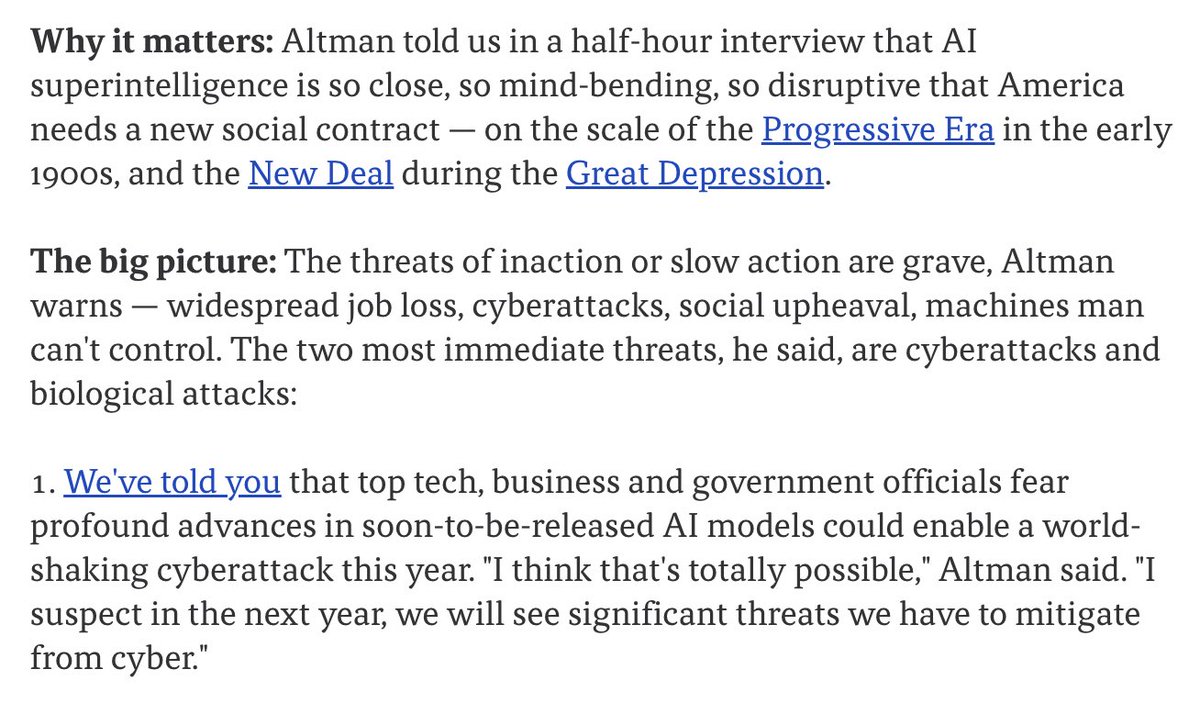
    1. The more Sam's finances don't add up, the hype he generates gets bigger. 2. But he's right that a massive cyberattack is likely imminent. (See my January 2025 @politico essay for why.) Chubby♨️ (@kimmonismus)
    Holy moly: Sam Altman told Axios in a half-hour interview that AI superintelligence is so close, so mind-bending, so disruptive that America needs a new social contract. – It's on the scale of the Progressive Era in the early 1900s, and the New Deal during the Great Depression. – Altman warns: widespread job loss, cyberattacks, social upheaval, machines man can't control – "Soon-to-be-released AI models could enable a world-shaking cyberattack this year. I think that's totally possible," Altman said. "I suspect in the next year, we will see significant threats we have to mitigate from cyber." [Translated from EN to English]

    → View original post on X — @garymarcus, 2026-04-06 14:57 UTC

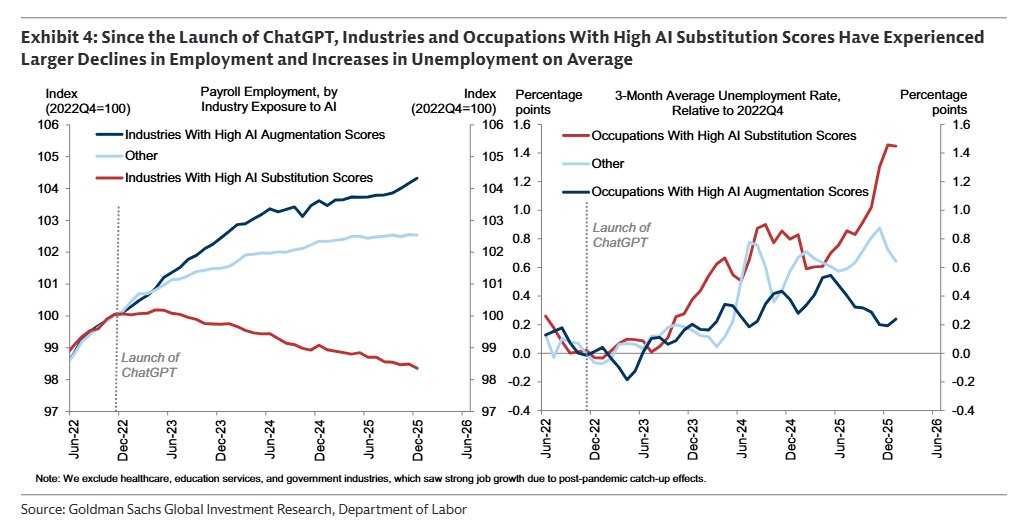
  • Goldman Sachs: AI Impact on U.S. Employment Shows Net Negative Effect
    Goldman Sachs: AI Impact on U.S. Employment Shows Net Negative Effect

    Goldman tries to quantify the net effect of AI both substituting for and augmenting U.S. employment. Their conclusion: AI substitution in occupations like phone operations and insurance claims administration have reduced monthly payroll gains by around -25K and raised the unemployment rate by 0.16 pp over the past year. AI augmentation in occupations including medicine and education have added +9K to monthly payrolls and lowered the unemployment rate by 0.06 pp. This nets out to a slight -16K drag on payrolls and an increase in the unemployment rate by 0.1 pp. Caveat: This exercise doesn't account for the possible benefit from either construction hiring due to data-center buildout or AI-driven productivity/income gains.

    → View original post on X — @mfordfuture, 2026-04-06 14:57 UTC