AI Dynamics

Global AI News Aggregator

About

AGENTS

  • Codex App Server Enables Easy Agentic App Development

    Codex app server makes it easy to build your own agentic apps: am.will (@LLMJunky) The Codex app server was such a brilliant stroke of foresight that really doesn't get enough love Not only are you allowed to use your chatgpt account with any harness, but you can build your own apps directly on top of theirs. They just make building on and with codex such a great experience To demonstrate this utility, I want to highlight the kitty litter app, made by @SIGKITTEN. Instead of having to build the entire harness, and all the infrastructure, he's plugged into the app server for a unified experience between mobile and dev machine. When I create a session on my computer, it's automatically available on my phone. All of the chats you see in this video automatically populated when we connected to the app server. All my skills. My agents. My sessions. My folders. My prompts. They're all ready to use – automatically. Because they're exposed by the app server, along with many other endpoints. It's a great ux/dx that really deserves some love. It's almost like they want you to build on top of their products 😉 Btw Litter is great 👍 — https://nitter.net/LLMJunky/status/2040506388292546761#m

    → View original post on X — @gdb, 2026-04-05 03:18 UTC

  • One-Person Billion Dollar Companies: The AI-Powered Future

    THE ONE PERSON $1B COMPANY ERA IS STARTING TO LOOK REAL. One founder, six AI departments, and zero employees sounds insane until you realize the whole stack is already here.

    → View original post on X — @ceobillionaire, 2026-04-05 03:15 UTC

  • Codex and Claude Agent SDK Server Limitations Discussed

    Codex app server is limited in its own ways, unfortunately – it does too much server-side which limits what one can do with it. (Claude Agent SDK has it's own silly limitations too; no-one has actually got this right yet.)

    → View original post on X — @jeremyphoward

  • Microsoft 365 Connectors Limited: Read-Only Access Insufficient for Task Automation
    Microsoft 365 Connectors Limited: Read-Only Access Insufficient for Task Automation

    My hot take is that this is only a 15% productivity gain for M365 users. M365 read connectors are a great start. As is Claude computer use for windows. But computer use is too slow (on purpose) for actual inbox triage. And this connector only really has Read access. So yes it can access and search and read and gather and synthesize and analyze…but that’s not TASK completion in these tools. That doesnt let me delegate any email management to my AI system. Give me the power to manage, edit, write, draft, send, and then we can talk. MSFT is clearly dipping its toes in the Anthropic waters more. Here’s to hoping they crack enterprise-secure actions beyond search, find, and read. Claude (@claudeai) Microsoft 365 connectors are now available on every Claude plan. Connect Outlook, OneDrive, and SharePoint to bring your email, docs, and files into the conversation. Get started here: claude.ai/customize/connecto… — https://nitter.net/claudeai/status/2040086268562842097#m

    → View original post on X — @alliekmiller, 2026-04-04 23:06 UTC

  • Boardy AI Agent Disrupts Startup Funding at Scale

    @boardy is about to disrupt it anyway. It can talk to thousands of investors and thousands of founders at the same time and help both of them. YC can't do that.

    → View original post on X — @scobleizer

  • Legacy Context Risks in AI Agent Development and Coding

    you can't. legacy makes no sense for coding or agentic work. far too risky re prompt injection too.

    → View original post on X — @steipete

  • Next two months in AI agents industry insights

    The next two months in AI agents. At Pokee's hackathon in San Francisco today. It makes a very powerful agentic platform. More on that later tonight when the Hackathon concludes. Founder/CEO @ZheqingZhu (Bill) Zhu told me the next move the industry will make (and he'll be

    → View original post on X — @scobleizer

  • 8 Building Blocks of Effective Claude Prompts
    8 Building Blocks of Effective Claude Prompts

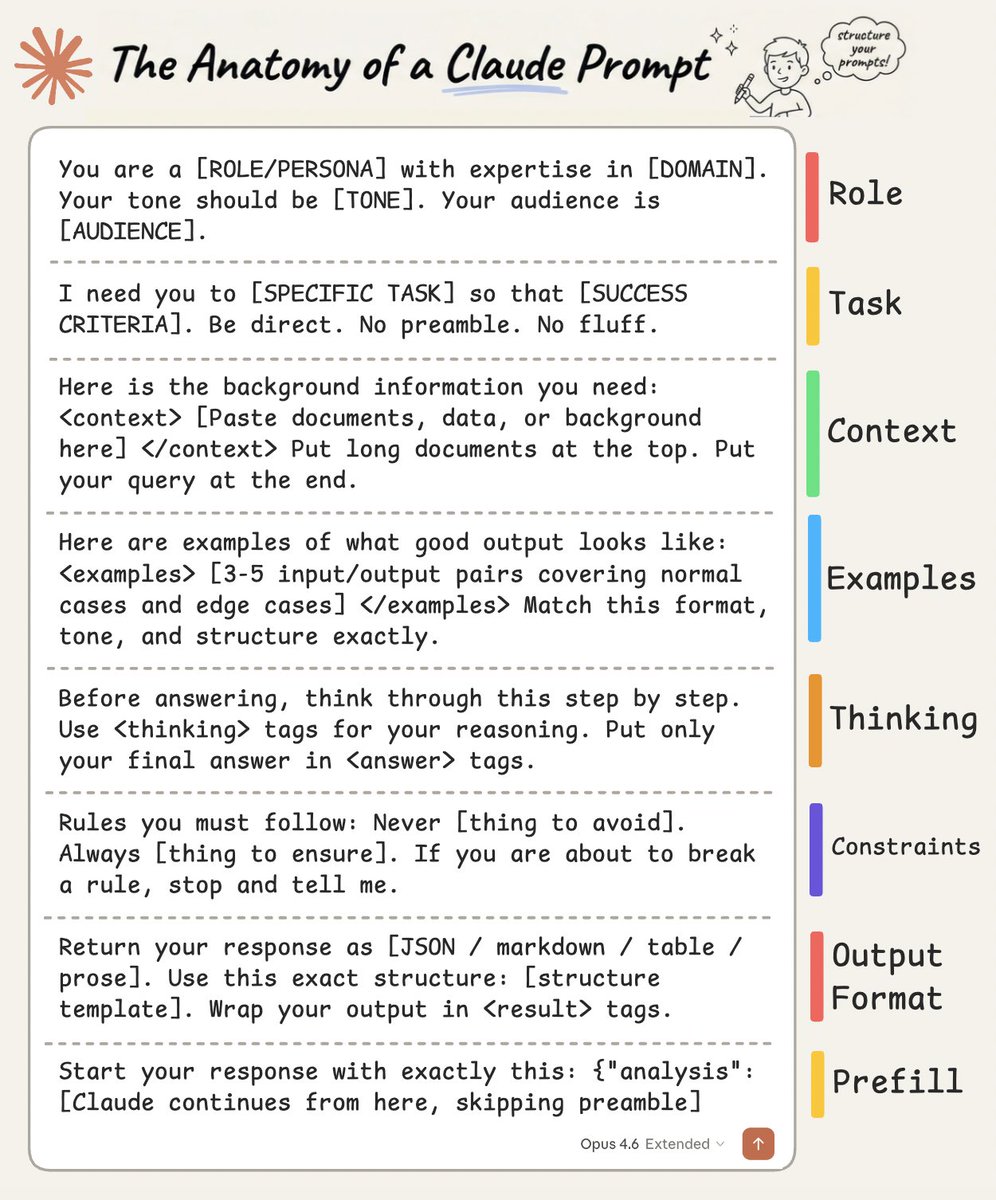
    If you found it insightful, reshare with your network. Find me → @akshay_pachaar ✔️ For more insights and tutorials on LLMs, AI Agents, and Machine Learning! nitter.net/akshay_pachaar/status/… Akshay 🚀 (@akshay_pachaar) The anatomy of a Claude prompt: The difference between a mediocre Claude output and a great one almost always comes down to how you structure your prompt. Not the specific words you choose. Not some secret phrasing. Just a clear, repeatable structure that gives Claude exactly what it needs to do the job well. Here's how a well-built Claude prompt breaks down into 8 building blocks, each doing one job: 1️⃣ Role Tell Claude who it is before telling it what to do. "You are a [ROLE] with expertise in [DOMAIN]. Your tone should be [TONE]. Your audience is [AUDIENCE]." Setting a role in the system prompt changes how Claude reasons, what it prioritizes, and how it communicates. A "senior backend engineer" writes differently than a "technical copywriter," and Claude picks up on that distinction immediately. 2️⃣ Task State what you want and what success looks like, in the same breath. "I need you to [SPECIFIC TASK] so that [SUCCESS CRITERIA]." The "so that" part is what people skip, and it's the part that matters. It gives Claude a way to evaluate its own output. Without it, Claude is guessing what "good" means. Be direct, skip the preamble, and cut the fluff. 3️⃣ Context This is where you feed Claude everything it needs to do the job well. Wrap it in XML tags like <context> and </context>, then paste your documents, data, or background inside. One thing that dramatically improves quality: put long documents at the top of your prompt and your actual query at the end. Anthropic's own testing shows this can improve response quality by up to 30%, especially with complex, multi-document inputs. 4️⃣ Examples Nothing steers output quality like showing Claude what "good" looks like. Provide 3-5 input/output pairs. Cover normal cases AND edge cases. Wrap them in <examples> tags so Claude doesn't confuse them with instructions. Claude pays extremely close attention to examples. If your example has a quirk you didn't intend, Claude will replicate it. So make sure every example models the behavior you actually want. 5️⃣ Thinking For anything requiring reasoning, analysis, or multi-step logic, ask Claude to think before answering. "Before answering, think through this step by step. Use <thinking> tags for your reasoning. Put only your final answer in <answer> tags." This separates the messy reasoning from the clean output. You get to see how Claude arrived at its answer without that reasoning cluttering the final result. 6️⃣ Constraints Every good prompt has guardrails. "Never [thing to avoid]. Always [thing to ensure]. If you are about to break a rule, stop and tell me." That last line is underrated. It turns Claude into a collaborator instead of a blind executor. Instead of silently violating a constraint, Claude flags the conflict and lets you decide. 7️⃣ Output Format Don't leave the format to chance. "Return your response as [JSON / markdown / table / prose]. Use this exact structure: [structure template]." If you want JSON, show the exact schema. If you want markdown, show the heading structure. If you want a table, define the columns. The more specific you are about shape, the less time you spend reformatting afterward. 8️⃣ Prefill This one is API-specific, but incredibly powerful. You can pre-fill the start of Claude's response to skip preamble and lock in the format. Claude will continue from exactly where you left off. No "Sure, I'd be happy to help!" opening, no throat-clearing, just clean output from the first token. Here's the thing people get wrong about prompting: they think it's about finding the right words. It's actually about giving Claude the right structure. If you want to go deeper, I wrote a detailed article covering the anatomy of the .claude/ folder, a complete guide to CLAUDE(.)md, hooks, skills, agents, and permissions, and how to set them all up properly. Link in the next tweet. — https://nitter.net/akshay_pachaar/status/2040414818696634635#m

    → View original post on X — @akshay_pachaar, 2026-04-04 20:24 UTC

  • Benchmarking AI Agents with 26B 8-bit Model on Jetson Orin

    Justement là je passe toute la soirée à le tester sur de l’agentique avec openclaw + benchmark sur la jetson nano orin. Moi le chiffre qui m’intéresse le plus c’est le 166 sur 26B 8-bits c’est juste hallucinant je trouve d’en être déjà arrivé là.

    → Voir le post original sur X — @dfintelligence

  • OpenClaw Agent Setup with Anthropic Authentication Command
    OpenClaw Agent Setup with Anthropic Authentication Command

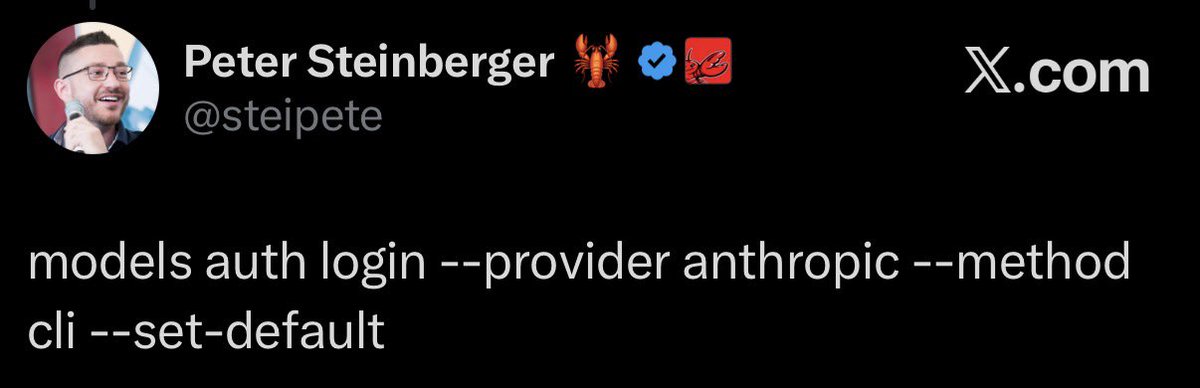
    OpenClaw is 🔥 and Peter is GOAT Send this to your OpenClaw Agent: models auth login –provider anthropic –method cli –set-default This is so much fun!

    → View original post on X — @saboo_shubham_, 2026-04-04 19:37 UTC