We are giving away Safetensors to the @pytorch foundation (shepherded by the Linux Foundation)
Our shared goal is to make the default serialization format for torch safe and performant. To unlock this, governance needs to be independent of @huggingface.
We are giving away Safetensors to the @pytorch foundation (shepherded by the Linux Foundation) Our shared goal is to make the default serialization format for torch safe and performant. To unlock this, governance needs to be independent of @huggingface. Looking forward to more stakeholders contributing to Safetensors in the coming months 🔥
Releasing one of our *largest* robotics project yet in the open We collected and annotated hours of clothes folding with open-arms and collaborators. We then explored how to train the best clothes folding robotic model for bimanual setups. And now we're releasing it all fully in the open: data, code, models, software, explorations, learnings, you name it Enjoy, play with it, use these learnings and share yours! PS: the hub is increasingly *the* place where robotics data is being shared and used, come take a look if you haven't yet. Robotics data has been our fastest growing dataset category by far over the past few months. LeRobot (@LeRobotHF) Releasing the Unfolding Robotics blog! Time to unfold robotics: we trained a robot to fold clothes using 8 bimanual setups, 100+ hours of demonstrations, and 5k+ GPU hours. Flashy robot demos are everywhere. But you rarely see the real story: the data, the failures, the engineering. We’re sharing everything: code, data, and details in the blog → huggingface.co/spaces/lerobo… — https://nitter.net/LeRobotHF/status/2041542790610297259#m
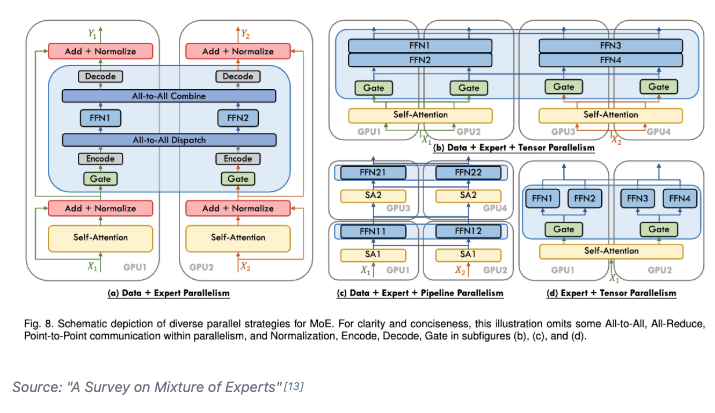
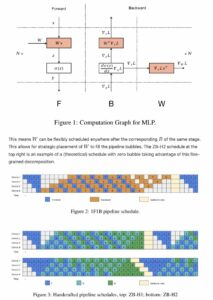
Day 93/365 of GPU Programming Studying parallelism today and stumbled upon this incredible blog post/book The Ultra-Scale Playbook: Training LLMs on GPU Clusters by Hugging Face that dives deep into data parallelism, expert parallelism, tensor parallelism, pipeline parallelism and context parallelism. I've read a bit about each of these methodologies before but this is the best resource I've found that really pieces them all together into a unified coherent picture. Kinda like its name implies, the team goes into actual empirical examples based on the 4000 scaling experiments (across up to 512 GPUs!) they conducted. E.g. how does tensor parallelism reduce activation memory for matmuls but still require gathering full activations for LayerNorm? When does pipeline parallelism's bubble overhead outweigh its memory savings? When and why would you combine TP/PP/DP on a specific cluster topology? What's the real memory breakdown between params, gradients, optimizer states and activations and which parallelism strategy targets which? et cetera Also loved all the beautiful and sometimes interactive diagrams that reminded me of distill.pub (which makes sense given they used distill's template to create the post). I wish more blog posts in ML would use a similar approach to help visual learners understand the content at an intuitive level. Especially now that rich visualizations/animations are so easy to spin up with LLMs. Really wonderful work by @Nouamanetazi @FerdinandMom @xariusrke @mekkcyber @lvwerra @Thom_Wolf. In times when things are going more and more closed source in, this is such a good example of what great open source AI education and research can look like. levi (@levidiamode) Day 92/365 of GPU Programming Taking a closer look at disaggregated LLM inference today, which I've been wanting to survey more after listening to the Dean <> Daly discussion at GTC. The best resource I found on the topic was this great talk by @Junda_Chen_ on the past, present and future of prefill decode disaggregation. In the lecture, Junda goes through Nvidia's dynamo, the intrinsic tradeoff spectrum between throughput & latency, TTFT, TPOT, the "goodput" metric, distinct characteristics between prefill vs decode, chunking P&D, the problem of interference, pipeline parallelism, resource & parallelism coupling, disaggregation and DistServe. — https://nitter.net/levidiamode/status/2040938107604742640#m
We’re very excited to deepen our work with the @SAIRfoundation co-founded by Terence Tao. We’ve been very active pushing the communities in AI x science in chemistry, physics, biology (more on that very soon) and this aligns perfectly with what the SAIR foundation has been doing… https://t.co/EA1EroWJTk
We’re very excited to deepen our work with the @SAIRfoundation co-founded by Terence Tao. We’ve been very active pushing the communities in AI x science in chemistry, physics, biology (more on that very soon) and this aligns perfectly with what the SAIR foundation has been doing in math (and soon extending as well). Sharing datasets, building challenges and communities Exciting future for open-science SAIR (@SAIRfoundation) We’re excited to announce our collaboration with @huggingface. Through SAIR competitions, we aim to provide open data, benchmarks, tools, and models, and expand the frontier of AI x Science through collective contributions from the community. SAIR on Hugging Face: huggingface.co/SAIRfoundatio… — https://nitter.net/SAIRfoundation/status/2041183272445559179#m
Terence Tao's SAIR foundation is doing some really cool work on enabling AI4Maths to be open and collaborative
I'm heaps excited that we now get to work together on bringing projects like their Mathematics Distillation Challenge to the HF ecosystem. Let's go 🚀! https://t.co/Mv0QbOD2I0
Terence Tao's SAIR foundation is doing some really cool work on enabling AI4Maths to be open and collaborative I'm heaps excited that we now get to work together on bringing projects like their Mathematics Distillation Challenge to the HF ecosystem. Let's go 🚀! SAIR (@SAIRfoundation) We’re excited to announce our collaboration with @huggingface. Through SAIR competitions, we aim to provide open data, benchmarks, tools, and models, and expand the frontier of AI x Science through collective contributions from the community. SAIR on Hugging Face: huggingface.co/SAIRfoundatio… — https://nitter.net/SAIRfoundation/status/2041183272445559179#m
TFW the R&D boss of arguably the oldest and most legendary robotics lab in the world stops you at a conference to tell you that your robot is "the coolest social robot in the world" Pollen Robotics (@pollenrobotics) "The coolest social robot in the world" As HRI 2026 in Edinburgh showed us, Reachy Mini already holds a special place in your hearts. Step by step, it is becoming the ideal companion for your projects, and your interactions with our robot encourage us to make it even better! — https://nitter.net/pollenrobotics/status/2040350732042285501#m
I trained an LLM from scratch on pre-1900 text to see if it could come up with quantum mechanics and relativity. While the model is too small to do meaningful reasoning, it has glimpses of intuition. When given observations from past landmark experiments, the model can declare that “light is made up of definite quantities of energy” and even suggest that gravity and acceleration are locally equivalent. I’m releasing the dataset + models and leave this as an open problem to the research community. I also include what this project has taught me about intelligence in a mini essay linked below. 🧵(1/n)
Today we're releasing Trinity-Large-Thinking. Available now on the Arcee API, with open weights on Hugging Face under Apache 2.0. We built it for developers and enterprises that want models they can inspect, post-train, host, distill, and own.
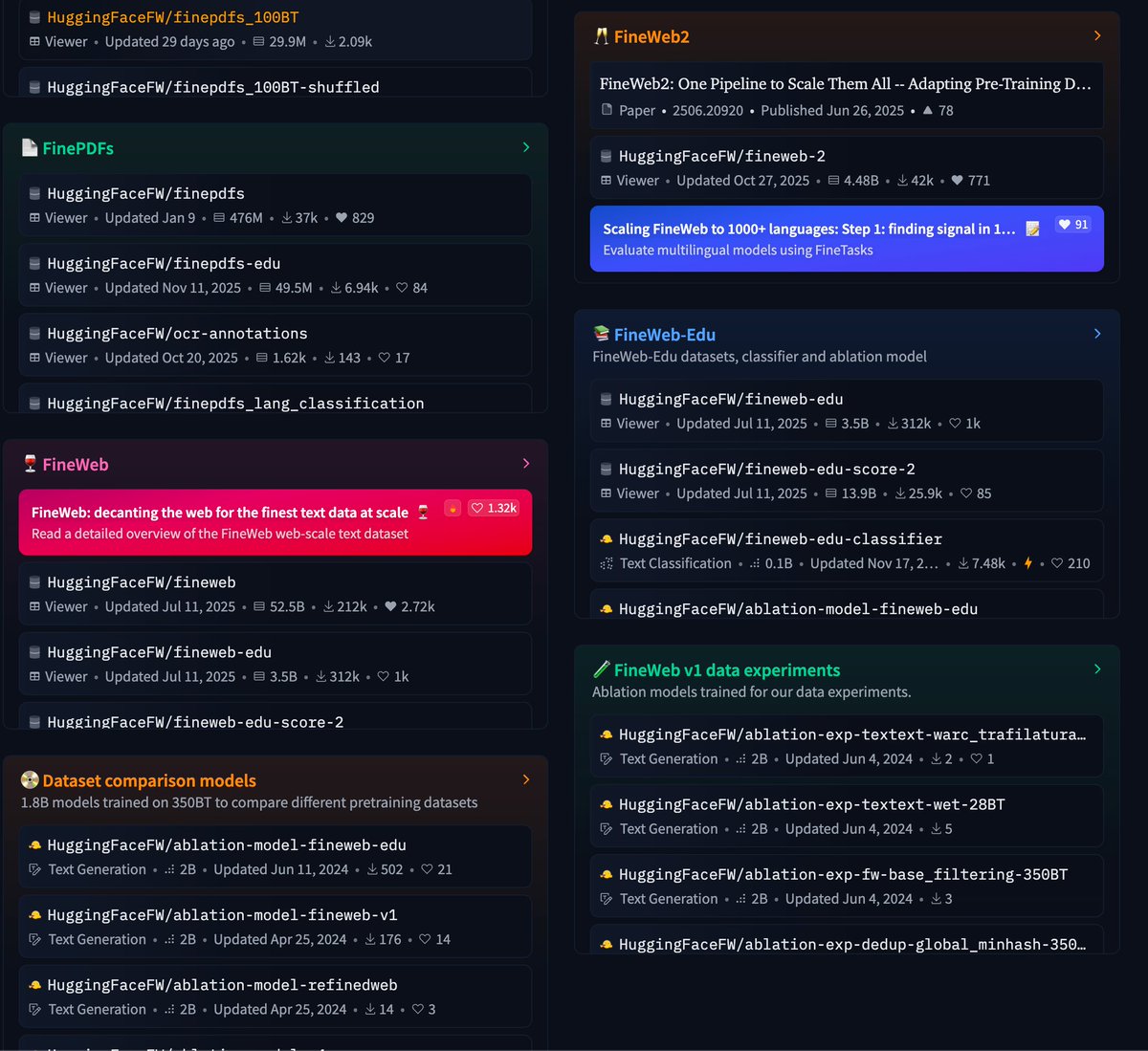
Oh shit, it seems like all the HF Research team pretraining data has been accidentally leaked to the public. The web, PDFs, and synthetic datasets are expode on hf FineData org… Apparently, an intern used CC to push the data with private=False.
Today, we release LFM2.5-350M. Agentic loops at 350M parameters. A 350M model trained for reliable data extraction and tool use, where models at this scale typically struggle. <500MB when quantized, built for environments where compute, memory, and latency are constrained. 🧵