is the future value of "open source" code anymore? i believe it's shifting to data, provenance, protocols, evals, and weights. in that order.
→ View original post on X — @thom_wolf, 2026-03-22 23:49 UTC
By
–
is the future value of "open source" code anymore? i believe it's shifting to data, provenance, protocols, evals, and weights. in that order.
→ View original post on X — @thom_wolf, 2026-03-22 23:49 UTC

By
–
If you're building anything in AI, the best skill you need to be using right now is hugging-face-paper-pages Whatever problem you're facing, someone has probably already published a paper about it. HF's Papers API gives a hybrid semantic search over AI papers. I wrote an internal skill, context-research, that orchestrates the HF Papers API into a research pipeline. It runs five parallel searches with keyword variants, triages by relevance and recency, fetches full paper content as markdown, then reads the actual methodology and results sections. The skill also chains into a deep research API that crawls the broader web to complement the academic findings. The gap between "a paper was published" and "a practitioner applies the insight" is shrinking, and I think this is a practical way to provide relevant context to coding agents. So you should write a skill on top of the HF Paper skill that teaches the model how to think about research, not just what to search for.
→ View original post on X — @thom_wolf, 2026-03-22 18:35 UTC
By
–
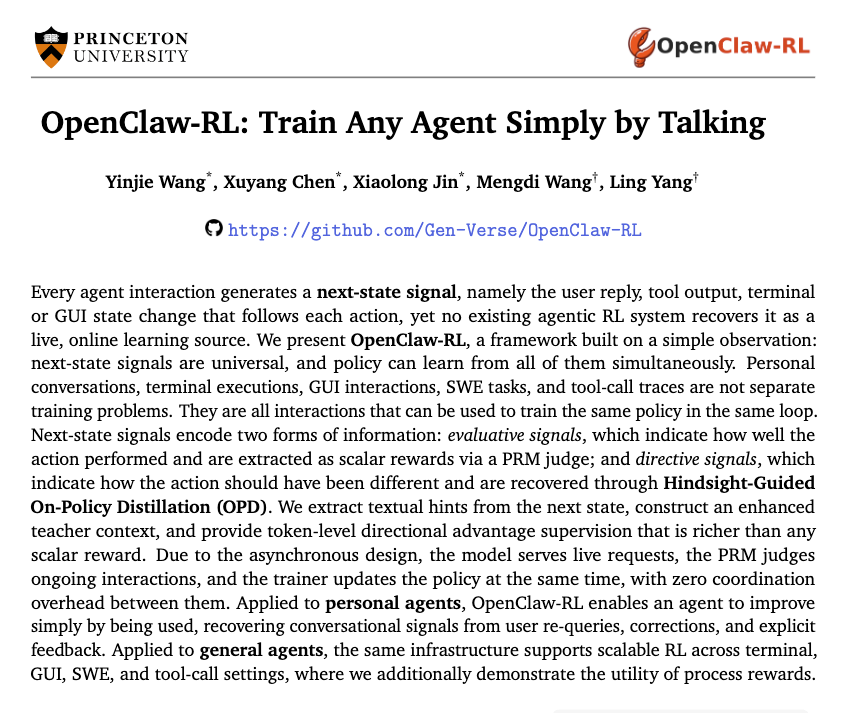
This is really cool. It got me thinking more deeply about personalized RL: what’s the real point of personalizing a model in a world where base models can become obsolete so quickly? The reality in AI is that new models ship every few weeks, each better than the last. And the pace is only accelerating, as we see on the Hugging Face Hub. We are not far away from better base models dropping daily. There’s a research gap in RL here that almost no one is working on. Most LLM personalization research assumes a fixed base model, but very few ask what happens to that personalization when you swap the base model. Think about going from Llama 3 to Llama 4. All the tuned preferences, reward signals, and LoRAs are suddenly tied to yesterday’s model. As a user or a team, you don’t want to reteach every new model your preferences. But you also don’t want to be stuck on an older one just because it knows you. We could call this "RL model transferability": how can an RL trace, a reward signal, or a preference representation trained on model N be distilled, stored, and automatically reapplied to model N+1 without too much user involvement? We solved that in SFT where a training dataset can be stored and reused to train a future model. We also tackled a version of that in RLHF phases somehow but it remain unclear more generally when using RL deployed in the real world. There are some related threads (RLTR for transferable reasoning traces, P-RLHF and PREMIUM for model-agnostic user representations, HCP for portable preference protocols) but the full loop seems under-studied to me. Some of these questions are about off-policy but other are about capabilities versus personalization: which of the old customizations/fixes does the new model already handle out of the box, and which ones are actually user/team-specific to ever be solved by default? That you would store in a skill for now but that RL allow to extend beyond the written guidance level. I have surely missed some work so please post any good work you’ve seen on this topic in the comments. Ronak Malde (@rronak_) This paper is almost too good that I didn't want to share it Ignore the OpenClaw clickbait, OPD + RL on real agentic tasks with significant results is very exciting, and moves us away from needing verifiable rewards Authors: @YinjieW2024 Xuyang Chen, Xialong Jin, @MengdiWang10 @LingYang_PU — https://nitter.net/rronak_/status/2034158978733904160#m
→ View original post on X — @thom_wolf, 2026-03-19 15:01 UTC
By
–
Karpathy asked. I delivered. Introducing OpenSquirrel! Written in pure rust with GPUI (same as zed) but with agents as central unit rather than files. Supports Claude Code, Codex, Opencode, and Cursor (cli). This really forced me to think up the UI/UX from first principles instead of relying on common electron slop. github.com/Infatoshi/OpenSqu… Andrej Karpathy (@karpathy) Expectation: the age of the IDE is over Reality: we’re going to need a bigger IDE (imo). It just looks very different because humans now move upwards and program at a higher level – the basic unit of interest is not one file but one agent. It’s still programming. — https://nitter.net/karpathy/status/2031767720933634100#m
→ View original post on X — @thom_wolf, 2026-03-15 22:03 UTC

By
–
Codexing games together with my 12 yo has been a surprisingly fun dad-son activity over the past couple months as well I don’t pretend he’s really learning to code through that but the very low friction from ideas to implementation and the pure pleasure to invent/propose-anything/mix-and-match-games-ideas/collaboratively-create-something-fun is deeply enjoyable Somewhere between LEGOs and exquisite corpse Sebastien Bubeck (@SebastienBubeck) My 9 yo is now fully independent with codex and it's insane to watch, we built a few games together and then he went off to build his own tower defense, adding features by himself and testing them … crazy — https://nitter.net/SebastienBubeck/status/2032940846962847980#m
→ View original post on X — @thom_wolf, 2026-03-15 17:16 UTC

By
–
wow this is soooo fun!
— Thomas Wolf (@Thom_Wolf) 9 avril 2025
CGI for now but really not far from current robot capabilities –though battery life is a challenge with 150 lb sitting on it–
now we need this as open-source hardware + software so I can build one in my garage pic.twitter.com/QzOMZkBLf3
wow this is soooo fun! CGI for now but really not far from current robot capabilities –though battery life is a challenge with 150 lb sitting on it– now we need this as open-source hardware + software so I can build one in my garage
By
–
Demo: https://
huggingface.co/spaces/yourben
ch/demo
…
Advanced usage: https://
huggingface.co/spaces/yourben
ch/advanced
…
Github: https://
github.com/huggingface/yo
urbench
…
Paper: https://
huggingface.co/papers/2504.01
833
…

By
–
Wow this is a game-changer!
— Thomas Wolf (@Thom_Wolf) 4 avril 2025
No. 1 question we get with +1.5M models on the hub: how to find the best one for your use-case?
Here comes YourBench 🪄 – work led by @sumukx @ailozovskaya and team
From a single document example, generate a custom eval with questions and test a… pic.twitter.com/W9tmAwTiaK
Wow this is a game-changer! No. 1 question we get with +1.5M models on the hub: how to find the best one for your use-case? Here comes YourBench – work led by @sumukx @ailozovskaya and team From a single document example, generate a custom eval with questions and test a
By
–
Blog post: https://
all-hands.dev/blog/introduci
ng-openhands-lm-32b—-a-strong-open-coding-agent-model
… Model:

By
–
Wow – open-source LLMs for code are so back Just one week after the latest DeepSeek release which brought vibe-coding for free, here is the high profile @allhands_ai team dropping a 32B model with matching performance on software engineering tasks benchmarks like SWE-Bench