The key distinction: Vanilla flow matching learns a trajectory. Recursive Flow Matching learns consistency across a family of trajectories. That turns step size from a source of error into a training signal.
@montreal_ai
-
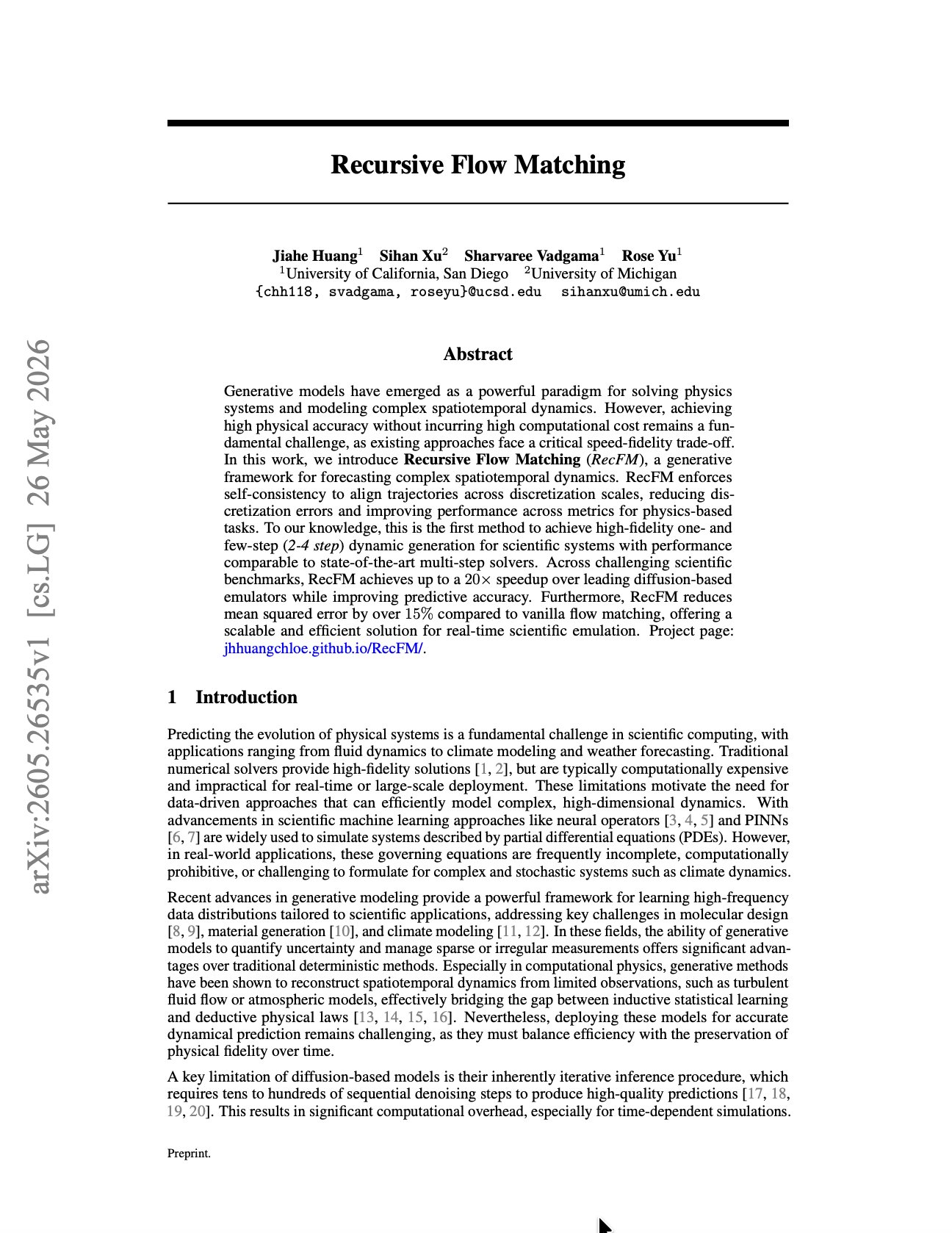
Recursive Flow Matching: New AI Approach for Scientific Simulation
By
–
Scientific simulation has a brutal tradeoff: fast is usually coarse,
accurate is usually expensive. A new paper by Jiahe Huang, Sihan Xu, Sharvaree Vadgama, and Rose Yu proposes a serious way through that bottleneck: Recursive Flow Matching. The target is one of the hardest -
Scalable Memory vs. Reasoning in AI Models
By
–
The key distinction: scalable memory ≠ scalable reasoning. A model can store evicted context in fixed-size fast weights and still fail if it has not spent enough computation transforming that context into a useful state. That is why the “sleep” phase is interesting: it moves
-
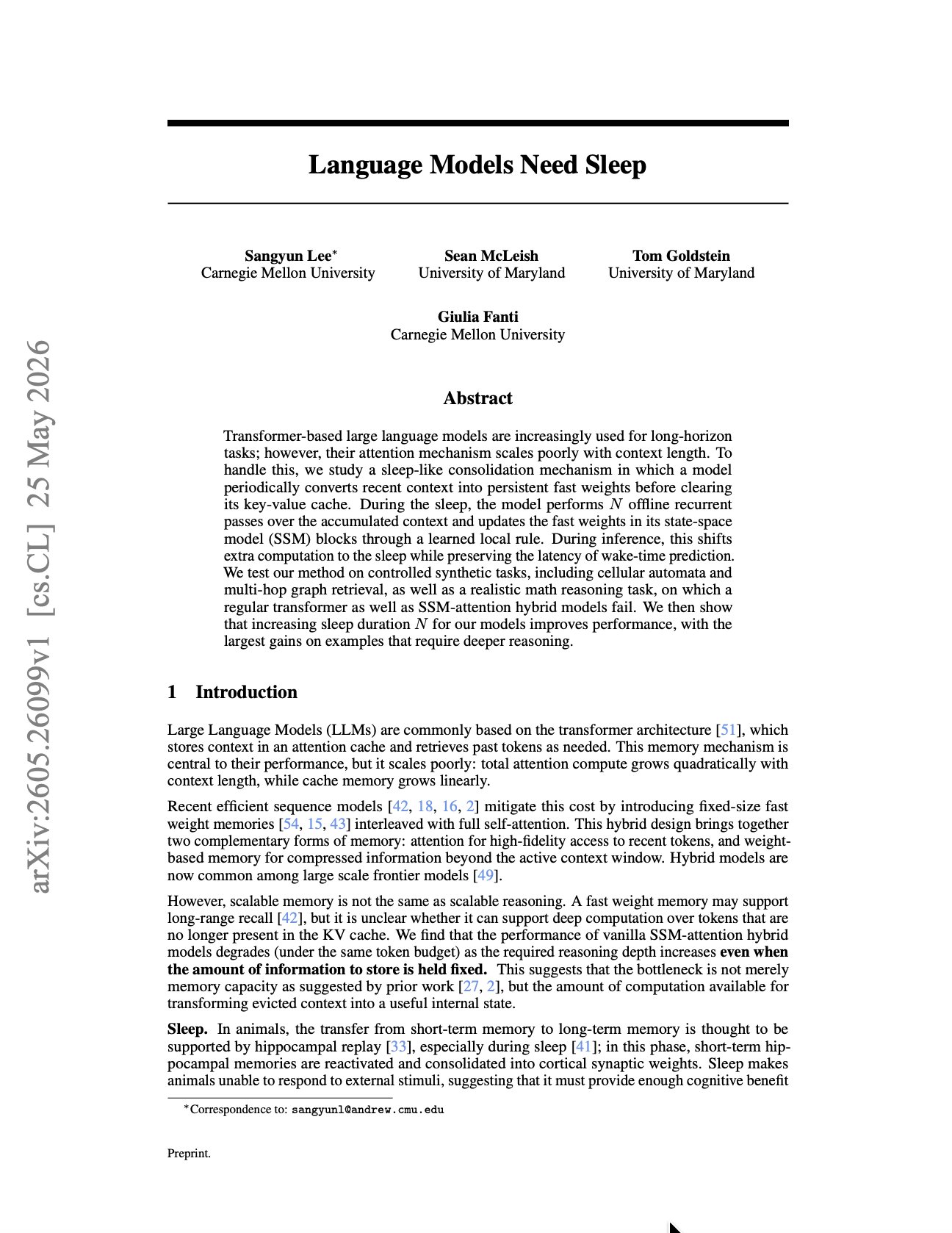
Sleep-like memory consolidation for AI models
By
–
Language models may not need longer context. They may need sleep. A fascinating new paper by Sangyun Lee, Sean McLeish, Tom Goldstein, and Giulia Fanti proposes one of the most biologically resonant ideas in long-context AI: sleep-like memory consolidation. The problem is
-
Functional vs Distributional Geometry in Hierarchical Concept Spectral Analysis
By
–
The key distinction here is subtle but important: Functional geometry asks what a representation can do. Distributional geometry asks where that representation came from. This paper shows that at least part of hierarchical concept geometry can be explained by the spectral
-

SkillOS: Open-Source AI-Agent Work Compounding Framework
By
–
http://
MONTREAL.AI just shipped SkillOS. An open-source proof that AI-agent work can compound. Jobs become traces.
Traces become tested skills.
Tested skills improve unit economics. 62% cost ↓
62% time ↓
+46 pts quality Proof: https://
montrealai.github.io/skillos/ GitHub: -
SkillOS Automates AI Agent Skill Development Across Networks
By
–
SkillOS gives organizations what human teams cannot do manually: turn every completed job into a tested, reusable skill that can upgrade every authorized agent across the network.
-
AI Agents Scaling: From Useful to Network Intelligence Layer
By
–
10 agents: useful
100 agents: powerful
1,000 agents: compounding
10,000 agents: network intelligence layer -

SkillOS: Agents Learn Once, All Level Up
By
–
AI agents shouldn’t start from zero every time. SkillOS captures what works from each job, turns it into a tested Skill, and shares it with every approved Agent. One Agent learns.
All Agents level up. That’s how AI work becomes compounding intelligence. -
SkillOpt: Reusable External Skills for AI Agents
By
–
The key idea: SkillOpt does not make the deployed agent larger. It trains a reusable external skill artifact offline, then ships only the improved procedure. That is a very different adaptation layer than fine-tuning, prompting, or adding more inference-time calls.