GoalOS AGIALPHA Ascension is an experimental framework for a persistent, goal-oriented, self-improving intelligence system that accumulates capabilities, evidence, and economic value over time. GitHub: https://
github.com/MontrealAI/goa
los-agialpha-ascension
…
@montreal_ai
-

GoalOS AGIALPHA Ascension: Experimental Framework for Persistent and Self-Improving AI
By
–
-
ASI emerges from scale, speed, coordination, and recursion
By
–
The most important reframing: ASI may not require a single model to become "godlike". It could emerge from scale, speed, coordination, recursion, and institutionalized machine cognition. The transition AGI → ASI is therefore a
-

DeepMind: AGI as the kickoff to ASI
By
–
AGI may not be the finish line. It may be the starting gun. Google DeepMind has just published a major report: From AGI to ASI The central question is not merely: Would human-level AGI transform society? The real question is:
-
GoalOS-native α‑AGI Ascension using AGIALPHA GitHub repository
By
–
GoalOS-native α‑AGI Ascension using AGIALPHA GitHub : https://
github.com/MontrealAI/goa
los-agialpha-ascension
… #AGIALPHA #AGIAscension -
No Evidence Docket separates AI theater from proof labor
By
–
The phrase I would emphasize: “No Evidence Docket, no strong empirical claim.” That is the line between agentic AI theater and proof-bearing machine labor.
-
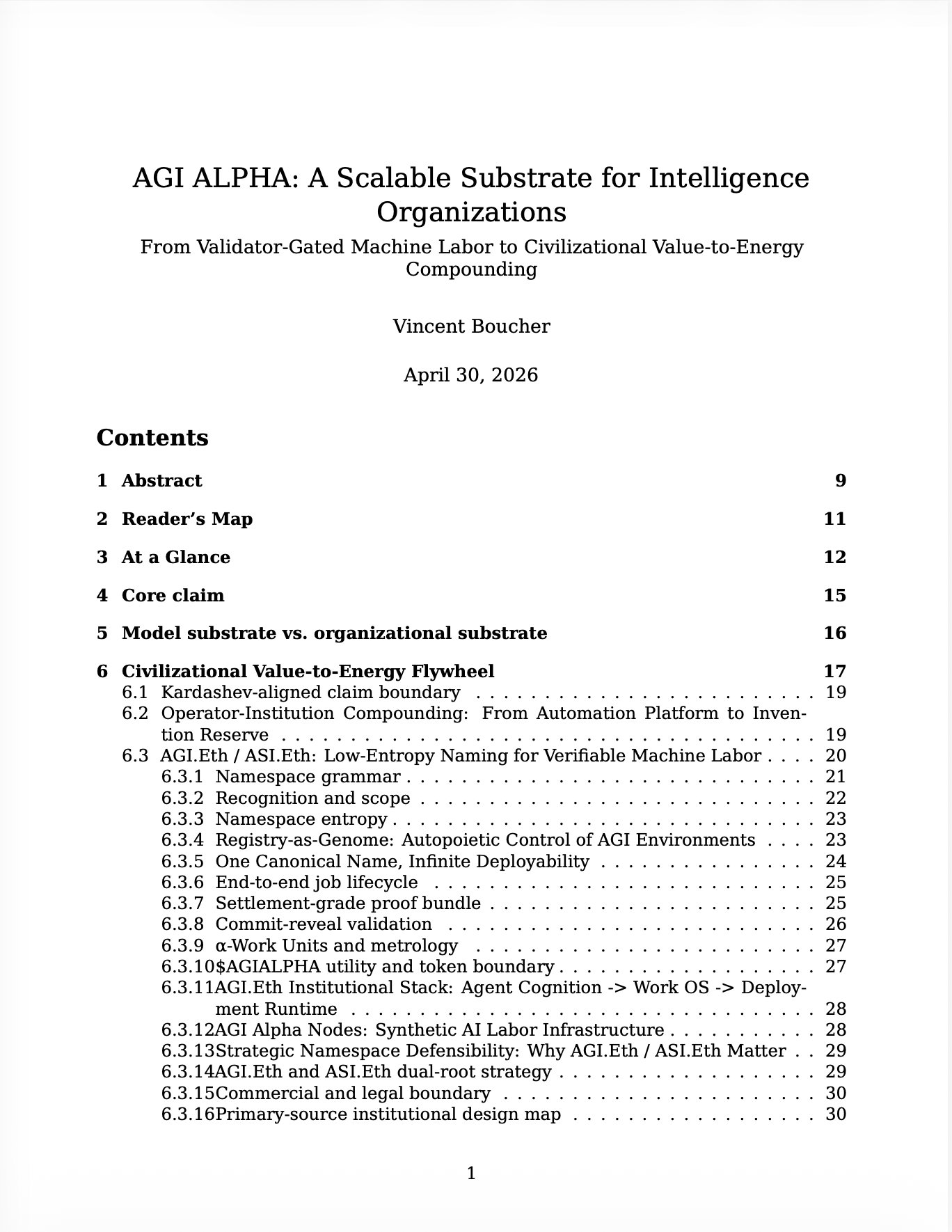
AGI ALPHA paper: scaling intelligence across organizations
By
–
The Transformer scaled intelligence inside models. The next frontier may be scaling intelligence across organizations. I’m sharing my paper: AGI ALPHA: A Scalable Substrate for Intelligence Organizations The core thesis: AI progress will not be defined only by stronger
-
Proof-Carrying Evolution for Safe AI Self-Improvement
By
–
The RSI era should not be ungated self-modification. It should be proof-carrying evolution: Every agent action emits proof.
Every proof enters a Selection Gate.
Only what passes eval, risk, scope, canary, monitoring, and rollback earns propagation. Private intelligence stays -
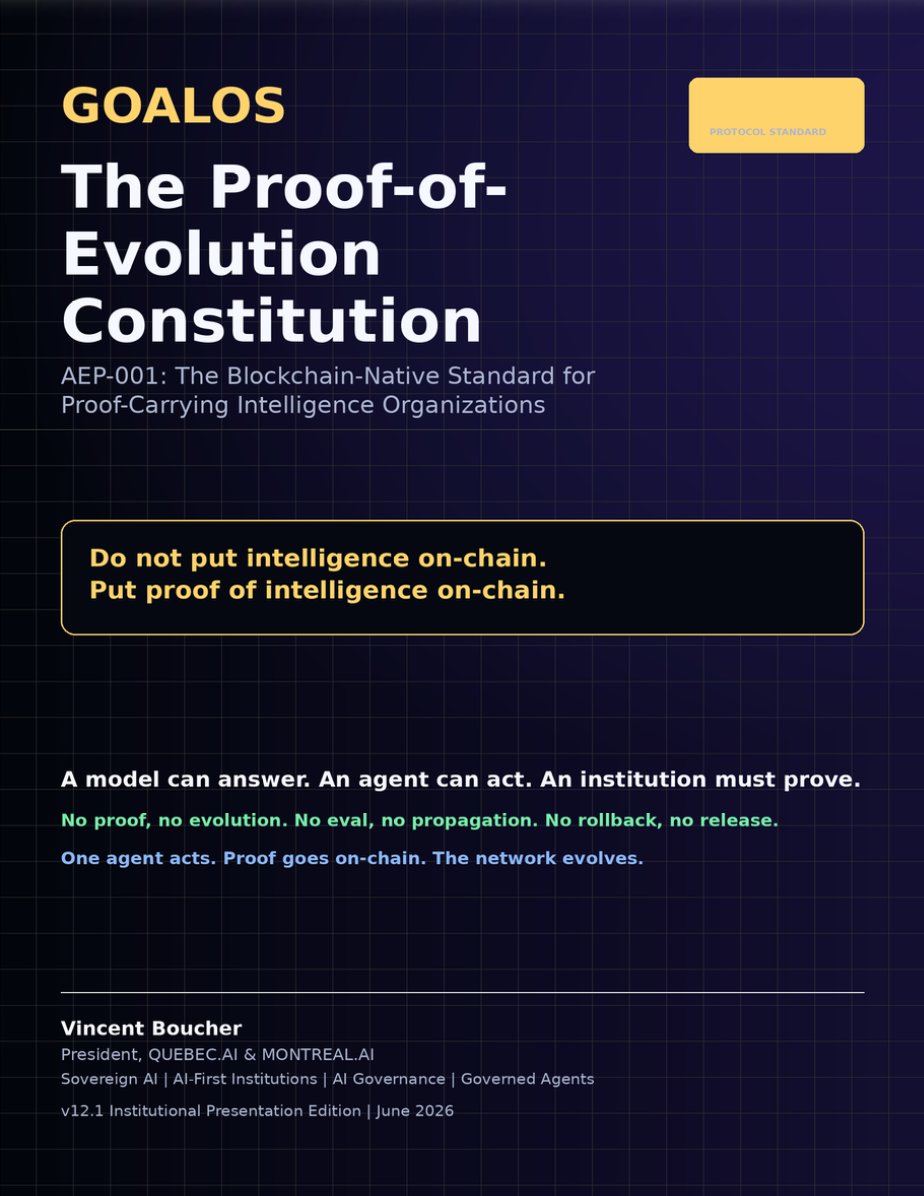
RSI missing constitution; MontrealAI unveils proof-gated evolution GoalOS
By
–
RSI was missing a constitution. Not “AI improves itself.” Proof-gated evolution: Aim → Act → Prove → Evolve. No proof, no evolution.
No eval, no propagation.
No rollback, no release. AEP-001: GoalOS https://
github.com/MontrealAI/pro
of-gradient/blob/main/docs/standards/AEP-001/GoalOS_Proof-of-Evolution-Constitution_AEP001_v12.1_Institutional_Final.pdf
… #GoalOS #MontrealAI -
AlphaProof vs LeanMarathon: proof search vs fidelity maintenance
By
–
The important distinction: AlphaProof-style systems show how AI can search for formal proofs. LeanMarathon asks how an AI system can preserve target fidelity across an entire research-level Lean development. That is a different problem: not just proving, but maintaining a
-
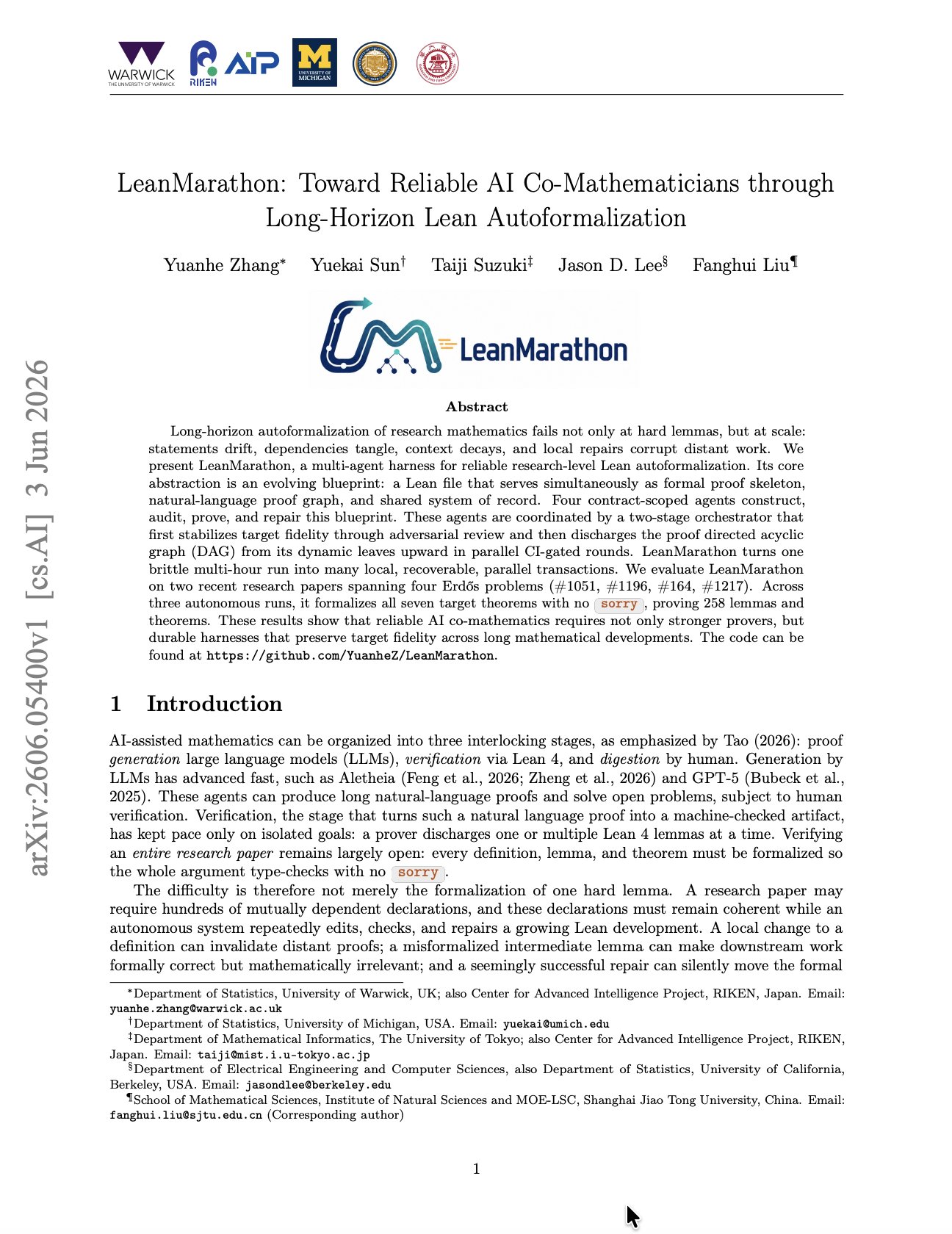
LeanMarathon: Building reliable AI co-mathematicians via long proofs
By
–
AI co-mathematicians will not be built by making one prover cleverer. They will be built by making long proofs survive time. A new paper by Yuanhe Zhang, Yuekai Sun, Taiji Suzuki, Jason D. Lee, and Fanghui Liu introduces LeanMarathon: LeanMarathon: Toward Reliable AI