10 agents: useful
100 agents: powerful
1,000 agents: compounding
10,000 agents: network intelligence layer
@montreal_ai
-
AI Agents Scaling: From Useful to Network Intelligence Layer
By
–
-

SkillOS: Agents Learn Once, All Level Up
By
–
AI agents shouldn’t start from zero every time. SkillOS captures what works from each job, turns it into a tested Skill, and shares it with every approved Agent. One Agent learns.
All Agents level up. That’s how AI work becomes compounding intelligence. -
SkillOpt: Reusable External Skills for AI Agents
By
–
The key idea: SkillOpt does not make the deployed agent larger. It trains a reusable external skill artifact offline, then ships only the improved procedure. That is a very different adaptation layer than fine-tuning, prompting, or adding more inference-time calls.
-

SkillOpt: Self-Evolving Agent Skills in Agentic AI
By
–
One of the most important objects in agentic AI may turn out to be a Markdown file. Not the model weights.
Not the prompt. The skill document. A new Microsoft paper introduces SkillOpt: Executive Strategy for Self-Evolving Agent Skills. The thesis is sharp: If an agent’s -
Self-Play RL vs Static Bug Generation in SWE Training
By
–
The key distinction: Synthetic bug generation is static. Self-play SWE-RL is online. The bug generator and bug solver improve together, so the curriculum changes as the model changes. That is what makes this much more interesting than simply manufacturing more training data.
-

Self-Play SWE-RL: Training Superintelligent Software Agents
By
–
The bottleneck for coding agents may not be code. It may be experience. A new ICML 2026 paper introduces Self-play SWE-RL (SSR): Toward Training Superintelligent Software Agents through Self-Play SWE-RL The question is simple and profound: How do you train software agents
-
Model Calibration vs. Discrimination in AI Uncertainty
By
–
The calibration vs. discrimination distinction is crucial. A model can know its average error rate without knowing which particular answer is wrong. That is why “just abstain when uncertain” is not enough — poor discrimination creates a utility tax. Faithful uncertainty is a
-

Hallucinations and Metacognition in Trustworthy AI Research
By
–
Trustworthy AI may not require omniscience. It may require epistemic honesty. A new paper by Gal Yona, Mor Geva, and Yossi Matias makes one of the clearest arguments I’ve seen for why hallucinations remain hard — and why the path forward may be metacognition. Hallucinations
-
Test-Time Compute and Solution-Aligned Attractors
By
–
The key distinction: More test-time compute is not automatically useful. It becomes useful when the model has learned an internal landscape where extra iterations move the latent state toward solution-aligned attractors rather than spurious ones. That is why the convergence
-
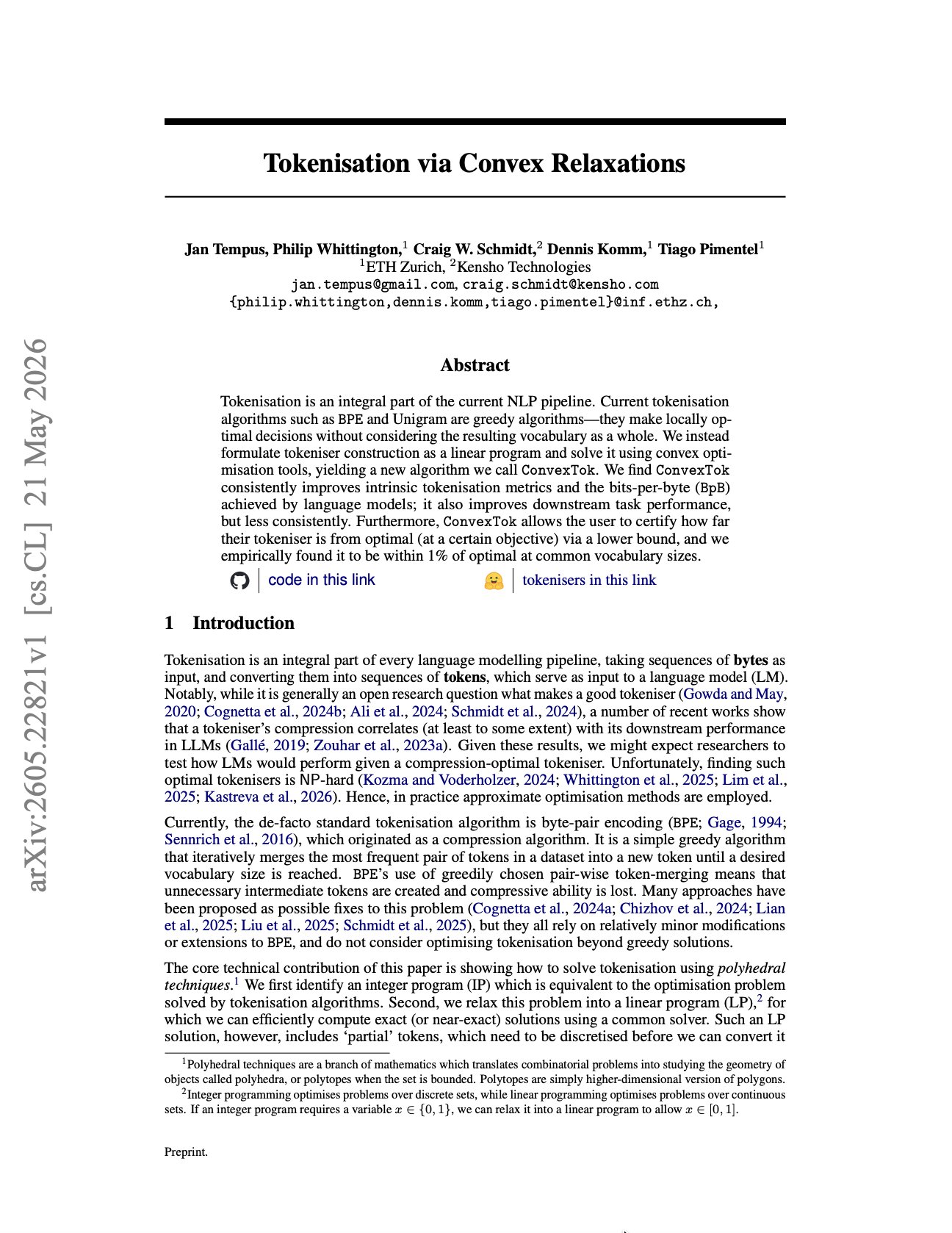
Tokenization as Architectural Prior: New Research Paper
By
–
The tokenizer is an architectural prior disguised as preprocessing. And almost everyone has been treating it like plumbing. A new paper by Jan Tempus, Philip Whittington, Craig W. Schmidt, Dennis Komm, and Tiago Pimentel changes the frame: Tokenisation via Convex Relaxations