
10/ The Influence Between NLP and Other Fields – aims to quantify the degree of influence between 23 fields of study and NLP; the cross-field engagement of NLP has declined from 0.58 in 1980 to 0.31 in 2022…
@dair_ai
-
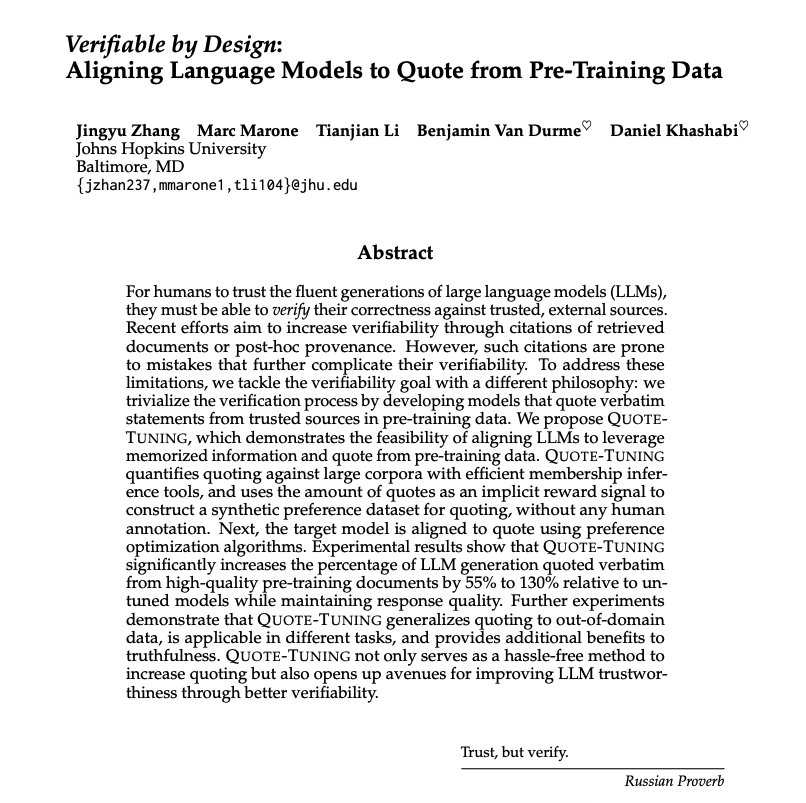
Aligning LLMs to Quote from Pre-Training Data
By
–
9/ Aligning LLMs to Quote from Pre-Training Data – proposes techniques to align LLMs to leverage memorized information quotes directly from pre-training data.
-

Multilingual LLMs Survey: Methods, Taxonomy and Research Frontiers
By
–
7/ Overview of Multilingual LLMs – a survey on multilingual LLMs including a thorough review of methods, a taxonomy, emerging frontiers, challenges, and resources to advance research.
-

Knowledge Capacity Scaling Laws in Language Models
By
–
8/ The Physics of Language Models – investigates knowledge capacity scaling laws where it evaluates a model’s capability via loss or benchmarks, to estimate the number of knowledge bits a model stores.
-
Iterative Self-Revision and Search for LLM Reasoning Tasks
By
–
6/ Reasoning with Intermediate Revision and Search – presents an approach for general reasoning and search on tasks that can be decomposed into components; incorporates iterative self-revision capabilities and allows an LLM to build an interwoven network of thoughts.
-
Google DeepMind Synthetic Data Research Best Practices Overview
By
–
5/ Best Practices and Lessons on Synthetic Data – an overview by Google DeepMind on synthetic data research, covering applications, challenges, and future directions
-
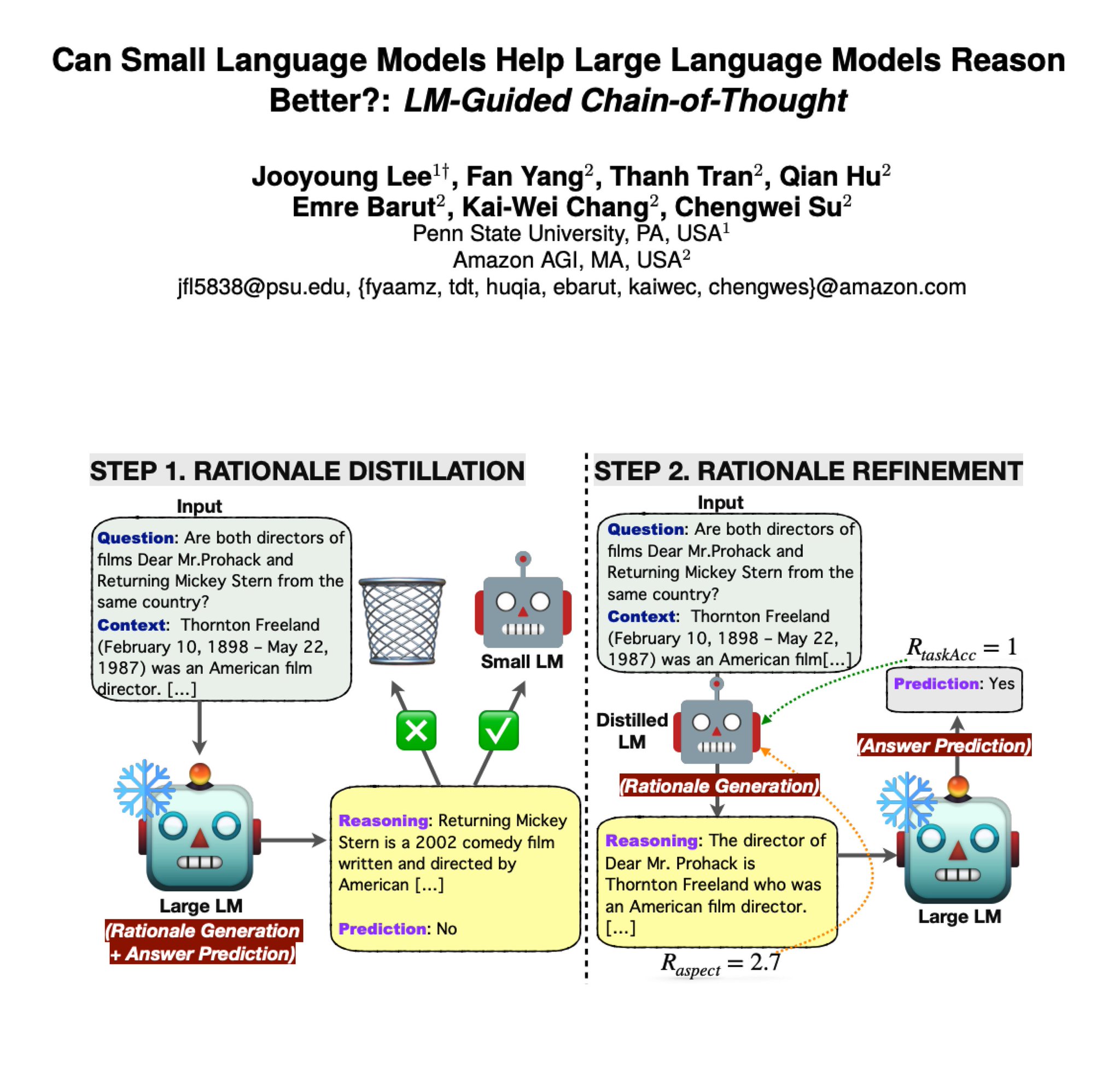
LM-Guided Chain-of-Thought Knowledge Distillation Technique
By
–
4/ LM-Guided Chain-of-Thought – applies knowledge distillation to a small LM with rationales generated by the large LM; the rationale is then generated by the lightweight LM and the answer prediction is done by the frozen large LM.
-
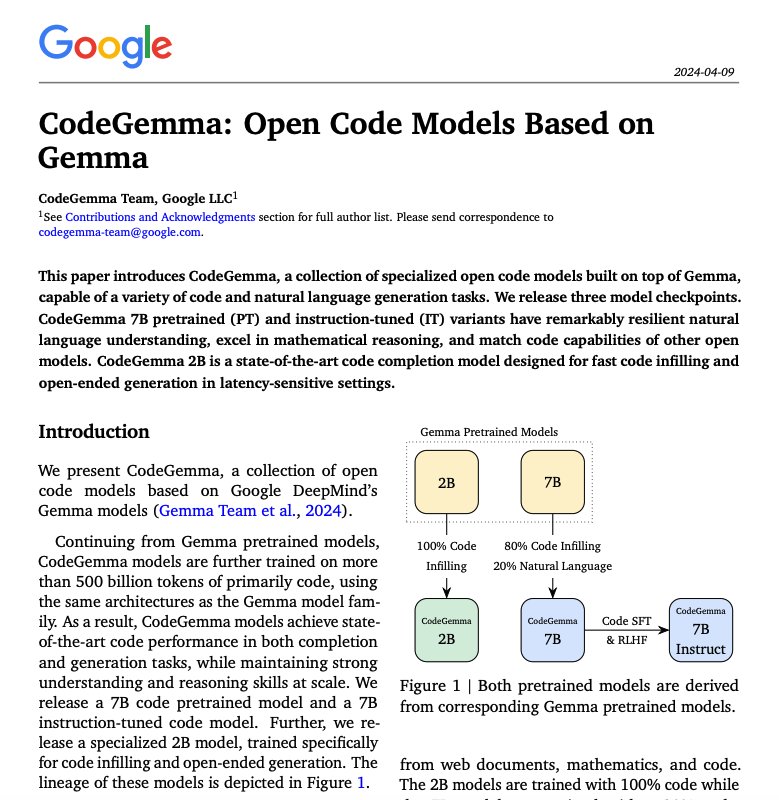
CodeGemma: Open Code LLM Family Matching Performance Benchmarks
By
–
3/ CodeGemma – a family of open code LLMs based on Gemma; CodeGemma 7B models excel in mathematical reasoning and match the code capabilities of other open models.
-
OpenEQA Benchmark Dataset for Embodied Question Answering
By
–
2/ OpenEQA – proposes an open-vocabulary benchmark dataset to measure the capabilities of AI models to perform embodied question answering (EQA); it contains 1600 human-generated questions composed from 180 real-world environments.https://t.co/8OYcRgcyjH
— DAIR.AI (@dair_ai) 14 avril 20242/ OpenEQA – proposes an open-vocabulary benchmark dataset to measure the capabilities of AI models to perform embodied question answering (EQA); it contains 1600 human-generated questions composed from 180 real-world environments.
-

LLM2LLM: Iterative Data Augmentation Strategy for Model Fine-tuning
By
–
10). LLM2LLM – an iterative data augmentation strategy that leverages a teacher LLM to enhance a small seed dataset by augmenting additional data that can be used to effectively fine-tune models.