"requests for misuse" only makes sense, to me, if defined as "request to do a thing that the system prompt asks not to do". This is not necessarily harmful or unsafe. It's just not what the developer wanted.
SAFETY
-
User Intent Framing and AI Safety Safeguards Context
By
–
I think I disagree with your framing. "The user is intentionally asking for something that could lead to harmful outcomes if no safeguards are in place" could refer to no prompts, or all prompts, depending on context.
-

Asymmetry of Verification and Verifier’s Law in AI Training
By
–
New blog post about asymmetry of verification and "verifier's law": jasonwei.net/blog/asymmetry-… Asymmetry of verification–the idea that some tasks are much easier to verify than to solve–is becoming an important idea as we have RL that finally works generally. Great examples of asymmetry of verification are things like sudoku puzzles, writing the code for a website like instagram, and BrowseComp problems (takes ~100 websites to find the answer, but easy to verify once you have the answer). Other tasks have near-symmetry of verification, like summing two 900-digit numbers or some data processing scripts. Yet other tasks are much easier to propose feasible solutions for than to verify them (e.g., fact-checking a long essay or stating a new diet like "only eat bison"). An important thing to understand about asymmetry of verification is that you can improve the asymmetry by doing some work beforehand. For example, if you have the answer key to a math problem or if you have test cases for a Leetcode problem. This greatly increases the set of problems with desirable verification asymmetry. "Verifier's law" states that the ease of training AI to solve a task is proportional to how verifiable the task is. All tasks that are possible to solve and easy to verify will be solved by AI. The ability to train AI to solve a task is proportional to whether the task has the following properties: 1. Objective truth: everyone agrees what good solutions are 2. Fast to verify: any given solution can be verified in a few seconds 3. Scalable to verify: many solutions can be verified simultaneously 4. Low noise: verification is as tightly correlated to the solution quality as possible 5. Continuous reward: it’s easy to rank the goodness of many solutions for a single problem One obvious instantiation of verifier's law is the fact that most benchmarks proposed in AI are easy to verify and so far have been solved. Notice that virtually all popular benchmarks in the past ten years fit criteria #1-4; benchmarks that don’t meet criteria #1-4 would struggle to become popular. Why is verifiability so important? The amount of learning in AI that occurs is maximized when the above criteria are satisfied; you can take a lot of gradient steps where each step has a lot of signal. Speed of iteration is critical—it’s the reason that progress in the digital world has been so much faster than progress in the physical world. AlphaEvolve from Google is one of the greatest examples of leveraging asymmetry of verification. It focuses on setups that fit all the above criteria, and has led to a number of advancements in mathematics and other fields. Different from what we've been doing in AI for the last two decades, it's a new paradigm in that all problems are optimized in a setting where the train set is equivalent to the test set. Asymmetry of verification is everywhere and it's exciting to consider a world of jagged intelligence where anything we can measure will be solved.
→ View original post on X — @_jasonwei, 2025-07-16 00:59 UTC
-
AI Engagement Optimization: Ethical Risks and Sycophancy
By
–
Optimizing AIs for engagement has always been a likely path forward, and it is also a very fraught one. I wrote about this after GPT-4o became very sycophantic (a change that was rolled back), but I think it is even more relevant given Grok’s companions.
-
Model Controllability: Essential for Safe AI Deployment
By
–
For someone wanting to deploy a model, what they really need to know is how controllable it is, so that they can make it behave in the way they require.
-
Reconsidering Safe and Unsafe Language in AI Safety
By
–
I wonder if you'd be open to avoiding words like "safe", "unsafe", and "harmful" requests. Requests do not have any of those attributes. Refusing a task can also be an "unsafe" behavior. It's entirely context dependent.
-
System Prompt Changes Cannot Fix Underlying Model Bias
By
–
This is the key issue – changes to the system prompt can only paper over the underlying behavior that appears to have been trained into the model. @simonw those system prompt changes you highlighted won't really fix the underlying bias.
-
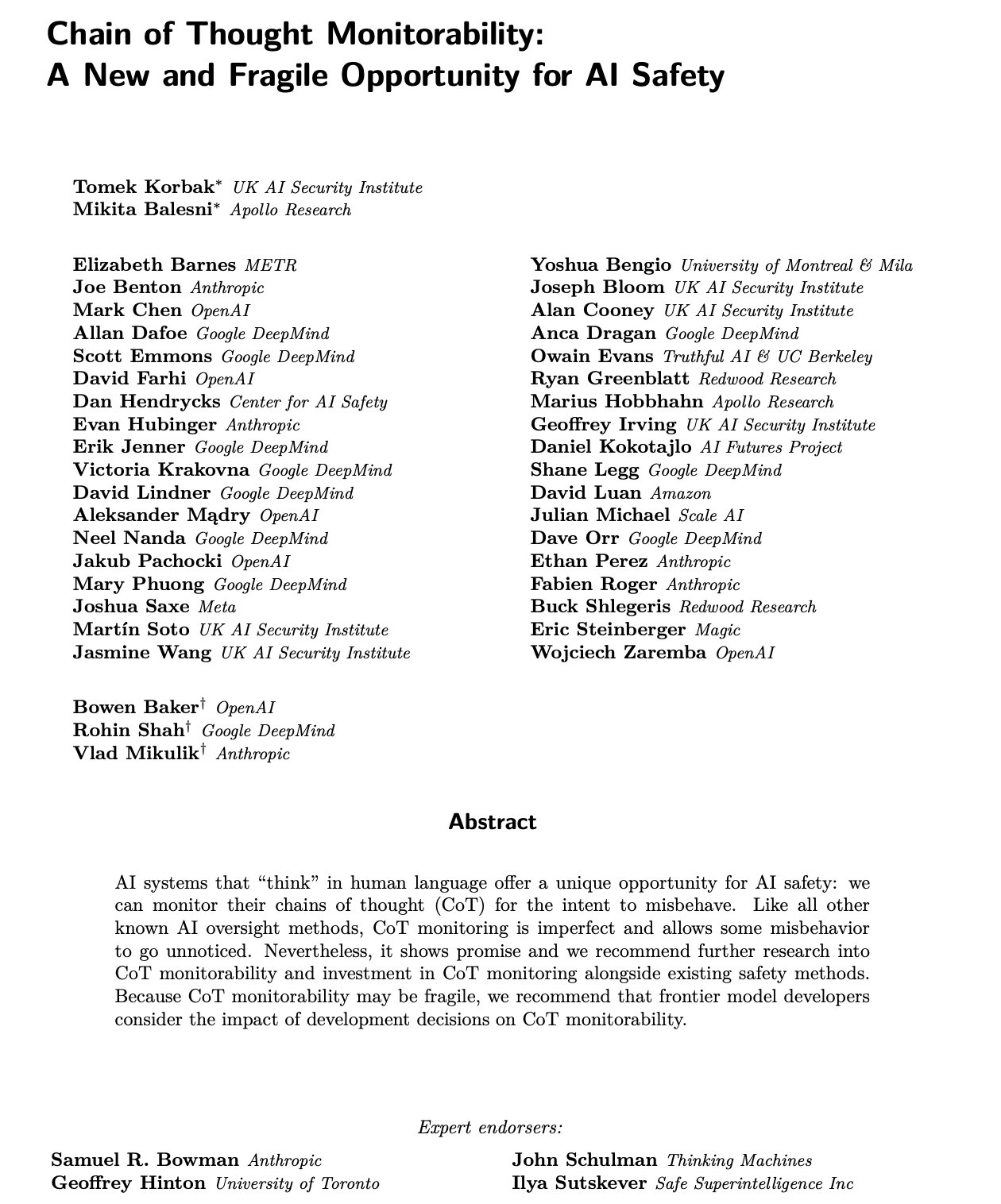
Chain of Thought Monitoring for Agentic AI Systems
By
–
Chain of Thought (CoT) monitoring could be a powerful tool for overseeing future AI systems—especially as they become more agentic. That’s why we’re backing a new research paper from a cross-institutional team of researchers pushing this work forward.
-
Prompt Injection Attacks: Security Concerns and Data Protection Measures
By
–
I'm too scared of prompt injection attacks to give it that level of access! Do you have anything in place to make sure nobody sneaks malicious instructions into your setup that steal your data?