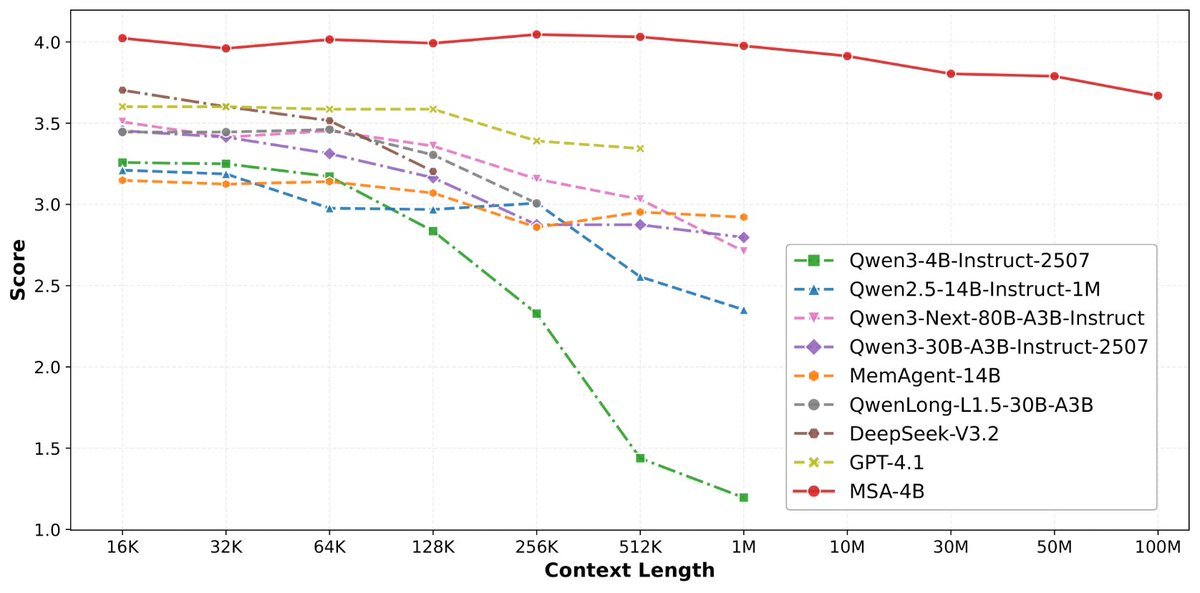
Very impressive: MSA (memory sparse attentions) is a so exciting because it lets AI models directly store and reason over massive long-term memory inside their attention system, without relying on external retrieval or lossy compression, making them far more accurate and
RESEARCH
-

CUWM: AI Agents Navigate Software Without Costly Mistakes
By
–
How can AI agents confidently navigate complex software without making costly mistakes? Nankai University, Nanjing University, The University of New South Wales, and Microsoft present CUWM. This Computer-Using World Model helps AI agents "see the future" of their actions on
-

Deep dive series on Saining Xie’s seven-hour interview about AI
By
–
I’ve started a new four-part deep dive series exploring a fascinating seven-hour interview with Saining Xie, hosted by Xiaojun Zhang. robonaissance.com/t/language… Saining Xie, cofounder and chief science officer of AMI Labs, believes the AI industry’s most successful technology is also its most seductive trap. His company has just raised $1.03 billion to prove it. 张小珺 Xiaojun Zhang (@zhang_benita) 和@sainingxie 一起挑战7小时播客!他刚和Yann LeCun踏上“世界模型”的创业旅程(AMI Labs)。这是他第一次Podcast、第一次访谈。 2026年2月雪后的一天,我们在纽约布鲁克林,从下午2点,开启了一场始料未及的马拉松式访谈,直到凌晨时分散去。 这篇访谈的中文标题叫做《逃出硅谷》,但他又不厌其烦地枚举了影响他学术生涯的每一个人,并反反复复口头描摹这些人的人物特征(侯晓迪、何恺明、杨立昆、李飞飞…)正是这些,让这篇“逃出硅谷”的对话充斥着人性的温度。 By the way, 下面是访谈的YouTube版本,我们提供了中英字幕。 And yes, 我们是在用播客给这个世界建模😎 A 7-hour podcast with Saining Xie. He has just begun a new journey on world models with Yann LeCun at AMI Labs. This was his first podcast appearance and his first long-form interview. A day after the snowfall in February 2026, in Brooklyn, New York, we started recording at 2 p.m. What followed became an unexpected marathon conversation that lasted until the early hours of the morning. The Chinese title of the interview is “Escaping Silicon Valley.” Yet throughout the conversation, he patiently listed the people who shaped his academic life, repeatedly sketching their personalities in vivid detail: Hou Xiaodi, Kaiming He, Yann LeCun, Fei-Fei Li, and others. These portraits are what give this “escape from Silicon Valley” conversation its human warmth. By the way, the YouTube version of the interview is below, with Chinese and English subtitles. And yes, we are using podcasts to model the world 😎 A 7-hour marathon interview with Saining Xie: World Models, AMI Labs, Ya… piped.video/rIwgZWzUKm8?si=edxa… 来自 @YouTube — https://nitter.net/zhang_benita/status/2033467851655512142#m
→ View original post on X — @shiqi_yang_147, 2026-03-21 09:54 UTC
-
Style preferences for code complexity and variable usage in ML
By
–
I also think it's interesting that @karpathy 's style preference seems quite different from my own! I actually prefer complex lines a lot of the time, because the intermediate variables introduce more free choices and spread things out more. I have to look to see if the variable is reused later. Obviously there's a limit and dense lines are often pretty bad in ML code, but I definitely wouldn't have a "one op per line" rule in my style guide.
-
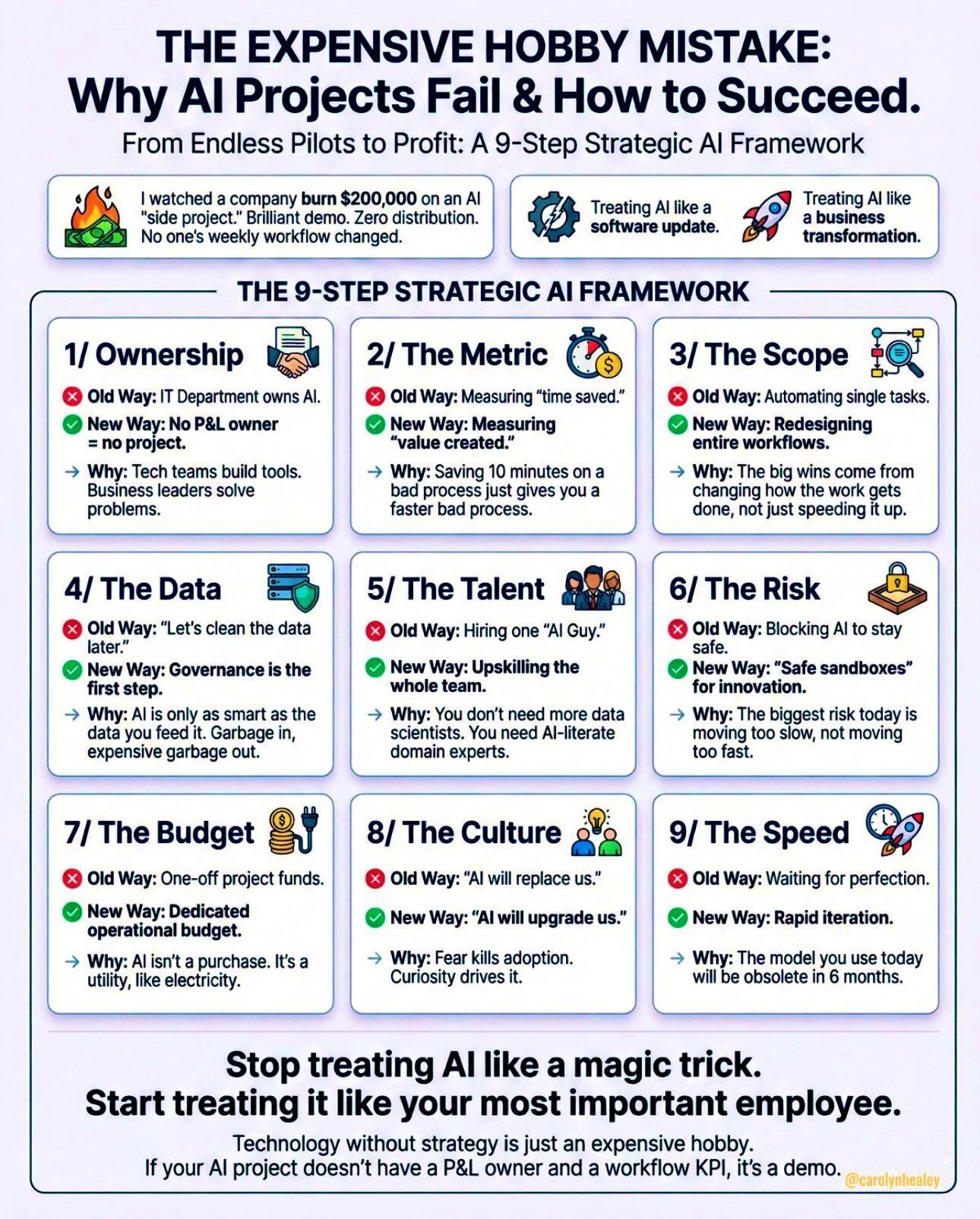
AI Projects: Common Failures and Success Strategies
By
–
The Expensive Hobby Mistake: Why #AI Projects Fail and How to Succeed
by @Khulood_Almani #MachineLearning #ArtificialIntelligence #ML -
Iterative Improvement Over Single-Pass Instructions for AI Agents
By
–
You can't expect instructions like "Every line should do one thing" in an AGENTS.md to work. You need multiple passes. Trying to front-load all the style advice is like setting a really high learning rate. The space of possible code solutions is very large. Rather than trying to get there in one step, it's better to make lots of little steps that reliably iteratively improve the solution. Andrej Karpathy (@karpathy) I'm not very happy with the code quality and I think agents bloat abstractions, have poor code aesthetics, are very prone to copy pasting code blocks and it's a mess, but at this point I stopped fighting it too hard and just moved on. The agents do not listen to my instructions in the AGENTS.md files. E.g. just as one example, no matter how many times I say something like: "Every line of code should do exactly one thing and use intermediate variables as a form of documentation" They will still "multitask" and create complex constructs where one line of code calls 2 functions and then indexes an array with the result. I think in principle I could use hooks or slash commands to clean this up but at some point just a shrug is easier. Yes I think LLM as a judge for soft rewards is in principle and long term slightly problematic (due to goodharting concerns), but in practice and for now I don't think we've picked the low hanging fruit yet here. — https://nitter.net/karpathy/status/2035173492447224237#m
-
Proving AI Security: The Challenge Beyond Attack Prevention
By
–
"Solved" implies that it's not possible to craft an attack that works. I'm not convinced that's true, even as attacks get harder The big challenge is proving you can't get an attack through – I'm not sure how you'd do that
-
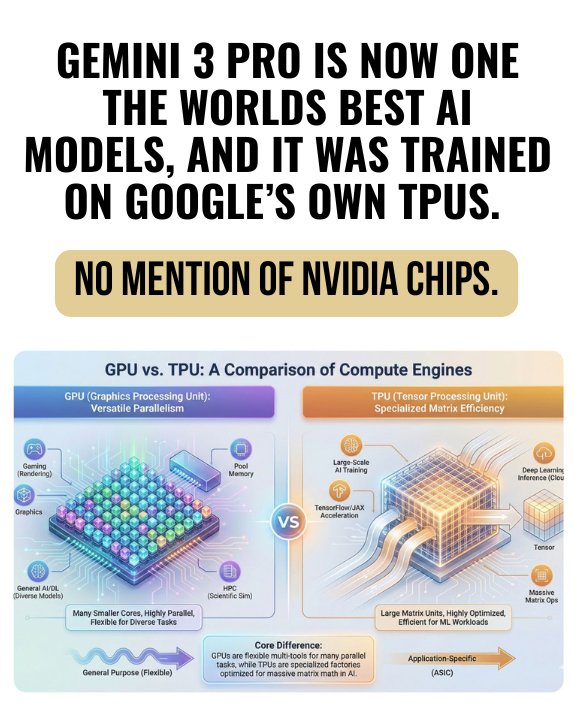
Google’s Gemini 3 Pro Dominates AI Leaderboards with Innovative Training
By
–
Google’s Gemini 3 Pro is now sitting at the top of several major AI leaderboards. Not by a little — clearly ahead on LMArena, WebDev Arena, and Vision Arena. But what really caught my attention isn’t just the model performance. It’s how it was trained. Google trained Gemini
-
HexRunner Achieves Stable 30 MPH Locomotion Through Speed Design
By
–
Designing for Speed: How HexRunner Achieved Stable 30 MPH Locomotion
— Ronald van Loon (@Ronald_vanLoon) 21 mars 2026
by @lukas_m_ziegler
#EmergingTech #Engineering #ArtificialIntelligence #Innovation #Technology pic.twitter.com/RDEv4JShktDesigning for Speed: How HexRunner Achieved Stable 30 MPH Locomotion
by @lukas_m_ziegler #EmergingTech #Engineering #ArtificialIntelligence #Innovation #Technology