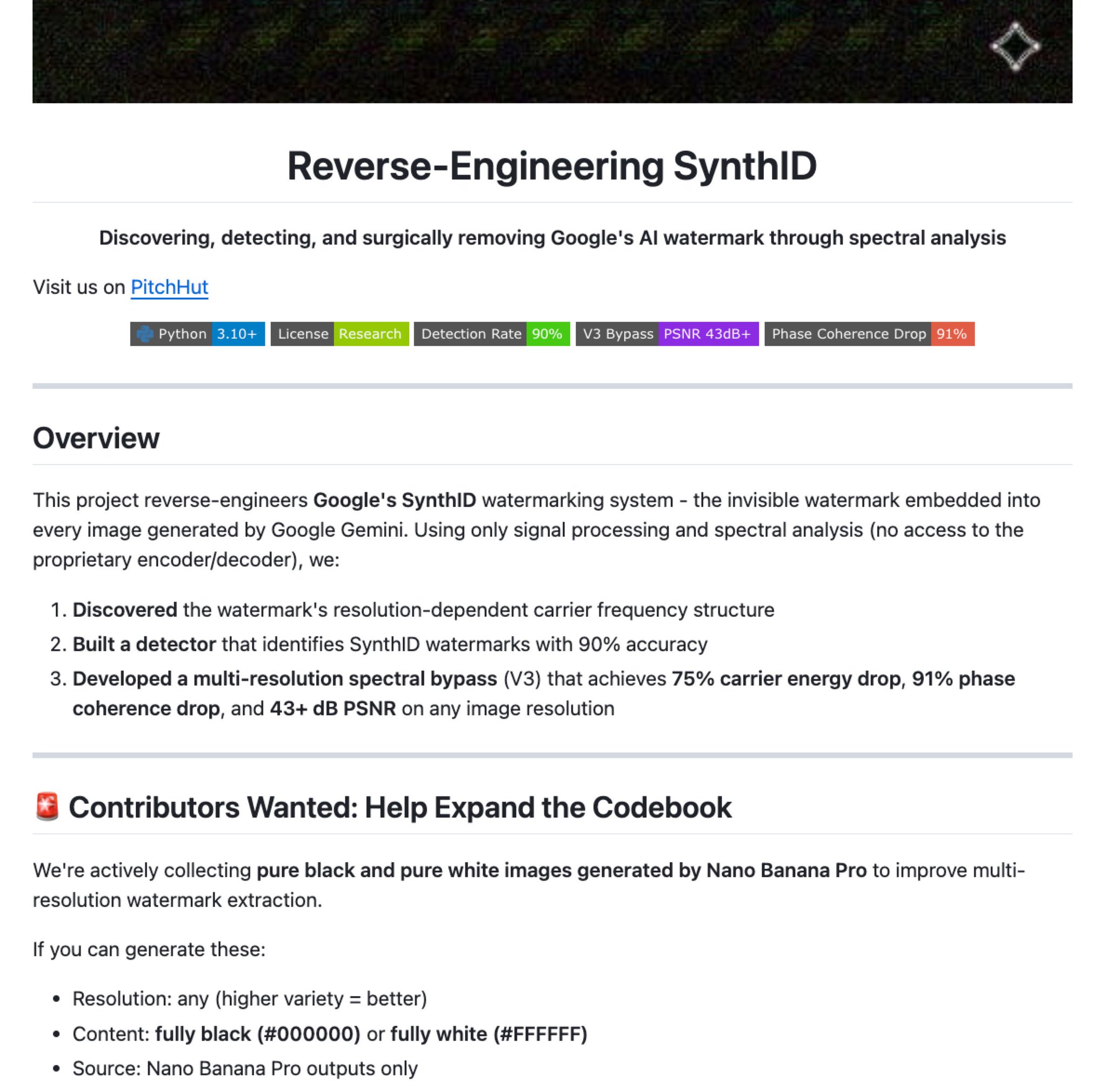
How do you crack Google’s invisible AI watermark on 10 billion images? Math, 200 black images, and a Fourier transform. One unemployed engineer just exposed DeepMind’s SynthID. The system was designed to be unbreakable, surviving compression, screenshots, and edits. Enter
RESEARCH
-
First-mover advantage in AI technology despite expected challenges
By
–
Just remember, the first ones have superpowers. So, yeah, I expect a bunch of problems, but I still want to be first.
-
Human Intelligence Versus AI Standards Comparison
By
–
Relatively smart
for a human, but
not by AI standards -
AI Leadership Gap: Companies vs Academia and Policymakers
By
–
Most of the competence and the goodwill sits in the companies now, while academics don't distinguish science and ideology, philosophers largely still don't believe that AI is happening, and policymakers… oh well
-
Solving Easy Problems Isn’t Progress Toward AGI
By
–
By all means solve the easiest problems first, but don’t mistake that for being close to AGI.
-
What Risk Will Anthropic Promote After Cyber-Collapse
By
–
Which risk will Anthropic hype when cyber-collapse goes the way of AI extinction?
-
Advisor Models: Pairing Weak and Strong AI for Cost-Efficient Intelligence
By
–

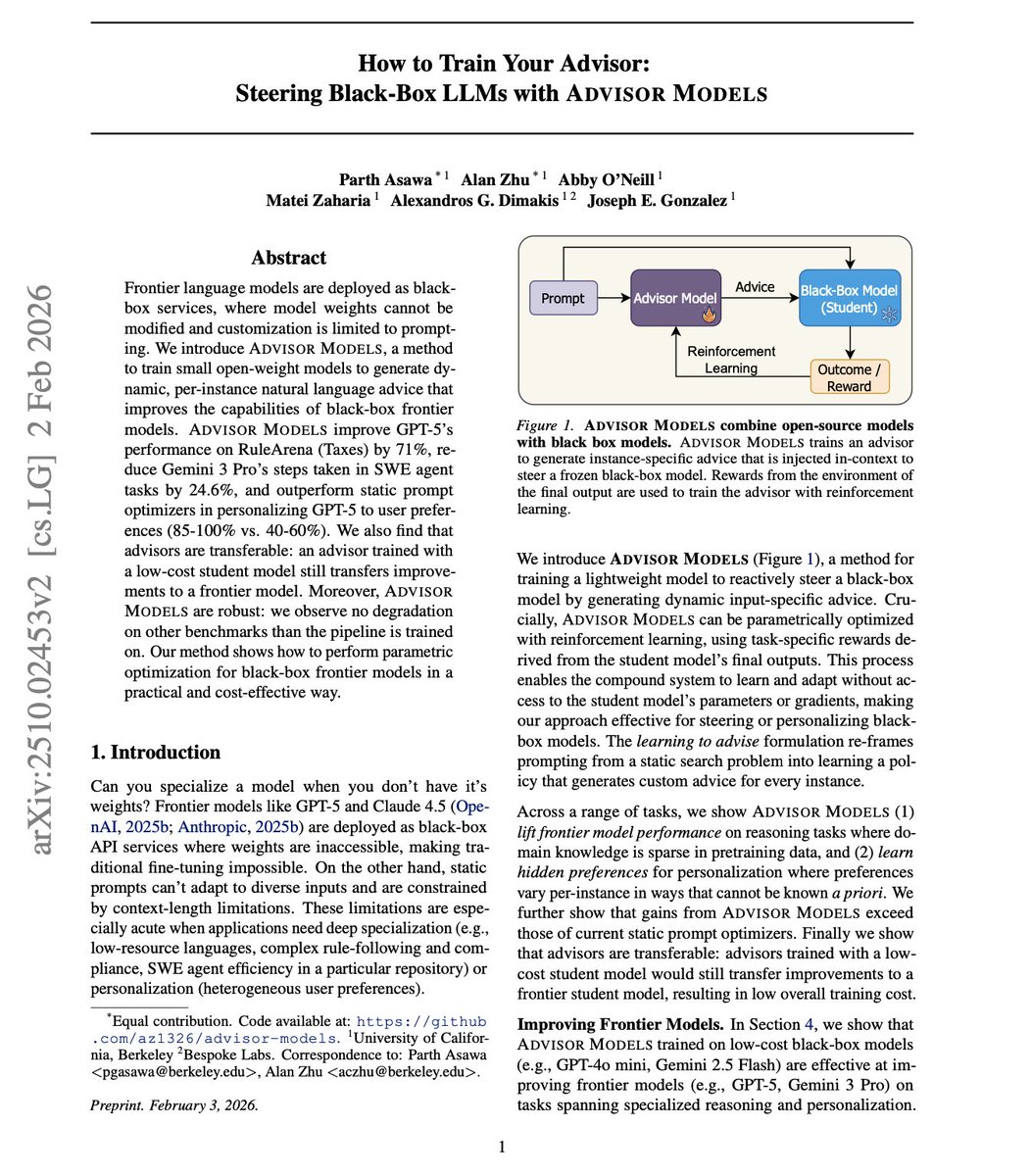
this is one of the most important ideas in AI right now, and it just got two independent validations. yesterday, Anthropic shipped an "advisor tool" in the Claude API that lets Sonnet or Haiku consult Opus mid-task, only when the executor needs help. the benefit is straightforward: you get near Opus-level intelligence on the hard decisions while paying Sonnet or Haiku rates for everything else. frontier reasoning only kicks in when it's actually needed, not on every token. back in February, UC Berkeley published a paper called "Advisor Models" that trains a small 7B model with RL to generate per-instance advice for a frozen black-box model. same idea. two very different implementations. the paper's approach: take Qwen2.5 7B, train it with GRPO to generate natural language advice, and inject that advice into the prompt of a black-box model. the black-box model never changes. the advisor learns what to say to make it perform better. GPT-5 scores 31.2% on a tax-filing benchmark. add the trained advisor, it jumps to 53.6%. on SWE agent tasks, a trained advisor cuts Gemini 3 Pro's steps from 31.7 to 26.3 while keeping the same resolve rate. training is cheap too. you train with GPT-4o Mini, then swap in GPT-5 at inference. the advisor even transfers across families: a GPT-trained advisor improves Claude 4.5 Sonnet. Anthropic's advisor tool takes a different path to the same idea. Sonnet runs as executor, handles tools and iteration. when it hits something it can't resolve, it consults Opus, gets a plan or correction, and continues. Sonnet with Opus as advisor gained 2.7 points on SWE-bench Multilingual over Sonnet alone, while costing 11.9% less per task. Haiku with Opus scored 41.2% on BrowseComp, more than double its solo 19.7%. it's a one-line API change. advisor tokens bill at Opus rates, and the advisor typically generates only 400-700 tokens per call. blended cost stays well below running Opus end-to-end. both approaches point at the same thing: you don't need the most powerful model on every token. you need it at the right moments, for the right inputs. Paper: arxiv.org/abs/2510.02453 Code: github.com/az1326/advisor-mo… Claude (@claudeai) We're bringing the advisor strategy to the Claude Platform. Pair Opus as an advisor with Sonnet or Haiku as an executor, and get near Opus-level intelligence in your agents at a fraction of the cost. — https://nitter.net/claudeai/status/2042308622181339453#m
→ View original post on X — @akshay_pachaar, 2026-04-10 05:46 UTC
-
JAX Solver for Gyrokinetics Achieves 10x Speedup with CUDA
By
–
The power of JAX https://t.co/qtC3JcVik9
— François Chollet (@fchollet) 10 avril 2026The power of JAX Eric Volkmann (@e_volkmann) Introducing gyaradax 🐉: A JAX solver for local flux-tube gyrokinetics with custom CUDA kernels for acceleration. This entire code was vibecoded by @ggalletti_ and me in a month. Validated against GKW (CPU-only Fortran code) with 10x speedups. Details and code in the replies. — https://nitter.net/e_volkmann/status/2041853935430881771#m
-
Hidden Research Foundations Enable Future Technology Innovation
By
–
The technology that enabled all the things you ever produced had its origin in a "useless paper" 5, 10, or 20 years prior that you don't even realize exists.