5 Thoughts on Kimi K2 Thinking https://
buff.ly/UZ77hqY
#AI #MachineLearning #DeepLearning #LLMs #DataScience
RESEARCH
-
Five Thoughts on Kimi K2 Thinking Model
By
–
-

AI Accelerates Knowledge Discovery in Mathematics and Physics
By
–
6 months in, after the IMO-gold achievement, I’m very excited to share another important milestone: AI can help accelerate knowledge discovery in mathematics, physics, and computer science! We’re sharing Two new papers from @GoogleDeepMind and @GoogleResearch that explore how
-

MIT Backtracking Method Improves AI Agent Debugging Efficiency
By
–
AI agents can be very effective when they use LLMs, but coding agents to work backwards to fix mistakes is time-consuming. MIT method executes AI agent programs by backtracking & making multiple attempts, helping coders work w/these systems efficiently: https://
bit.ly/45QNta0 -

AgentSkiller: Automated Multi-Turn Agent Training Data Framework
By
–
// Scaling Generalist Agent Intelligence // This new research introduces AgentSkiller, a fully automated framework for synthesizing multi-turn interaction data across realistic, semantically linked domains. The architecture uses a Directed Acyclic Graph to ensure determinism and
-

Why AI Pilots Fail to Reach Production: Leader Survey
By
–
New research: Why AI pilots stall and rarely deliver impact. Survey of 1,400 global leaders: <25% of pilots reach production 28% trust AI decisions 49% cite governed data as critical AI ownership shifting to the business Read: https://
ow.ly/EWCx50YcPpX -
Post-Training as Key Differentiator in Modern AI Development
By
–
Good question. I would say the post-training is usually one of the biggest distinguishing contributors these days
-
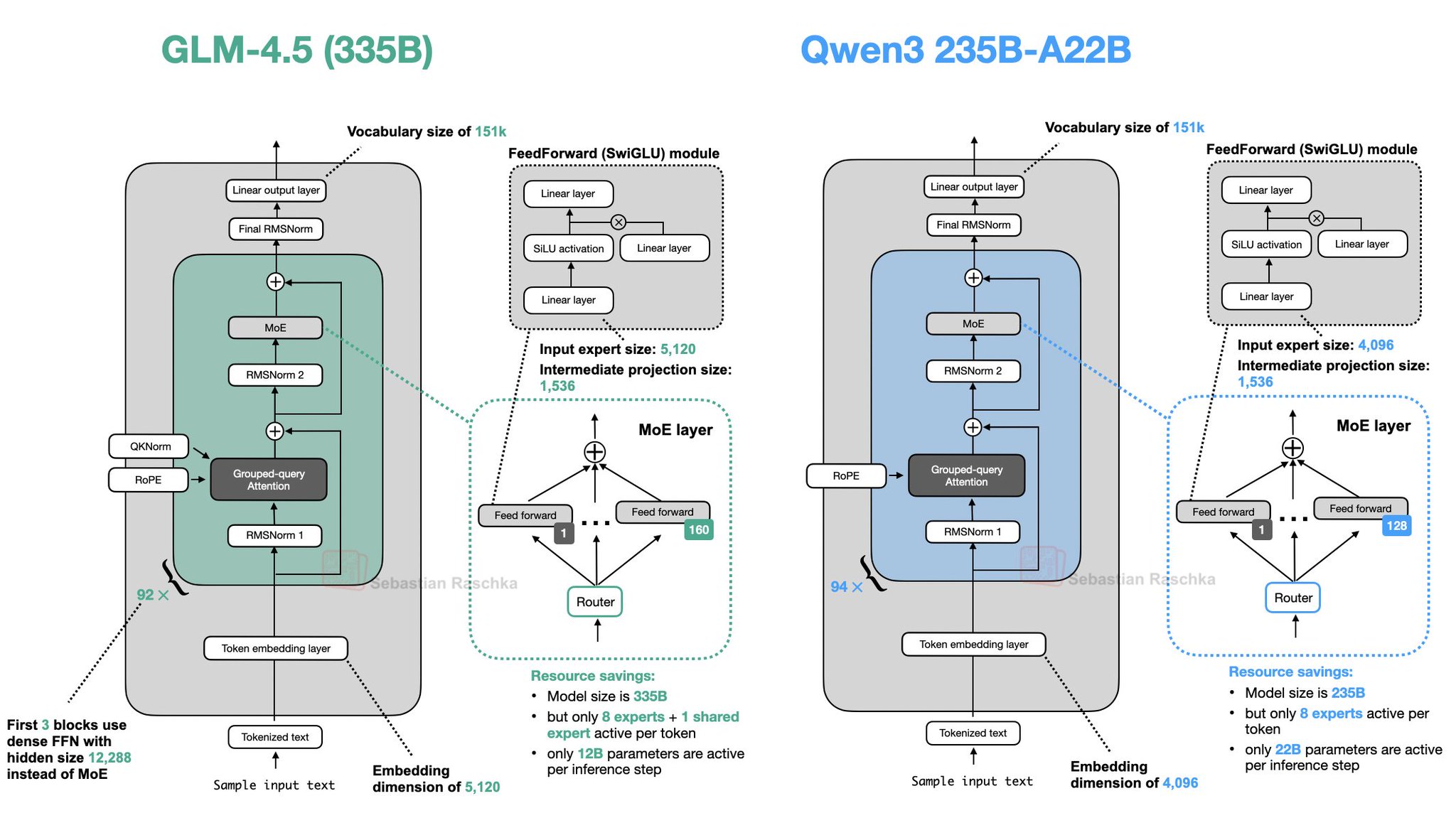
GLM-4.5: Notable benchmark performance between o3 and Claude
By
–
I think 4.5 was the first really notable one. Benchmark-wise it sat between between OpenAI o3 and Claude 4 Opus.
I have a brief section about it in my Big LLM Architecture Comparison article: https://
magazine.sebastianraschka.com/i/168650848/11
-glm-45
… -
Model-Agnostic Approach Recovers 90% Sequence Packing Gains
By
–
5/5 Because this approach is model-agnostic, it applies to any architecture. Even on transformers (like Qwen2.5-7B by @alibaba_cloud
, this method recovers ~90% of the gains of sequence packing, without relying on specific attention implementations. Full breakdown + -

Model-Agnostic Approach: Minimizing Padding with Truncation and Batching
By
–
4/5 So we took a different, model agnostic path: minimize padding before it reaches the model using truncation combined with padding-aware batching.
-

Sequence packing: limitations for hybrid models like Jamba
By
–
3/5 Sequence packing helps for transformers, but it relies on architecture-specific support that is often missing and introduces implementation risks for non-transformer or hybrid models like @AI21Labs' Jamba.